Learn the Art of Combat: Longsword Guards - Beginners Guide
0
Unterhau·Björn Rüther
Knowing the guards in the long sword, knowing which techniques and concepts to apply from each posture, and being able t…
Translation: unterhau (under cut)
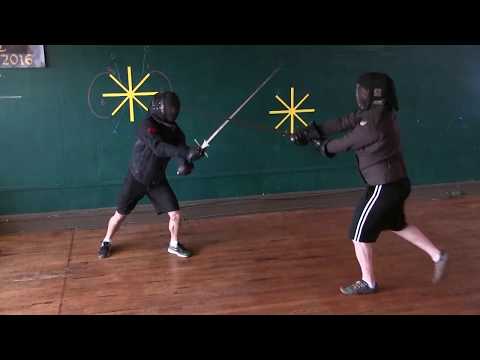
The Unterhau (rising cut) travels from below upward, targeting the opponent's arms, chin, or torso from a low guard (Alber or similar). [1] The Unterhau is the natural complement to the Oberhau, and alternating between descending and rising cuts creates the continuous cutting flow that characterises German longsword fencing. [1],[2] Though less powerful than the Oberhau, the Unterhau attacks from an unexpected angle and is effective against opponents in high guards. [2],[3]
The Unterhau (Under Cut) is a rising cut delivered from below, typically from a low guard position such as Alber. [1] Its effectiveness comes from its unexpected trajectory — rising cuts target the arms, hands, and chin from beneath the opponent's guard, attacking angles that are difficult to defend from a high guard (Vom Tag). [2] Liechtenauer's tradition pairs the Unterhau with the Oberhau as complementary opposites. [2]
The Unterhau (underhand cut) is used in HEMA longsword competition as both an opening attack and a counter against high guards. [1]
No images yet for this technique.
Sign in to suggest an image.
Knowing the guards in the long sword, knowing which techniques and concepts to apply from each posture, and being able t…
You can't return to the basics too much. Over the years, Josh and Aaron have often seen that problems students have in …
taken from jan 2011 training. We have since moved back to a zornhau that "punches" out more and clears the centre line, …
The Unterhau (underhau, undercut) is one of two foundational cuts in Liechtenauer longsword tradition, from which all other master cuts derive, according to the historical manuscripts. Sword Carolina emphasizes that the Unterhau, like its counterpart the Oberhau, functions as a category encompassing multiple techniques rather than a single rigid movement. The cut should target the opponent's body rather than their sword, creating genuine threat and forcing defensive commitment. Mechanically, Sword Carolina stresses that the sword must lead the movement before the feet follow, keeping the weapon as both offensive and defensive instrument. The Unterhau transitions between guards—commonly executed from Vom Tag (from above) into positions like Plow or Ox—and practitioners should aim to arrive cleanly at the finishing guard rather than cutting uncontrolled and retreating. This guard-to-guard progression provides structural clarity and improved cutting accuracy. The Unterhau serves as a fundamental versetzung (setting aside), capable of deflecting incoming attacks while simultaneously attacking available openings. Distance and balance maintenance are critical; while reach toward the target is important, overextension compromises defensive positioning and invites counterattack. Sword Carolina's approach treats the Unterhau as both an attacking and defensive tool within the bind, emphasizing intentional movement from one position to another with continuous threat.
Synthesized from 3 instructors
No instructional courses yet for this technique.
Sign in to suggest a course.
Risk of injury to the person this technique is applied to
Edged weapons cause fatal lacerations; historical battlefield mortality rates >30% (Amberger 1999)
Skill level needed to execute this technique reliably
Whether this technique is allowed under major competition rule sets
The Art of Combat (Joachim Meyer, 1570)
Alias sources — [1] Sigmund Ringeck's Knightly Arts of Combat [2] Sigmund Ringeck's Knightly Arts of Combat [3] Sigmund Ringeck's Knightly Arts of Combat
Effectiveness sources — [1] Forgeng, J., The Art of Combat (Palgrave Macmillan, 2003) [2] Tobler, C., In Saint George's Name (Freelance Academy Press, 2010)
Standard katakana transliteration of Western martial arts terminology (外来語) — used in Japanese MMA, boxing, and BJJ communities
Alias sources — [1] Sigmund Ringeck's Knightly Arts of Combat [2] Sigmund Ringeck's Knightly Arts of Combat [3] Sigmund Ringeck's Knightly Arts of Combat
Effectiveness sources — [1] Forgeng, J., The Art of Combat (Palgrave Macmillan, 2003) [2] Tobler, C., In Saint George's Name (Freelance Academy Press, 2010)
wrist control for edge alignment, grip endurance, footwork precision
quick wrists, strong forearms, good posture
forearm extensors/flexors, deltoids, core, calves
According to the historical manuscripts, the Oberhau and Unterhau are the two most fundamental cuts from which everything else in longsword technique is derived. Mastering these cuts provides the foundation for all other techniques.
Every cut involves moving from one guard to another—you are fundamentally transitioning between guard positions as you execute the technique. Understanding this guard-to-guard progression is essential to proper cutting mechanics.
Never change your guard without an intention or idea behind it; otherwise your opponent gains more opportunities to attack the openings you create while you're repositioning. Each guard change must have a tactical purpose.
Yes—for example, if an Oberhau is coming at you, you can defend by executing an Oberhau yourself from a position like the long tag into plow to set the opponent's sword aside. This defensive cut can work against many attacks.
The Unterhau (rising cut) travels from below upward, targeting the opponent's arms, chin, or torso from a low guard (Alber or similar). The Unterhau is the natural complement to the Oberhau, and alternating between descending and rising cuts creates the continuous cutting flow that characterises German longsword fencing.
The Unterhau is described in all major German fight-books as the complementary cut to the Oberhau, together forming the basic cutting vocabulary upon which the master cuts are built. Fiore dei Liberi's system includes the equivalent sottano (rising blow) as a core technique.
FIE: legal — Legal fencing technique — governed by FIE rules for foil, épée, and sabre; HEMA: legal — Legal in historical fencing competition
Danger rating 9/10. Extreme — edged weapons cause fatal lacerations; historical battlefield mortality rates >30% (Amberger 1999)
The standard setup chain: Assume Guard (Kamae/Hut) → Measure Distance (Ma-ai) → Initiate Cut/Thrust → Follow Through (Zanshin).
Standard counters include: Parry (Absetzen) — deflect the incoming blade with a counter-displacement / Void (Step Back) — withdraw from measure to avoid the cutting arc / Counter-Cut (Nachreisen) — strike into the opponent's opening during their attack.
Common variants: Standard cut (primary cutting angle from the ready stance); Thrust (tsuki) (straight thrust targeting the throat, chest, or face); Rising cut (kiri-age) (upward diagonal cut from low to high); Diagonal cut (kesa-giri) (downward diagonal cut following the kimono line).
The Unterhau (underhand cut) is used in HEMA longsword competition as both an opening attack and a counter against high guards.
Top errors to watch for: Using the Unterhau only as a secondary technique — it is a primary cut that should be trained as extensively as the O… / Rising too steeply — the Unterhau can be vertical or diagonal; the diagonal version is often more effective / Not transitioning to a high guard after the Unterhau — the sword naturally rises to Ochs or Vom Tag; use that position / Using the Unterhau without footwork — the rising cut requires a step to generate power and close distance.
The Unterhau is also known as Untāhau, Under-Cut, Low Cut, Rising Strike.