Review: Customized BlackFencer 1459 Steel Messer
0
Standard Ringen Am Schwert·Die Freifechter
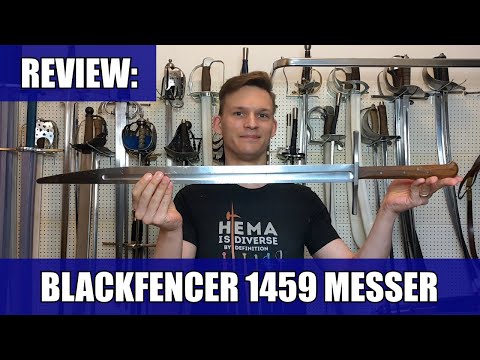
A review of a slightly customised BlackFencer 1459 steel Messer: https://blackfencer.com/en/steel-generation-line/224-la…
Translation: standard ringen am schwert
The Standard Ringen am Schwert technique encompasses the fundamental grappling actions at sword range: the pommel strike (Mordschlag), crossguard hooks, half-swording transitions, and disarms executed when the bind closes to wrestling distance. [1] The Mordschlag — gripping the blade and striking with the pommel like a hammer — is the signature technique of Ringen am Schwert, capable of denting a helmet or stunning an armoured opponent. [1],[2] Training includes controlled sparring with padded weapons to practise the transitions from cutting range to grappling range. [2],[3]
Ringen am Schwert techniques are illustrated in numerous fifteenth-century German and Italian fight-books, with Talhoffer's 1467 Fechtbuch providing some of the most detailed depictions of armoured sword grappling. [1] The Mordschlag technique demonstrates the medieval pragmatism of using every part of the weapon as a tool. [2],[3]
Ringen am Schwert techniques are allowed and used in HEMA longsword competition, though scoring varies by rule set. [1]
No images yet for this technique.
Sign in to suggest an image.
A review of a slightly customised BlackFencer 1459 steel Messer: https://blackfencer.com/en/steel-generation-line/224-la…
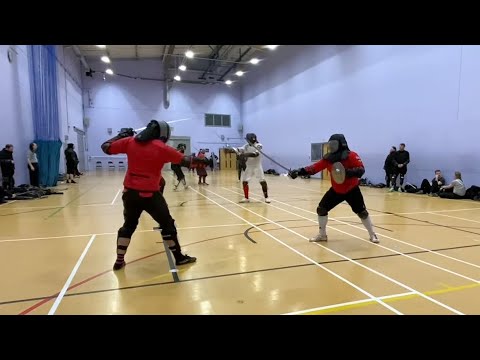
We are both using Kvetun Easton sabres here of the slotted form, Oli with the full length standard (86cm) blade and Nick…
The available instructional material does not contain substantive technical content addressing Standard Ringen am Schwert (grappling at the sword) as a longsword technique. The Academy of Historical Fencing transcript consists entirely of blank audio markers and provides no pedagogical information. The Die Freifechter transcript is a detailed equipment review of a customized Messer (single-handed blade) rather than instruction on longsword grappling methods. While the reviewer discusses sparring applications and bind work with the Messer—including remarks on authority in the bind, winding mechanics, and grip considerations—this does not constitute teaching of Ringen am Schwert methodology. The Messer and longsword operate under substantially different mechanical principles due to their respective blade profiles, length, and handling characteristics. No comparative analysis between the two weapons' grappling systems is presented. Consequently, the transcripts provide insufficient material to synthesize a coherent encyclopedia entry on Standard Ringen am Schwert longsword technique.
Synthesized from 2 instructors
No instructional courses yet for this technique.
Sign in to suggest a course.
Risk of injury to the person this technique is applied to
Edged weapons cause fatal lacerations; historical battlefield mortality rates >30% (Amberger 1999)
Skill level needed to execute this technique reliably
Whether this technique is allowed under major competition rule sets
The Art of Combat (Joachim Meyer, 1570)
Alias sources — [1] Sigmund Ringeck's Knightly Arts of Combat [2] Sigmund Ringeck's Knightly Arts of Combat [3] Sigmund Ringeck's Knightly Arts of Combat
Effectiveness sources — [1] Fighting with the German Longsword (Tobler, 2004) [2] Medieval Combat (Talhoffer, 2000 translation)
Mixed Japanese-Western terminology — combines traditional Japanese terms with katakana loanwords
Alias sources — [1] Sigmund Ringeck's Knightly Arts of Combat [2] Sigmund Ringeck's Knightly Arts of Combat [3] Sigmund Ringeck's Knightly Arts of Combat
Effectiveness sources — [1] Fighting with the German Longsword (Tobler, 2004) [2] Medieval Combat (Talhoffer, 2000 translation)
wrist control for edge alignment, grip endurance, footwork precision
quick wrists, strong forearms, good posture
forearm extensors/flexors, deltoids, core, calves
A well-balanced Messer should have a thickened (not folded) spine of around 5mm, a point of balance around 11cm, and a blade width of about 4cm. According to Die Freifechter, this combination provides good authority in the bind during grappling exchanges.
The Standard Ringen am Schwert technique encompasses the fundamental grappling actions at sword range: the pommel strike (Mordschlag), crossguard hooks, half-swording transitions, and disarms executed when the bind closes to wrestling distance. The Mordschlag — gripping the blade and striking with the pommel like a hammer — is the signature technique of Ringen am Schwert, capable of denting a helmet or stunning an armoured opponent.
Ringen am Schwert techniques are illustrated in numerous fifteenth-century German and Italian fight-books, with Talhoffer's 1467 Fechtbuch providing some of the most detailed depictions of armoured sword grappling. The Mordschlag technique demonstrates the medieval pragmatism of using every part of the weapon as a tool.
Traditional martial arts: legal — Practiced in traditional kata/forms and weapon-specific competition under var…; IWUF: legal — Legal in wushu taolu if applicable; HEMA: legal — Legal in applicable historical weapon categories
Danger rating 9/10. Extreme — edged weapons cause fatal lacerations; historical battlefield mortality rates >30% (Amberger 1999)
The standard setup chain: Assume Guard (Kamae/Hut) → Measure Distance (Ma-ai) → Initiate Cut/Thrust → Follow Through (Zanshin).
Standard counters include: Parry (Absetzen) — deflect the incoming blade with a counter-displacement / Void (Step Back) — withdraw from measure to avoid the cutting arc / Counter-Cut (Nachreisen) — strike into the opponent's opening during their attack.
Common variants: Standard cut (primary cutting angle from the ready stance); Thrust (tsuki) (straight thrust targeting the throat, chest, or face); Rising cut (kiri-age) (upward diagonal cut from low to high); Diagonal cut (kesa-giri) (downward diagonal cut following the kimono line).
Ringen am Schwert techniques are allowed and used in HEMA longsword competition, though scoring varies by rule set.
Top errors to watch for: Transitioning to Ringen without establishing the bind first — the bind is the entry point; don't skip it / Using the crossguard hook without controlling the opponent's balance — the hook must be combined with off-balancing / Attempting disarms without proper leverage — the sword's mechanics (crossguard, grip rotation) provide the leverage; … / Dropping the sword to grapple empty-handed — maintain weapon control throughout the technique.
The Standard Ringen Am Schwert is also known as Sutandādo Ken-jō Kumi-uchi, Basic Sword Grapple, Standard Schwertringen, Close-Quarter Sword Technique.