Introduction to Ringen Am Schwert
Ringen am Schwert, or wrestling at the sword, represents a critical phase in historical European martial arts where combatants transition from striking distance into close-quarters grappling. This instructional session demonstrates the practical application of these techniques through live sparring between two experienced practitioners using sabre and buckler. Understanding this range is essential for any serious student of historical swordplay.
Stance and Initial Distance Management
Both practitioners establish their fighting stance at measure, maintaining optimal distance for either striking or rapid entry into grappling range. Proper footwork and body positioning are fundamental to safely and effectively controlling the engagement. The buckler serves as both defensive and offensive tool, managing threats while enabling forward momentum.
Blade Contact and Pressure
As the engagement intensifies, the competitors establish contact through the blades, using pressure and angles to probe for openings and defensive weaknesses. This blade work creates the necessary momentum and commitment that naturally transitions into close-range techniques. Sensitive blade contact allows practitioners to feel and respond to their opponent's intentions.
Transition to Grappling Range
The practitioners demonstrate how committed striking exchanges naturally evolve into clinch positions and wrestling engagement. This transition requires timing, positioning, and the ability to control your opponent's weapon arm while maintaining your own defensive integrity. The buckler becomes invaluable for creating space and controlling distance during this critical phase.
Close-Quarters Wrestling Techniques
Once in grappling range, both competitors employ throws, sweeps, and positional controls derived from historical grappling systems. Leverage and body mechanics dominate over strength, allowing smaller practitioners to control larger opponents. These techniques seamlessly integrate weapon control, preventing the opponent from creating striking distance.
Recovery and Re-engagement
As the clinch breaks, both practitioners reset their distance and positioning, returning to measure for another cycle of engagement. This recovery phase demonstrates the importance of maintaining awareness and defensive posture even when separating from your opponent. Successful practitioners flow smoothly between all ranges of combat.
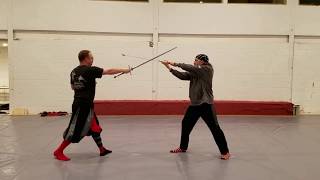
Sabre & Buckler Sparring - Oli v Nick
Key Takeaways
- •Introduction to Ringen Am Schwert
- •Stance and Initial Distance Management
- •Blade Contact and Pressure
- •Transition to Grappling Range
We are both using Kvetun Easton sabres here of the slotted form, Oli with the full length standard (86cm) blade and Nick with a shortened 80cm version. In this fight we use a mix of sabre and Bolognese sword and buckler styles. and so it isn't really trying to represent any one thing, just a fun match up with what we happened to grab. Once again we are experimenting with camera mounts and positions. Her we try out a table mounted camera using awide angle lens. We will continue to experiment to find the best angle and positioning of fighters for a static camera over the next few weeks. It is all about balancing the best view whilst being as close to the fighters as possible whilst not limiting their movement.
Frequently Asked Questions
What does this video teach about standard ringen am schwert?
This video covers introduction to ringen am schwert, stance and initial distance management, blade contact and pressure. It provides detailed instruction from Academy of Historical Fencing.
How long does it take to learn standard ringen am schwert?
The basic mechanics can be understood in a single session, but developing reliable execution requires consistent drilling over weeks of practice. This 6-part breakdown helps structure your training by isolating each phase of the technique.
What are the key details for finishing standard ringen am schwert?
Once in grappling range, both competitors employ throws, sweeps, and positional controls derived from historical grappling systems. Leverage and body mechanics dominate over strength, allowing smaller practitioners to control larger opponents. These techniques seamlessly integrate weapon control, preventing the opponent from creating striking distance.