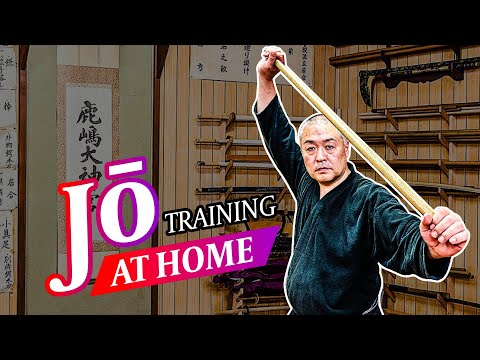
6 Jō (Staff) Swinging Exercises You Can Train at Home
0
Standard Jo Strike·Let's ask Seki Sensei | Online Katana Lessons
🎫Purchase Your Ticket to the Annual Asayama Ichiden Ryu Training Camp in Japan: https://asayamaichidenryu.shop/products…
Translation: Basic Short Staff Strike
The standard jo strike is the basic offensive striking action in jojutsu, delivered with a snapping, whip-like motion that maximises speed over raw power. [1] In Shinto Muso-ryu, the standard strike targets the opponent's wrists, temples, and collarbone — areas left exposed during sword cuts. [2] The technique appears in multiple Seitei Jodo kata and is typically the first offensive action taught to beginners in jodo, establishing the principle that the jo can strike faster than a sword can recover from its own cut. [1],[2]
The standard jō strike is a direct hitting technique using the short staff, emphasising speed and accuracy. [1]
Standard jō striking was codified within the Shintō Musō-ryū tradition and carried into modern AJKF jōdō. [1]
Standard jō strikes are fundamental techniques in AJKF jōdō competition. [1]
No images yet for this technique.
Sign in to suggest an image.
🎫Purchase Your Ticket to the Annual Asayama Ichiden Ryu Training Camp in Japan: https://asayamaichidenryu.shop/products…
A series of movements with the Japanese "Jo" or short staff made up of the basic Jo suburi found in most schools... It's…
Black Belt Weapons | Jo (Shinto Muso-Ryu Jojutsu Kata) Tutorial The only person to beat Miyamoto Musashi in a duel was …
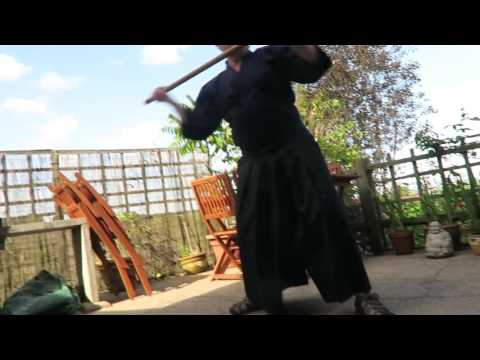
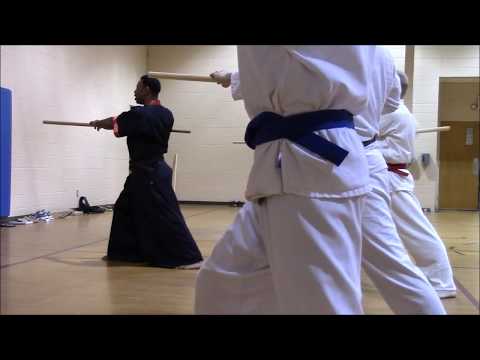
The standard jo strike encompasses fundamental swinging and striking movements foundational to jojutsu practice. Let's ask Seki Sensei provides the most detailed technical instruction, describing multiple variations of tsuburi (training swings) that develop striking proficiency. Seki Sensei emphasizes footwork coordination during strikes, explaining how leg switching timing varies across different tsuburi patterns, and introduces grip changes—particularly reverse-grip strikes and front-hand transitions—as critical technical distinctions. The instruction covers both downward strikes aimed at the head and strikes targeting an opponent's hands, noting that wrist mechanics should remain relatively straight rather than bent during certain variations. Seki Sensei also describes thrusting motions incorporated after strikes, where the practitioner releases the lower hand to allow the jo to spin before recatching it near the waist and executing a thrust with a grip change. Tony Wagstaffe's video demonstrates practical striking applications with emphasis on lateral head-level strikes and directional variation. MyKwonDo presents kata-level execution of jo strikes within formal Shinto Muso-Ryu jojutsu sequences, demonstrating the integration of standard strikes into complete movement patterns. All three instructors agree that mastering basic striking mechanics through tsuburi practice is essential before advancing to formal kata.
Synthesized from 3 instructors
No instructional courses yet for this technique.
Sign in to suggest a course.
Risk of injury to the person this technique is applied to
Staff/bo/jo weapons generate significant blunt force; fracture risk
Skill level needed to execute this technique reliably
Whether this technique is allowed under major competition rule sets
The Essence of Okinawan Karate-Do (Shoshin Nagamine, 1976)
Alias sources — [1] Kobudo: Okinawan Weapons (Demura, 1976) [2] Comprehensive Asian Fighting Arts (Draeger & Smith, 1969) [3] Comprehensive Asian Fighting Arts (Draeger & Smith, 1969)
History sources — [1] Krieger, P., The Jo: Art of the Japanese Short Staff (Koryu Books, 1989) [2] Draeger, D., Classical Bujutsu (Weatherhill, 1973)
Established Japanese martial arts naming convention — native Japanese term (和語/漢語)
Alias sources — [1] Kobudo: Okinawan Weapons (Demura, 1976) [2] Comprehensive Asian Fighting Arts (Draeger & Smith, 1969) [3] Comprehensive Asian Fighting Arts (Draeger & Smith, 1969)
History sources — [1] Krieger, P., The Jo: Art of the Japanese Short Staff (Koryu Books, 1989) [2] Draeger, D., Classical Bujutsu (Weatherhill, 1973)
wrist snap speed, sliding grip coordination, hip rotation
long reach and strong wrists for staff manipulation
forearms, wrist rotators, core rotators, shoulders
Tony Wagstaffe emphasizes being mindful of your partner's head and eyes during jo strikes, as the staff moves in circular patterns that can easily cause injury if proper awareness isn't maintained.
Fundamental striking technique with the jo, typically an overhead or diagonal blow delivered with a sliding grip change.
The standard jo strike is the basic offensive striking action in jojutsu, delivered with a snapping, whip-like motion that maximises speed over raw power. In Shinto Muso-ryu, the standard strike targets the opponent's wrists, temples, and collarbone — areas left exposed during sword cuts.
FIE Sabre: legal — Legal cutting technique to upper body target area; FIK Kendo: legal — Legal if targeting valid area with correct form; WEKAF: legal — Legal striking technique; HEMA: legal — Legal in applicable weapon categories
Danger rating 7/10. Very High — staff/bo/jo weapons generate significant blunt force; fracture risk
The standard setup chain: Ready Position → Distance Control → Execute Technique → Return to Guard.
Standard counters include: Guard Position — return to a defensive ready stance / Distance Management — control the measure to avoid being in range / Counter-Attack — strike during the opponent's recovery or between movements.
Common variants: Overhead strike (bringing the staff down from above in a vertical arc); Lateral strike (horizontal sweep targeting the ribs or head); Thrust (straight thrust with the end of the staff); Butt-end strike (striking with the rear end of the staff at close range).
Standard jō strikes are fundamental techniques in AJKF jōdō competition.
Top errors to watch for: Striking downward without hip rotation — the hips must drive the strike; arm-only strikes are weak and slow / Not targeting precisely — the standard strike must land on the intended target; vague swinging is ineffective / Keeping both hands in fixed positions — the grip should adjust during the strike for maximum power and reach / Not stepping into the strike — the step adds body mass to the impact; stationary strikes lack penetration.
The Standard Jo Strike is also known as Shomen Jo Uchi, Basic Jo Strike, Standard Jodo Strike.