Ninjutsu Short Staff (Hanbō 半棒) Basics
0
Jojutsu — Short Staff·AIKIDO SILVERDALE
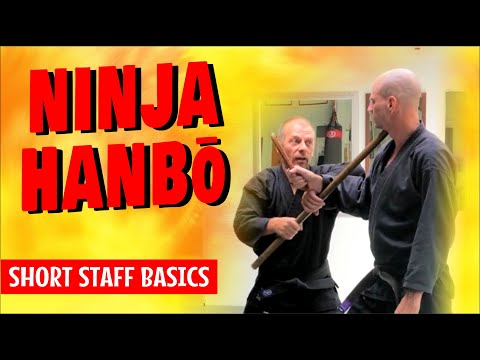
In today's video Nick Tomlinson from Bujinkan Whangaparaoa takes a group of mainly Aikidoka through the basic techniques…
Translation: Short Staff Art
Jojutsu (short staff art) traces its most famous lineage to Muso Gonnosuke Katsuyoshi, a swordsman who, according to tradition, was defeated by Miyamoto Musashi in the early 17th century and subsequently developed Shinto Muso-ryu jojutsu using a four-shaku (approximately 128 cm) staff to counter sword techniques. [1] Pascal Krieger, a senior practitioner and historian of Shinto Muso-ryu, documents how the jo's shorter length compared to the bo allows for more rapid manipulation, thrusting, and striking from both ends. [2] In 1968, the All Japan Kendo Federation adopted Seitei Jodo, a standardised set of twelve jo kata, making jojutsu accessible to kendo practitioners worldwide and ensuring its continued transmission. [1],[3]
The jo (four-foot staff) occupies a tactical middle ground between the bo and the sword, offering more manoeuvrability than the bo while retaining a reach advantage over the sword. [1] Jodo techniques emphasise thrusts and targeted strikes rather than sweeping motions, making the jo an effective weapon in confined spaces where a longer staff would be unwieldy. [2]
The dominant jojutsu lineage is Shinto Muso-ryu, founded by Muso Gonnosuke Katsuyoshi (early 17th century), who according to tradition developed the jo after being defeated by Miyamoto Musashi. [1] Modern jodo was standardised by the AJKF through the Seitei Jodo kata set (12 forms), incorporating elements from Shinto Muso-ryu. [2]
Jōjutsu/jōdō is competed under AJKF rules with annual All Japan Jōdō Championships and international jōdō events. [1]
No images yet for this technique.
Sign in to suggest an image.
In today's video Nick Tomlinson from Bujinkan Whangaparaoa takes a group of mainly Aikidoka through the basic techniques…
Is there a better name for that kind of "short staff"?
No instructional courses yet for this technique.
Sign in to suggest a course.
Risk of injury to the person this technique is applied to
Staff/bo/jo weapons generate significant blunt force; fracture risk
Skill level needed to execute this technique reliably
Whether this technique is allowed under major competition rule sets
The Essence of Okinawan Karate-Do (Shoshin Nagamine, 1976)
Alias sources — [1] Kodokan Judo (Kano, 1986) [2] Kodokan Judo (Kano, 1986) [3] Kodokan Judo (Kano, 1986)
Effectiveness sources — [1] Draeger, D., Classical Bujutsu (Weatherhill, 1973) [2] Draeger, D. & Smith, R., Comprehensive Asian Fighting Arts (Kodansha, 1969)
Established Japanese martial arts naming convention — native Japanese term (和語/漢語)
Alias sources — [1] Kodokan Judo (Kano, 1986) [2] Kodokan Judo (Kano, 1986) [3] Kodokan Judo (Kano, 1986)
Effectiveness sources — [1] Draeger, D., Classical Bujutsu (Weatherhill, 1973) [2] Draeger, D. & Smith, R., Comprehensive Asian Fighting Arts (Kodansha, 1969)
wrist snap speed, sliding grip coordination, hip rotation
long reach and strong wrists for staff manipulation
forearms, wrist rotators, core rotators, shoulders
Every move, in any martial art, shares a few universal traits. Mix and match below to pinpoint the right tool — or compare equivalents across styles.
Defensive techniques using the jo to intercept sword strikes, a core element of jo-versus-sword kata.
Striking techniques with the jo, delivered with either end of the staff in overhead, lateral, or diagonal trajectories.
Thrusting techniques with the jo targeting the solar plexus, throat, or face using the tip of the staff.
The jo (4-foot staff) appears in 8 passages across 2 books. Jojutsu was systematized by Muso Gonnosuke, who reportedly created the art after being defeated by Miyamoto Musashi. The jo is shorter than the bo, allowing one-handed techniques. In aikido, jo techniques (jodo) are part of the weapons curriculum. (2 books; Suino, Budo Mind and Body; Draeger, Classical Budo)
You should strike the arm rather than just place and push the staff against it. Aikido Silverdale emphasizes practicing this striking motion slowly to develop proper technique.
Step to the side and trap their wrist with the staff, then flick it up to create control. Aikido Silverdale notes you want their wrist facing away so you can access the back of their arm and create a triangular control structure.
Get the weapon out of their hand first before applying throwing or joint techniques. Aikido Silverdale stresses this safety principle to avoid attempting control techniques on someone still holding a sharp implement.
Create a bend in their arm and grind the staff in so the opponent is pinned against your body, trapping them securely. This allows you to either neutralize their threat or follow up with additional techniques.
Japanese short staff (jo, approximately 4 feet) techniques blending striking, thrusting, and sweeping, notably systematized in Shinto Muso-ryu.
Jojutsu (short staff art) traces its most famous lineage to Muso Gonnosuke Katsuyoshi, a swordsman who, according to tradition, was defeated by Miyamoto Musashi in the early 17th century and subsequently developed Shinto Muso-ryu jojutsu using a four-shaku (approximately 128 cm) staff to counter sword techniques. Pascal Krieger, a senior practitioner and historian of Shinto Muso-ryu, documents how the jo's shorter length compared to the bo allows for more rapid manipulation, thrusting, and striking from both ends.
Traditional martial arts: legal — Practiced in traditional kata/forms and weapon-specific competition under var…; IWUF: legal — Legal in wushu taolu if applicable; HEMA: legal — Legal in applicable historical weapon categories
Danger rating 7/10. Very High — staff/bo/jo weapons generate significant blunt force; fracture risk
The standard setup chain: Grip and Stance → Chamber → Strike → Recovery.
Standard counters include: Beat Parry — deflect the blade with a sharp lateral beat before it reaches target / Displacement — move the body off the line while threatening with the point / Counter-Thrust — extend into the attacker's line during their advance.
Common variants: Overhead strike (bringing the staff down from above in a vertical arc); Lateral strike (horizontal sweep targeting the ribs or head); Thrust (straight thrust with the end of the staff); Butt-end strike (striking with the rear end of the staff at close range).
Jōjutsu/jōdō is competed under AJKF rules with annual All Japan Jōdō Championships and international jōdō events.
Top errors to watch for: Using the jo with the same techniques as the bo — the jo has its own distinct techniques that exploit its shorter length / Gripping only in the centre — the jo's grip shifts constantly; the hands move to the ends for thrusting, to the centr… / Not using one-handed techniques — the jo can be used effectively with one hand, unlike the bo; neglecting this wastes… / Treating the jo as inferior to the bo — the jo's shorter length gives it advantages in speed and manoeuvrability at c….
The Jojutsu — Short Staff is also known as Jodo, Jo Staff Art, Short Staff.