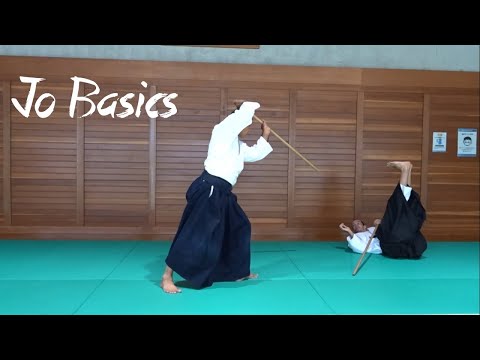
Basic Jo Principles - Introduction to Chiba Sensei's Weapons System #7
0
Jo Strike·Davinder Bath
Please Subscribe! This video tutorial looks at the basic framework for Chiba Sensei's Jo work. How to hold, how to atta…
Translation: Short Staff Strikes
Jo striking techniques evolved within the Shinto Muso-ryu system, where the ability to strike effectively with a weapon shorter than the opponent's sword was essential to the art's tactical validity. [1] Krieger identifies striking as one of the three fundamental jo actions (alongside thrusting and sweeping), with the jo's lighter weight enabling faster strike sequences than the heavier bo. [2] The striking methods were refined through centuries of paired kata practice between jo and sword practitioners, creating a sophisticated interplay of attack and defence. [1],[2]
Jō strikes use the short staff's versatility to attack from multiple angles, combining speed with the ability to switch grip and direction rapidly. [1]
Jōdō (modernised jōjutsu) competition is governed by the AJKF, with the All Japan Jōdō Championship held annually. [1]
No images yet for this technique.
Sign in to suggest an image.
Please Subscribe! This video tutorial looks at the basic framework for Chiba Sensei's Jo work. How to hold, how to atta…
No instructional courses yet for this technique.
Sign in to suggest a course.
Risk of injury to the person this technique is applied to
Staff/bo/jo weapons generate significant blunt force; fracture risk
Skill level needed to execute this technique reliably
Whether this technique is allowed under major competition rule sets
The Essence of Okinawan Karate-Do (Shoshin Nagamine, 1976)
Alias sources — [1] Kobudo: Okinawan Weapons (Demura, 1976) [2] Comprehensive Asian Fighting Arts (Draeger & Smith, 1969) [3] Comprehensive Asian Fighting Arts (Draeger & Smith, 1969)
History sources — [1] Draeger, D., Classical Bujutsu (Weatherhill, 1973) [2] Krieger, P., The Jo: Art of the Japanese Short Staff (Koryu Books, 1989)
Established Japanese martial arts naming convention — native Japanese term (和語/漢語)
Alias sources — [1] Kobudo: Okinawan Weapons (Demura, 1976) [2] Comprehensive Asian Fighting Arts (Draeger & Smith, 1969) [3] Comprehensive Asian Fighting Arts (Draeger & Smith, 1969)
History sources — [1] Draeger, D., Classical Bujutsu (Weatherhill, 1973) [2] Krieger, P., The Jo: Art of the Japanese Short Staff (Koryu Books, 1989)
wrist snap speed, sliding grip coordination, hip rotation
long reach and strong wrists for staff manipulation
forearms, wrist rotators, core rotators, shoulders
Every move, in any martial art, shares a few universal traits. Mix and match below to pinpoint the right tool — or compare equivalents across styles.
According to Davinder Bath, Chiba-sensei's system emphasizes the concept of fire and water—contraction and relaxation. There is a big contraction during the form or defense, followed by total relaxation. Additionally, big rotations are central to the technique, involving the wrists, elbows, shoulders, and body.
Position your body so your hands are in a strong position, then go where your opponent's jaw is. This positioning allows you to trap your opponent regardless of where they attack, while simultaneously neutralizing them and controlling their hands.
Striking techniques with the jo, delivered with either end of the staff in overhead, lateral, or diagonal trajectories.
Jo striking techniques evolved within the Shinto Muso-ryu system, where the ability to strike effectively with a weapon shorter than the opponent's sword was essential to the art's tactical validity. Krieger identifies striking as one of the three fundamental jo actions (alongside thrusting and sweeping), with the jo's lighter weight enabling faster strike sequences than the heavier bo.
FIE Sabre: legal — Legal cutting technique to upper body target area; FIK Kendo: legal — Legal if targeting valid area with correct form; WEKAF: legal — Legal striking technique; HEMA: legal — Legal in applicable weapon categories
Danger rating 7/10. Very High — staff/bo/jo weapons generate significant blunt force; fracture risk
The standard setup chain: Grip and Stance → Chamber → Strike → Recovery.
Standard counters include: Guard Position — return to a defensive ready stance / Distance Management — control the measure to avoid being in range / Counter-Attack — strike during the opponent's recovery or between movements.
Common variants: Overhead strike (bringing the staff down from above in a vertical arc); Lateral strike (horizontal sweep targeting the ribs or head); Thrust (straight thrust with the end of the staff); Butt-end strike (striking with the rear end of the staff at close range).
Jōdō (modernised jōjutsu) competition is governed by the AJKF, with the All Japan Jōdō Championship held annually.
Top errors to watch for: Striking with the arms alone — jo power comes from hip rotation and weight transfer, not arm strength / Using only overhead strikes — the jo has a full range of angles; limiting to one reduces effectiveness / Not using the jo's speed advantage — the jo is faster than the bo; exploit this speed in combinations / Neglecting precision — the jo's impact zone is smaller; strikes must land accurately on target.
The Jo Strike is also known as Jo Uchi, Short Staff Strike, Jodo Uchi.