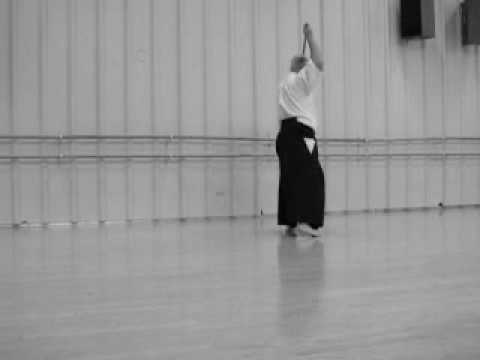
Shinto Muso Ryu Gyakute zuki
0
Jo Thrust·funkrelaxo
Technique number 5 of the 12 jodo kihon (basic techniques).
Translation: Short Staff Thrusts
The jo thrust (tsuki) is considered the most distinctive technique in jojutsu, exploiting the staff's ability to deliver a powerful spearing action that a sword cannot replicate. [1] According to tradition, Muso Gonnosuke's development of the jo thrust was the key technical innovation that allowed him to overcome Miyamoto Musashi's sword in their legendary rematch. [2] Krieger identifies the thrust as the technique that gives the jo its primary tactical advantage over the sword: the ability to attack from a distance with a linear, difficult-to-deflect action. [1]
Jō thrusts use the staff's end to deliver precise linear strikes to the solar plexus, throat, or face, a technique that is difficult to defend against due to the jō's speed. [1]
Jō thrusting is a signature technique of jōjutsu, particularly in Shintō Musō-ryū where the thrust to the solar plexus is a key technique. [1]
Jō thrusts are featured in AJKF jōdō competition kata and koryū demonstrations. [1]
No images yet for this technique.
Sign in to suggest an image.
Technique number 5 of the 12 jodo kihon (basic techniques).
No instructional courses yet for this technique.
Sign in to suggest a course.
Risk of injury to the person this technique is applied to
Staff/bo/jo weapons generate significant blunt force; fracture risk
Skill level needed to execute this technique reliably
Whether this technique is allowed under major competition rule sets
The Essence of Okinawan Karate-Do (Shoshin Nagamine, 1976)
Alias sources — [1] Kobudo: Okinawan Weapons (Demura, 1976) [2] Comprehensive Asian Fighting Arts (Draeger & Smith, 1969) [3] Comprehensive Asian Fighting Arts (Draeger & Smith, 1969)
History sources — [1] Krieger, P., The Jo: Art of the Japanese Short Staff (Koryu Books, 1989) [2] Draeger, D., Classical Bujutsu (Weatherhill, 1973)
Established Japanese martial arts naming convention — native Japanese term (和語/漢語)
Alias sources — [1] Kobudo: Okinawan Weapons (Demura, 1976) [2] Comprehensive Asian Fighting Arts (Draeger & Smith, 1969) [3] Comprehensive Asian Fighting Arts (Draeger & Smith, 1969)
History sources — [1] Krieger, P., The Jo: Art of the Japanese Short Staff (Koryu Books, 1989) [2] Draeger, D., Classical Bujutsu (Weatherhill, 1973)
wrist snap speed, sliding grip coordination, hip rotation
long reach and strong wrists for staff manipulation
forearms, wrist rotators, core rotators, shoulders
Every move, in any martial art, shares a few universal traits. Mix and match below to pinpoint the right tool — or compare equivalents across styles.
Thrusting techniques with the jo targeting the solar plexus, throat, or face using the tip of the staff.
The jo thrust (tsuki) is considered the most distinctive technique in jojutsu, exploiting the staff's ability to deliver a powerful spearing action that a sword cannot replicate. According to tradition, Muso Gonnosuke's development of the jo thrust was the key technical innovation that allowed him to overcome Miyamoto Musashi's sword in their legendary rematch.
FIE: legal — Legal thrusting technique — primary scoring method in foil and épée; FIK Kendo: legal — Tsuki (throat thrust) is a valid target; HEMA: legal — Legal in applicable weapon categories
Danger rating 7/10. Very High — staff/bo/jo weapons generate significant blunt force; fracture risk
The standard setup chain: Grip and Stance → Chamber → Strike → Recovery.
Standard counters include: Beat Parry — deflect the blade with a sharp lateral beat before it reaches target / Displacement — move the body off the line while threatening with the point / Counter-Thrust — extend into the attacker's line during their advance.
Common variants: Overhead strike (bringing the staff down from above in a vertical arc); Lateral strike (horizontal sweep targeting the ribs or head); Thrust (straight thrust with the end of the staff); Butt-end strike (striking with the rear end of the staff at close range).
Jō thrusts are featured in AJKF jōdō competition kata and koryū demonstrations.
Top errors to watch for: Thrusting slowly — the jo thrust must be explosive; a slow extension is easily deflected or avoided / Over-extending and losing balance — the thrust extends the arms but the body stays centred over the base / Not retracting immediately after the thrust — the extended jo can be grabbed or redirected; snap it back / Aiming imprecisely — the thrust requires exact targeting; a miss wastes the technique and creates an opening.
The Jo Thrust is also known as Jo Tsuki, Short Staff Thrust, Jodo Tsuki.