5 Beginner Arnis Double Stick Moves You can do today! Filipino Martial Arts
0
Double Sinawali·Kali Center
Join my online school and purchase Kali gear today at: https://www.kalicenter.com/ Join my online Kali school and start…
Translation: double sinawali
Double Sinawali (also called Heaven Six or Redonda) is the sinawali pattern where both sticks strike the same target area simultaneously or in rapid succession, creating a doubled striking pattern that overwhelms the opponent's ability to block both strikes at once. [1] In double sinawali, both sticks swing to the same side — for example, both sticks strike the opponent's left side in succession, then both swing to the right side — creating a powerful, concentrated attack pattern. [1],[2] The double sinawali develops power generation with both hands and trains the practitioner to deliver coordinated maximum-force strikes. [2],[3]
Double sinawali is a core pattern in Filipino martial arts training, taught across most Arnis and Eskrima systems as an intermediate-level doble baston technique. [1] The pattern emphasises offensive power through doubled strikes, reflecting the aggressive combat philosophy of many Filipino fighting systems. [2],[3]
Double sinawali is an advanced double-stick weaving pattern where both sticks follow the same path, creating continuous striking patterns. [1]
Double sinawali is performed in FMA forms competition and used as a training method for double-stick fighting. [1]
No images yet for this technique.
Sign in to suggest an image.
Join my online school and purchase Kali gear today at: https://www.kalicenter.com/ Join my online Kali school and start…
Academy http://www.kalimethod.com 1st Lesson in the Foundation Elements Curriculum. The basic Sinawali is the Mother of …
The 7 Different Sinawali variations that are very useful in self-defense because it offers unique but very effective fig…
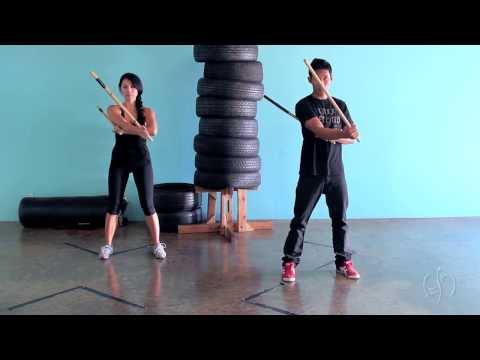
Double Sinawali is a foundational double-stick weaving pattern in Filipino martial arts (Kali, Arnis, Eskrima) characterized by alternating diagonal strikes executed in continuous six-count sequences. According to kalimethod's pedagogical framework, the technique begins in chamber position with one stick held under the armpit and the other ready to strike diagonally. The "mother Sinawali" comprises three primary variations: heaven (all strikes at head level), standard (alternating high and low strikes), and combo (integrating knee-level strikes with footwork). Each variation uses identical arm mechanics; only the striking height changes. Kalimethod emphasizes maintaining parallel stick alignment to prevent collision and keeping the torso upright during low strikes. The pattern transitions into footwork coordination where practitioners synchronize contralateral limbs—right leg with right hand, left leg with left hand—progressing through heaven, standard, and combo before descending into earth variations (all strikes targeting lower targets). Kali Center presents Double Sinawali as a progression from foundational broken and fluid strikes in the open and chamber positions, treating the weaving pattern as an intermediate skill combining strike mechanics with rhythm coordination. Both instructors stress slow, deliberate practice before increasing speed, emphasizing that proficiency develops through repetitive training hours rather than years of unfocused practice.
Synthesized from 3 instructors
No instructional courses yet for this technique.
Sign in to suggest a course.
Risk of injury to the person this technique is applied to
Arnis/Escrima/Kali stick and blade techniques; designed for close-range lethality
Skill level needed to execute this technique reliably
Whether this technique is allowed under major competition rule sets
The Filipino Martial Arts (Dan Inosanto, 1980)
Alias sources — [1] Filipino Martial Arts (Wiley, 1994) [2] Filipino Martial Arts (Wiley, 1994) [3] Filipino Martial Arts (Wiley, 1994)
Effectiveness sources — [1] Inosanto, D., The Filipino Martial Arts (Know Now Publishing, 1980)
Standard katakana transliteration of Western martial arts terminology (外来語) — used in Japanese MMA, boxing, and BJJ communities
Alias sources — [1] Filipino Martial Arts (Wiley, 1994) [2] Filipino Martial Arts (Wiley, 1994) [3] Filipino Martial Arts (Wiley, 1994)
Effectiveness sources — [1] Inosanto, D., The Filipino Martial Arts (Know Now Publishing, 1980)
wrist speed, hand coordination (especially double stick), cardiovascular endurance
quick hands, conditioned forearms, coordination
forearms, wrists, shoulders, core rotators
Keep your hands diagonal rather than perpendicular to avoid the sticks catching each other. According to Kali Method's instruction, beginners often make the mistake of putting their hand out perpendicular when it should be diagonal so that when you strike, the stick will turn over properly.
Match your footwork to your strikes by moving your right leg forward with your right hand and your left leg forward with your left hand. Kali Method emphasizes keeping your back straight and starting slowly before building up speed, moving through patterns like 'heaven' and 'earth' with synchronized leg and arm movements.
You can start training immediately by using whatever you have on hand or even just your hands to practice the motions. Paul Ingram at Kali Center recommends grabbing anything available to get started with your training today while you wait for proper rattan sticks to arrive.
Once you master the five basic drills, practice karenza—a solitary free flow where you creatively explore how the drills link together. Start slow for about 60 seconds, mixing up the movements in different orders to develop fluidity without rushing.
Double Sinawali (also called Heaven Six or Redonda) is the sinawali pattern where both sticks strike the same target area simultaneously or in rapid succession, creating a doubled striking pattern that overwhelms the opponent's ability to block both strikes at once. In double sinawali, both sticks swing to the same side — for example, both sticks strike the opponent's left side in succession, then both swing to the right side — creating a powerful, concentrated attack pattern.
Double sinawali is a core pattern in Filipino martial arts training, taught across most Arnis and Eskrima systems as an intermediate-level doble baston technique. The pattern emphasises offensive power through doubled strikes, reflecting the aggressive combat philosophy of many Filipino fighting systems.
WEKAF: legal — Legal in padded stick competition; HEMA: legal — Legal in applicable weapon categories
Danger rating 8/10. Very High — Arnis/Escrima/Kali stick and blade techniques; designed for close-range lethality
The standard setup chain: Grip and Stance → Chamber → Strike → Recovery.
Standard counters include: Umbrella Block — raise the stick overhead to intercept a downward strike / Cross Block — meet the incoming strike with a perpendicular block / Disarm — strip the opponent's weapon through leverage on the hand or wrist.
Common variants: Angle 1 (forehand diagonal) (downward diagonal strike from the dominant side); Angle 2 (backhand diagonal) (downward diagonal strike from the off side); Angle 5 (thrust) (straight thrust with the tip of the stick); Redonda (continuous) (flowing circular strikes chaining multiple angles).
Double sinawali is performed in FMA forms competition and used as a training method for double-stick fighting.
Top errors to watch for: Making both strikes the same power — the first strike sets up the second; vary power for tactical effect / Not chambering the non-striking hand — while one hand strikes, the other must chamber for the next strike / Striking at different heights unintentionally — both high strikes should be at the same level for the pattern to work / Leaning back from the partner — maintain proper distance by standing your ground.
The Double Sinawali is also known as Daburu Shinawari, Double Weave, X-Pattern Sinawali, Standard Double Weave.