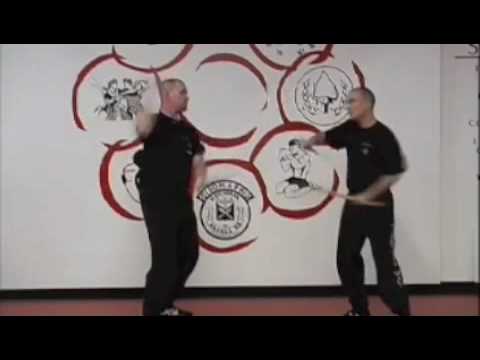
Guro Harley Elmore: Doble Baston/Double Stick
0
Double Stick — Doble Baston·WarriorswayTX
These clips are from the Doble Baston DVD.
Translation: double stick — doble baston
The Double Stick (Doble Baston) family covers techniques using two rattan sticks simultaneously, one in each hand, which is one of the most distinctive and visually spectacular aspects of Filipino martial arts. [1] Doble baston training develops ambidexterity, coordination, and the ability to attack and defend simultaneously with both hands, which translates directly to double-weapon combat (two swords, sword and dagger) and empty-hand fighting. [1],[2] The double stick family includes sinawali patterns (weaving drills), flow drills (continuous two-person training sequences), and combative applications (simultaneous attack-and-block combinations). [2],[3]
Double stick fighting was a core component of Filipino warrior training, used both as a combat method and as a training tool for developing the bilateral coordination needed for espada y daga (sword and dagger) fighting. [1] The sinawali weaving patterns take their name from the Tagalog word 'sinawali' (to weave), referencing the woven patterns created by the interacting sticks. [2],[3]
Doble baston (double stick) provides simultaneous offensive and defensive capability with a weapon in each hand, allowing continuous flowing attacks from multiple angles. [1]
Double-stick fighting is a distinctive feature of Filipino martial arts, developed from the dual-weapon traditions of the Philippine islands. [1]
Double stick is competed in WEKAF tournaments and other FMA events as a separate division from single stick. [1]
No images yet for this technique.
Sign in to suggest an image.
These clips are from the Doble Baston DVD.
No instructional courses yet for this technique.
Sign in to suggest a course.
Risk of injury to the person this technique is applied to
Arnis/Escrima/Kali stick and blade techniques; designed for close-range lethality
Skill level needed to execute this technique reliably
Whether this technique is allowed under major competition rule sets
The Filipino Martial Arts (Dan Inosanto, 1980)
Alias sources — [1] Filipino Martial Arts (Wiley, 1994) [2] Filipino Martial Arts (Wiley, 1994) [3] Filipino Martial Arts (Wiley, 1994)
Effectiveness sources — [1] Filipino Martial Arts (Wiley, 1997)
Standard katakana transliteration of Western martial arts terminology (外来語) — used in Japanese MMA, boxing, and BJJ communities
Alias sources — [1] Filipino Martial Arts (Wiley, 1994) [2] Filipino Martial Arts (Wiley, 1994) [3] Filipino Martial Arts (Wiley, 1994)
Effectiveness sources — [1] Filipino Martial Arts (Wiley, 1997)
wrist control for edge alignment, grip endurance, footwork precision
quick wrists, strong forearms, good posture
forearm extensors/flexors, deltoids, core, calves
Every move, in any martial art, shares a few universal traits. Mix and match below to pinpoint the right tool — or compare equivalents across styles.
The Flow Drill subfamily covers continuous, partner-based training patterns in double-stick work where both practitioners cycle through predetermined sequences of attacks and defences without stopping, developing timing, reflexes, and sensitivity to the opponent's movements. [1] Flow drills are the primary training methodology in Filipino martial arts — they simulate the continuous nature of actual combat by eliminating the stop-start pattern of technique isolation, instead training the practitioner to react fluidly and maintain offensive-defensive flow. [1,2] In double-stick flow drills, both practitioners wield two sticks and cycle through attack-block sequences that build progressively in complexity and speed. [2,3]
The Sinawali subfamily covers the signature weaving patterns of Filipino double-stick combat, where two sticks are swung in coordinated, crossing patterns that create a continuous offensive-defensive shield of strikes. [1] The name sinawali derives from the Tagalog word 'sawali' — woven split bamboo panels used in traditional Filipino construction — reflecting the visual similarity between the woven sticks and woven bamboo. [1,2] Sinawali patterns are categorised by the direction and sequence of the weaving: single sinawali (basic alternating X-pattern), double sinawali (both sticks striking the same side simultaneously), and reverse sinawali (outside-to-inside weaving pattern). [2,3]
Double stick (doble baston/sinawali) trains ambidexterity and coordination — both hands work independently with a stick each. The sinawali (weaving) patterns are the fundamental double-stick drills. (Wiley, Filipino Martial Arts; FMA manuals)
According to Guro Harley Elmore, you should squat on your knees and turn while keeping your head back out of the way to avoid strikes during practice.
Guro Harley Elmore emphasizes that you should aim at the actual target (such as the head) rather than avoiding your partner's hands, as this develops proper technique and targeting accuracy.
Guro Harley Elmore teaches that strikes are organized into levels: heaven, six, standard, and earth, with earth representing strikes aimed at lower targets.
The Double Stick (Doble Baston) family covers techniques using two rattan sticks simultaneously, one in each hand, which is one of the most distinctive and visually spectacular aspects of Filipino martial arts. Doble baston training develops ambidexterity, coordination, and the ability to attack and defend simultaneously with both hands, which translates directly to double-weapon combat (two swords, sword and dagger) and empty-hand fighting.
Double stick fighting was a core component of Filipino warrior training, used both as a combat method and as a training tool for developing the bilateral coordination needed for espada y daga (sword and dagger) fighting. The sinawali weaving patterns take their name from the Tagalog word 'sinawali' (to weave), referencing the woven patterns created by the interacting sticks.
WEKAF: legal — Legal in padded stick competition; HEMA: legal — Legal in applicable weapon categories
Danger rating 8/10. Very High — Arnis/Escrima/Kali stick and blade techniques; designed for close-range lethality
The standard setup chain: Assume Guard (Kamae/Hut) → Measure Distance (Ma-ai) → Initiate Cut/Thrust → Follow Through (Zanshin).
Standard counters include: Parry (Absetzen) — deflect the incoming blade with a counter-displacement / Void (Step Back) — withdraw from measure to avoid the cutting arc / Counter-Cut (Nachreisen) — strike into the opponent's opening during their attack.
Common variants: Standard cut (primary cutting angle from the ready stance); Thrust (tsuki) (straight thrust targeting the throat, chest, or face); Rising cut (kiri-age) (upward diagonal cut from low to high); Diagonal cut (kesa-giri) (downward diagonal cut following the kimono line).
Double stick is competed in WEKAF tournaments and other FMA events as a separate division from single stick.
Top errors to watch for: Focusing only on the dominant hand — both hands must develop equal skill; the live hand is not a passive holder / Crossing the sticks unintentionally — crossed sticks tangle and create openings; maintain proper weapon paths / Using the same pattern repeatedly — predictable double stick work is easily countered; vary combinations / Neglecting the check hand between strikes — the non-striking stick should always be in a guard or check position.
The Double Stick — Doble Baston is also known as Dobure Basuton, Doble Baston, Double Baston, Two Sticks.