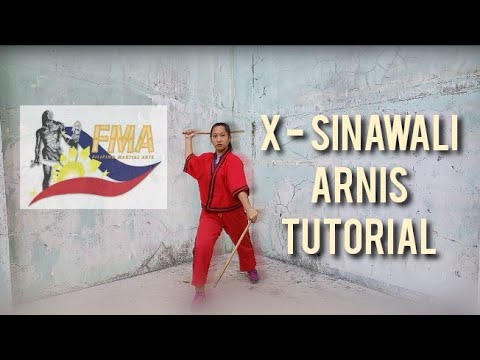
X - SINAWALI | ARNIS TUTORIAL
0
Sinawali·MATTI San Juan Official
X - Sinawali Arnis tutorial
Translation: sinawali
The Sinawali subfamily covers the signature weaving patterns of Filipino double-stick combat, where two sticks are swung in coordinated, crossing patterns that create a continuous offensive-defensive shield of strikes. [1] The name sinawali derives from the Tagalog word 'sawali' — woven split bamboo panels used in traditional Filipino construction — reflecting the visual similarity between the woven sticks and woven bamboo. [1],[2] Sinawali patterns are categorised by the direction and sequence of the weaving: single sinawali (basic alternating X-pattern), double sinawali (both sticks striking the same side simultaneously), and reverse sinawali (outside-to-inside weaving pattern). [2],[3]
Sinawali patterns are among the oldest and most recognisable techniques in Filipino martial arts, documented across virtually every Arnis, Eskrima, and Kali system throughout the Philippine archipelago. [1] The weaving drills served both as combat training and as the basis for cultural performances and demonstrations. [2],[3]
Sinawali (weaving) drills develop ambidextrous coordination, pattern recognition, and the ability to maintain continuous offensive pressure with two weapons simultaneously. [1] The interlocking figure-eight patterns train both hemispheres of the brain to coordinate weapon strikes independently, a skill with no parallel in single-weapon systems. [2]
Sinawali drills are demonstrated at FMA events and competitions, forming the foundation of double-stick fighting technique. [1]
No images yet for this technique.
Sign in to suggest an image.
X - Sinawali Arnis tutorial
VOTE FOR UNION MARTIAL ARTS: https://top-choice-awards.webflow.io/vote?survey_id=PEYjOz Remember to follow us on IG! We…
No instructional courses yet for this technique.
Sign in to suggest a course.
Risk of injury to the person this technique is applied to
Arnis/Escrima/Kali stick and blade techniques; designed for close-range lethality
Skill level needed to execute this technique reliably
Whether this technique is allowed under major competition rule sets
The Filipino Martial Arts (Dan Inosanto, 1980)
Alias sources — [1] Filipino Martial Arts (Wiley, 1994) [2] Filipino Martial Arts (Wiley, 1994) [3] Filipino Martial Arts (Wiley, 1994)
Effectiveness sources — [1] Wiley, M., Filipino Martial Arts (Charles E. Tuttle, 1994) [2] Inosanto, D., The Filipino Martial Arts (Know Now Publishing, 1980)
Standard katakana transliteration of Western martial arts terminology (外来語) — used in Japanese MMA, boxing, and BJJ communities
Alias sources — [1] Filipino Martial Arts (Wiley, 1994) [2] Filipino Martial Arts (Wiley, 1994) [3] Filipino Martial Arts (Wiley, 1994)
Effectiveness sources — [1] Wiley, M., Filipino Martial Arts (Charles E. Tuttle, 1994) [2] Inosanto, D., The Filipino Martial Arts (Know Now Publishing, 1980)
wrist speed, hand coordination (especially double stick), cardiovascular endurance
quick hands, conditioned forearms, coordination
forearms, wrists, shoulders, core rotators
Every move, in any martial art, shares a few universal traits. Mix and match below to pinpoint the right tool — or compare equivalents across styles.
Double Sinawali (also called Heaven Six or Redonda) is the sinawali pattern where both sticks strike the same target area simultaneously or in rapid succession, creating a doubled striking pattern that overwhelms the opponent's ability to block both strikes at once. [1] In double sinawali, both sticks swing to the same side — for example, both sticks strike the opponent's left side in succession, then both swing to the right side — creating a powerful, concentrated attack pattern. [1,2] The double sinawali develops power generation with both hands and trains the practitioner to deliver coordinated maximum-force strikes. [2,3]
Reverse Sinawali (also called Earth or Abaniko Sinawali in some systems) reverses the standard weaving pattern so that the sticks travel from outside to inside rather than the standard inside-to-outside path. [1] The reverse pattern creates a different striking angle and defensive coverage — where standard sinawali tends to generate forehand-dominant strikes, reverse sinawali emphasises backhand strikes and outside deflections. [1,2] Reverse sinawali trains the practitioner to handle attacks coming from non-standard angles and develops the backhand striking power that is often neglected in basic training. [2,3]
Single Sinawali (also called Heaven Standard or basic X-pattern) is the foundational weaving pattern where the two sticks alternate in a crossing pattern — one stick strikes high on one side while the other passes underneath, then they switch, creating a continuous figure-eight or X-shaped weaving motion. [1] Single sinawali is the first doble baston pattern taught in most Filipino martial arts systems because it establishes the fundamental bilateral coordination and timing that all more advanced patterns build upon. [1,2] The pattern creates a basic offensive-defensive screen: one stick is always striking while the other is in position to block, maintaining continuous coverage. [2,3]
Mark Anastacio explains that while a single sinawali hits when you're squared up in front, this is a bad formula for protecting yourself in actual head-to-head fighting because you're not accounting for defensive positioning and angles.
Mark Anastacio recommends practicing single sinawali drills solo to develop consciousness of which techniques work at different angles and attack positions, building awareness of what adjustments you need to make based on your angle of attack.
The Sinawali subfamily covers the signature weaving patterns of Filipino double-stick combat, where two sticks are swung in coordinated, crossing patterns that create a continuous offensive-defensive shield of strikes. The name sinawali derives from the Tagalog word 'sawali' — woven split bamboo panels used in traditional Filipino construction — reflecting the visual similarity between the woven sticks and woven bamboo.
Sinawali patterns are among the oldest and most recognisable techniques in Filipino martial arts, documented across virtually every Arnis, Eskrima, and Kali system throughout the Philippine archipelago. The weaving drills served both as combat training and as the basis for cultural performances and demonstrations.
WEKAF: legal — Legal in padded stick competition; HEMA: legal — Legal in applicable weapon categories
Danger rating 8/10. Very High — Arnis/Escrima/Kali stick and blade techniques; designed for close-range lethality
The standard setup chain: Grip and Stance → Chamber → Strike → Recovery.
Standard counters include: Umbrella Block — raise the stick overhead to intercept a downward strike / Cross Block — meet the incoming strike with a perpendicular block / Disarm — strip the opponent's weapon through leverage on the hand or wrist.
Common variants: Angle 1 (forehand diagonal) (downward diagonal strike from the dominant side); Angle 2 (backhand diagonal) (downward diagonal strike from the off side); Angle 5 (thrust) (straight thrust with the tip of the stick); Redonda (continuous) (flowing circular strikes chaining multiple angles).
Sinawali drills are demonstrated at FMA events and competitions, forming the foundation of double-stick fighting technique.
Top errors to watch for: Moving only the arms — sinawali requires hip rotation and weight shifting to generate power and maintain flow / Losing the rhythm — sinawali is rhythmic; breaking the rhythm means losing the pattern and the drill's benefit / Not matching the partner's tempo — sinawali is cooperative; both partners must maintain the same speed / Gripping the sticks too tightly — a death grip slows the wrists and prevents fluid weapon manipulation.
The Sinawali is also known as Shinawari, Weaving Pattern, Sinawali Drill, Hatid-Sungkit.