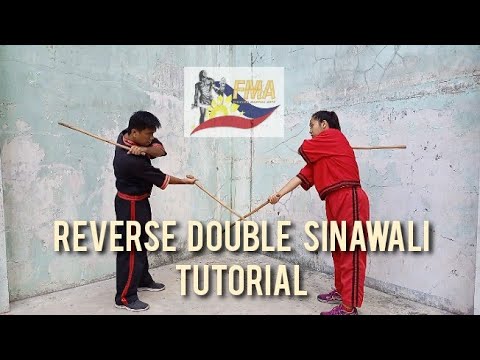
REVERSE DOUBLE SINAWALI - TUTORIAL
0
Reverse Sinawali·MATTI San Juan Official
Reverse Double Sinawali Tutorial
Translation: reverse sinawali
Reverse Sinawali (also called Earth or Abaniko Sinawali in some systems) reverses the standard weaving pattern so that the sticks travel from outside to inside rather than the standard inside-to-outside path. [1] The reverse pattern creates a different striking angle and defensive coverage — where standard sinawali tends to generate forehand-dominant strikes, reverse sinawali emphasises backhand strikes and outside deflections. [1],[2] Reverse sinawali trains the practitioner to handle attacks coming from non-standard angles and develops the backhand striking power that is often neglected in basic training. [2],[3]
Reverse sinawali reverses the weaving pattern, creating different timing and angles that are difficult for opponents accustomed to standard sinawali. [1]
Reverse sinawali was developed as an advanced variation of the basic sinawali double-stick patterns. [1]
Reverse sinawali is demonstrated at FMA events and used in double-stick competition. [1]
No images yet for this technique.
Sign in to suggest an image.
Reverse Double Sinawali Tutorial
Reverse Peripheral Sinawali | Arnis Tutorial #arnis #eskrima #kali #filipinomartialarts #sinawali #arnisbasic
Arnis Double Stick Reverse Sinawali with X- Footwork/Self Defense
Reverse Sinawali is a double-stick Filipino martial arts technique that inverts the striking and blocking patterns of standard Sinawali. MATTI San Juan Official demonstrates the fundamental mechanics: the pattern begins with the left hand striking over the right hand, followed by a right forearm downward strike, then a left back-hand downward strike, with the right hand transitioning to block over the right side. This sequence reverses on the opposite side, with left forehand and back-hand strikes followed by right-hand blocking over the left side. MATTI San Juan Official emphasizes footwork integration, including right foot forward stance and switching stances to facilitate fluid movement transitions. Master Tirso Tv expands the technique's application by combining reverse Sinawali with X-footwork and articulating the distinction between standard double-stick patterns and their reversed variants. Master Tirso Tv notes that reverse Sinawali can be performed in repetitive 12-count cycles and integrated with shadow work and self-defense applications. Both instructors stress the importance of precise hand sequencing and footwork coordination as foundational to executing the technique effectively.
Synthesized from 3 instructors
No instructional courses yet for this technique.
Sign in to suggest a course.
Risk of injury to the person this technique is applied to
Arnis/Escrima/Kali stick and blade techniques; designed for close-range lethality
Skill level needed to execute this technique reliably
Whether this technique is allowed under major competition rule sets
The Filipino Martial Arts (Dan Inosanto, 1980)
Alias sources — [1] Filipino Martial Arts (Wiley, 1994) [2] Filipino Martial Arts (Wiley, 1994) [3] Filipino Martial Arts (Wiley, 1994)
Effectiveness sources — [1] Filipino Martial Arts (Wiley, 1997)
Standard katakana transliteration of Western martial arts terminology (外来語) — used in Japanese MMA, boxing, and BJJ communities
Alias sources — [1] Filipino Martial Arts (Wiley, 1994) [2] Filipino Martial Arts (Wiley, 1994) [3] Filipino Martial Arts (Wiley, 1994)
Effectiveness sources — [1] Filipino Martial Arts (Wiley, 1997)
wrist speed, hand coordination (especially double stick), cardiovascular endurance
quick hands, conditioned forearms, coordination
forearms, wrists, shoulders, core rotators
Reverse Sinawali (also called Earth or Abaniko Sinawali in some systems) reverses the standard weaving pattern so that the sticks travel from outside to inside rather than the standard inside-to-outside path. The reverse pattern creates a different striking angle and defensive coverage — where standard sinawali tends to generate forehand-dominant strikes, reverse sinawali emphasises backhand strikes and outside deflections.
Reverse sinawali developed as a complementary pattern to standard sinawali, ensuring practitioners could weave and strike from all angles and directions. It is taught in most Filipino martial arts systems as an essential variation that completes the sinawali skill set.
WEKAF: legal — Legal in padded stick competition; HEMA: legal — Legal in applicable weapon categories
Danger rating 8/10. Very High — Arnis/Escrima/Kali stick and blade techniques; designed for close-range lethality
The standard setup chain: Grip and Stance → Chamber → Strike → Recovery.
Standard counters include: Umbrella Block — raise the stick overhead to intercept a downward strike / Cross Block — meet the incoming strike with a perpendicular block / Disarm — strip the opponent's weapon through leverage on the hand or wrist.
Common variants: Angle 1 (forehand diagonal) (downward diagonal strike from the dominant side); Angle 2 (backhand diagonal) (downward diagonal strike from the off side); Angle 5 (thrust) (straight thrust with the tip of the stick); Redonda (continuous) (flowing circular strikes chaining multiple angles).
Reverse sinawali is demonstrated at FMA events and used in double-stick competition.
Top errors to watch for: Using the same mechanics as standard sinawali — reverse requires different body mechanics for the upward motion / Not developing sufficient wrist strength — the upward strike demands wrist endurance; condition gradually / Rising too high with the strikes — the rising strikes should target specific zones, not flail upward aimlessly / Mixing up the pattern with standard sinawali — keep the patterns distinct until both are mastered individually.
The Reverse Sinawali is also known as Ribāsu Shinawari, Reverse Weave, Earth Pattern, Low Sinawali.