Direct Attack Overview
A direct attack is an explosive offensive action in fencing that travels from point A to point B without faints, disengagements, flicks, or coupés. The attacker finishes in the same line in which they began, making it the shortest and fastest path to the target. Direct attacks are used to either close distance rapidly or to probe the opponent's defensive responses and identify weaknesses.
Tactical Applications
Direct attacks serve two primary tactical purposes: testing an opponent's reactivity to determine if they will parry or disengage, and gathering information about their defensive effectiveness. If an opponent successfully carries or parries a direct attack, the fencer gains awareness that alternative techniques should be explored. The direct attack can also function as a feint to set up subsequent line changes.
The Marching Attack
The marching attack is a direct attack executed with repeated forward steps when distance is not yet sufficient for a lunge. The hand initiates the offensive action and establishes the attack line, while the blade reaches the target at the moment the front foot completes its final forward step. This timing is critical—the hit must arrive as the foot advances, not before or after.
The Lunge Attack
The lunge is a direct attack delivered from slightly greater distance, with the hand initiating the blade action before the feet move. The attacker may take one or more advance steps to close distance, then extends the arm and lunges forward in a single, committed motion. The attack must finish in the original line with the blade arriving at the target, not the foot arriving first followed by arm extension.
The Fleche Attack
The fleche is the most explosive direct attack option, typically employed when marching attacks and lunges have proven ineffective. The hand initiates the attack while the fencer commits fully to the line and leans forward, allowing the blade to arrive at the target before the front foot lands. Critically, the fleche maintains the original attack line throughout—no line changes occur despite the extreme speed and forward momentum.
Common Direct Attack Principles
All direct attacks—marching, lunging, and fleche—share fundamental characteristics: the hand initiates the attack, the blade travels in a single committed line, and there are no searching movements or blade manipulations. The speed of a direct attack is directly related to this commitment to one line; any blade movement like cut-overs or disengagements introduces delay. Direct attacks close distance between the blade tip and target more rapidly than any alternative attacking strategy.
Direct Attack: What is it, why use it, and how?
Key Takeaways
- •Direct Attack Overview
- •Tactical Applications
- •The Marching Attack
- •The Lunge Attack
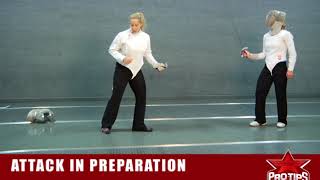
The Direct Attack is an explosive, fast, yet simplistic action that enables the foilist to initiate an attack that travels to the target using the least amount of time. Whether being used to make a quick touch or to flesh out an opponent's potential strengths and weaknesses, the Direct Attack is an invaluable tool for any foilist's repertoire. Explore this valuable tool as this lesson applies it to the March, the Lunge, and the Flèche. Note: this video is not intended as a coaching lesson but as an outline for exploring the video content on your own, with fellow foilists, or with your coach. Interpretation, instruction, and articulation of actions may differ from coach to coach. www.osmfencing.com
Related Techniques
Frequently Asked Questions
What does this video teach about attack on preparation?
This video covers direct attack overview, tactical applications, the marching attack. It provides detailed instruction from OSM Fencing.
How long does it take to learn attack on preparation?
The basic mechanics can be understood in a single session, but developing reliable execution requires consistent drilling over weeks of practice. This 6-part breakdown helps structure your training by isolating each phase of the technique.
What are the key details for finishing attack on preparation?
The fleche is the most explosive direct attack option, typically employed when marching attacks and lunges have proven ineffective. The hand initiates the attack while the fencer commits fully to the line and leans forward, allowing the blade to arrive at the target before the front foot lands. Critically, the fleche maintains the original attack line throughout—no line changes occur despite the extreme speed and forward momentum.