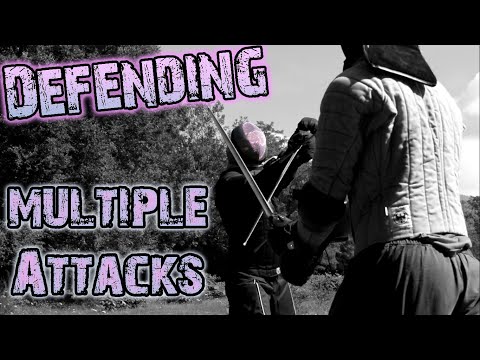
Longsword Beginners Guide #15 - Defending from a Combination of Attacks
0
Standard Epee Counter-Attack·Federico Malagutti HEMA
Follow me on: PATREON - https://www.patreon.com/MalaguttiFederico Instagram - https://www.instagram.com/federicom…
Translation: standard epee counter-attack
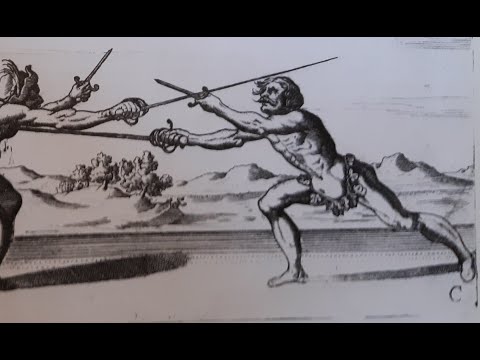
The Standard Epee Counter-Attack executes the basic stop hit or time-hit by extending the arm into the path of the attacker, aiming to land the point on the attacker's closest target (typically the hand, arm, or shoulder) before or simultaneously with the incoming attack. [1] The technique relies on the 40-millisecond lockout window in epee: if both fencers hit within 40 ms of each other, both touches count (double touch), making the counter-attack a viable defensive-offensive tool even when it does not clearly precede the attack. [1],[2] Execution requires reading the opponent's preparation, committing the arm extension early, and maintaining point accuracy under pressure. [2],[3]
The stop hit to the hand or arm is the defining tactical action of epee fencing, exploiting the 40-millisecond lockout window to score on the attacker's closest target during their advance. [1] This counter-attack is the single most important technique distinguishing elite epee fencers from intermediate ones, as it requires reading the attacker's preparation and committing the arm extension with millisecond precision. [2]
The standard épée counter-attack developed from French duelling principles where hitting first—regardless of who initiated—was the goal. [1]
Statistical analysis of elite epee bouts indicates that counter-attacks (stop hits and time hits) account for approximately 30–40% of all touches scored, a higher proportion than in any other fencing weapon. [1]
No images yet for this technique.
Sign in to suggest an image.
Follow me on: PATREON - https://www.patreon.com/MalaguttiFederico Instagram - https://www.instagram.com/federicom…
This time I summarise the basic principles of using an off-hand dagger in combination with the rapier in Capoferro's sys…
International Armizare Society Basic Curriculum Lesson One: Fundamental Body & Sword Mechanics Students will learn to ex…
The three instructors address fundamentally different weapon systems and contexts, making direct synthesis problematic. Federico Malagutti HEMA teaches longsword defense against combination attacks using footwork (half-steps backward) and sequential parries followed by ripostes, emphasizing distance management and edge selection (true vs. false edge). Edinburgh Renaissance Fencing Academy covers rapier-and-dagger system mechanics, where the dagger functions primarily as a defensive tool held in a relaxed, partially-extended ready position near the chest, extended from the shoulder during attacks and parries to cover gaps in defense and support sword actions. Northwest Fencing Academy focuses on the fendente (descending cut) as an offensive technique, detailing biomechanics: shoulder-driven initiation, rotational leverage around the sword's node, hip rotation for power, and specific targeting geometry (teeth to opposite knee). All three instructors emphasize controlled extension rather than locked joints, smooth transitions between positions, and adaptability within their respective systems. Malagutti and Edinburgh stress defensive sequencing; Northwest emphasizes offensive development through repetitive, biomechanically precise drilling. The systems operate at different ranges and with different objectives: Malagutti addresses multi-attack defense, Edinburgh covers integrated weapon pairing, and Northwest teaches foundational cutting mechanics.
Synthesized from 3 instructors
No instructional courses yet for this technique.
Sign in to suggest a course.
Risk of injury to the person this technique is applied to
Modern sport fencing uses blunted weapons and full protective gear; injury rate ~2.5 per 1000 exposures (Harmer 2008)
Skill level needed to execute this technique reliably
Whether this technique is allowed under major competition rule sets
The Art of Fencing (Luigi Barbasetti, 1932)
Alias sources — [1] FIE Rules of Competition [2] Classical Fencing (Rogers, 2014) [3] Classical Fencing (Rogers, 2014)
Effectiveness sources — [1] Czajkowski, Z., Understanding Fencing (SKA Swordplay Books, 2005) [2] Roi, G.S. & Bianchedi, D., 'The Science of Fencing', Sports Medicine 38.6 (2008)
Mixed Japanese-Western terminology — combines traditional Japanese terms with katakana loanwords
Alias sources — [1] FIE Rules of Competition [2] Classical Fencing (Rogers, 2014) [3] Classical Fencing (Rogers, 2014)
Effectiveness sources — [1] Czajkowski, Z., Understanding Fencing (SKA Swordplay Books, 2005) [2] Roi, G.S. & Bianchedi, D., 'The Science of Fencing', Sports Medicine 38.6 (2008)
explosive lunge speed, finger/wrist dexterity, cardiovascular endurance
long reach (tall, long arms), fast-twitch legs
quadriceps (lunge), calves, forearm/finger flexors, core
According to Edinburgh Renaissance Fencing Academy, the dagger should be held in a relatively relaxed, partially extended position just a little bit out from the chest—a ready position rather than a committed one. This allows you to quickly extend it to parry counter-time attacks or plug defensive gaps as needed.
Yes. Edinburgh Renaissance Fencing Academy explains that if your opponent attempts a counter-time attack while you're executing a technique like the kabbatsyone, you can parry it with the dagger and then riposte with the sword, or move the dagger forward slightly to plug the gap in your defense.
The Standard Epee Counter-Attack executes the basic stop hit or time-hit by extending the arm into the path of the attacker, aiming to land the point on the attacker's closest target (typically the hand, arm, or shoulder) before or simultaneously with the incoming attack. The technique relies on the 40-millisecond lockout window in epee: if both fencers hit within 40 ms of each other, both touches count (double touch), making the counter-attack a viable defensive-offensive tool even when it does not clearly precede the attack.
The standard epee counter-attack is the modern expression of the classical stop thrust, refined through decades of competitive epee and the precision afforded by electronic scoring timing. It remains the most frequently used defensive action in high-level epee competition.
FIE: legal — Legal fencing technique — governed by FIE rules for foil, épée, and sabre; HEMA: legal — Legal in historical fencing competition
Danger rating 2/10. Low — modern sport fencing uses blunted weapons and full protective gear; injury rate ~2.5 per 1000 exposures (Harmer 2008)
The standard setup chain: En Garde → Advance/Lunge Preparation → Attack → Recovery.
Standard counters include: Parry (Absetzen) — deflect the incoming blade with a counter-displacement / Void (Step Back) — withdraw from measure to avoid the cutting arc / Counter-Cut (Nachreisen) — strike into the opponent's opening during their attack.
Common variants: Simple attack (single blade action (disengage, beat, or direct) to score); Compound attack (multiple blade actions (feint then disengage) to create a…); Riposte (immediate counter after a successful parry); Counter-attack (attacking into the opponent's attack with priority or rig…).
Statistical analysis of elite epee bouts indicates that counter-attacks (stop hits and time hits) account for approximately 30–40% of all touches scored, a higher proportion than in any other fencing weapon.
Top errors to watch for: Not retreating during the counter-attack — the retreat is essential to prevent the opponent's touch from arriving / Extending the arm too late — the counter-attack must begin as the opponent commits, not after / Targeting the body instead of the hand — the hand is closer and allows the counter to arrive earlier / Not reading the opponent's attack correctly — countering feints wastes the counter-attack and creates openings.
The Standard Epee Counter-Attack is also known as Sutandādo Epe Hangeki, Stop Hit, Arret Simple, Time Hit.