How to Suplex: Instruction & Heavybag Drills
0
Standard Suplex Technique·fightTIPS·Added by Admin
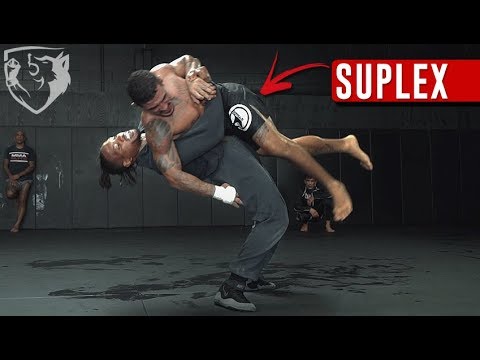
Bubba Jenkins teaches the suplex, one of his signature wrestling takedowns. The suplex is a powerful throw where you lau…
Translation: standard suplex technique
Standard Suplex Technique is the textbook front body lock suplex in which the wrestler secures a locked-hands grip around the opponent's torso at chest or waist height, pulls the opponent tight against their body, bends the knees and drives the hips forward to initiate the lift, and arches backward explosively to throw the opponent over their head and onto the mat. [1],[2] The technique requires the wrestler to maintain the body lock throughout the arc to control the opponent's landing. [2],[3]
The suplex has roots in ancient Greek and Roman wrestling traditions and was formalised as a core technique of modern Greco-Roman wrestling when the sport was codified in 19th-century France. [1] Soviet and Eastern European wrestling schools refined suplex mechanics into a systematic training methodology during the mid-20th century. [2]
The standard suplex is a fundamental Greco-Roman technique scored at all levels. [1]
No images yet for this technique.
Sign in to suggest an image.
Bubba Jenkins teaches the suplex, one of his signature wrestling takedowns. The suplex is a powerful throw where you lau…
No instructional courses yet for this technique.
Sign in to suggest a course.
Risk of injury to the person this technique is applied to
High-amplitude backward arch throw; severe head/neck injury risk (UWW injury data)
Skill level needed to execute this technique reliably
Whether this technique is allowed under major competition rule sets
Japanese pro wrestling (プロレス) terminology; Japanese amateur wrestling terminology
Japanese pro wrestling (プロレス) terminology; Japanese amateur wrestling terminology
Standard katakana transliteration of Western martial arts terminology (外来語) — used in Japanese MMA, boxing, and BJJ communities
Standard Japanese pro wrestling terminology
hip rotation speed, core strength, lower back stability
strong hips and core, good flexibility for turning entry
hip rotators, core, quadriceps, latissimus dorsi
The power line and the lock around it are vitally important for executing the suplex efficiently. According to fightTIPS, if the lock is compromised in any way, it will hamper or prevent the throw.
FightTIPS recommends placing your lock on one of the opponent's hips at a specific hip point to control their hips, then bringing that lock close to your own hips while using your lead leg to block their leg on the opposite side. This prevents them from stepping away, lowering their center of gravity, or maneuvering free.
No—according to fightTIPS, you should turn out at the last minute rather than backflip. Once you have a good arch and the opponent is at their arch point, start turning out instead of flipping backward.
FightTIPS advises to swing them under and keep squeezing as you go back, bringing them up as you execute what amounts to a controlled drop rather than letting them impact the ground freely.
Standard Suplex Technique is the textbook front body lock suplex in which the wrestler secures a locked-hands grip around the opponent's torso at chest or waist height, pulls the opponent tight against their body, bends the knees and drives the hips forward to initiate the lift, and arches backward explosively to throw the opponent over their head and onto the mat. The technique requires the wrestler to maintain the body lock throughout the arc to control the opponent's landing.
The standard suplex technique is one of the oldest and most fundamental throws in the wrestling canon, practised in competition since the revival of Greco-Roman wrestling in the 19th century.
IJF: legal — Legal throwing technique; IBJJF: banned — Suplex throws prohibited — throwing opponent backwards onto head/neck; UWW: legal — Legal in both freestyle and Greco-Roman; Unified MMA: legal — Legal throwing technique; ADCC: legal — Legal; FIAS Sport Sambo: legal — Legal; FIAS Combat Sambo: legal — Legal
Danger rating 8/10. Very High — high-amplitude backward arch throw; severe head/neck injury risk (UWW injury data)
The standard setup chain: Grip Setup (Kumi-kata) → Off-Balance (Kuzushi) → Entry (Tsukuri) → Execution (Kake).
Standard counters include: Lower Centre of Gravity — bend knees and drop hips to make the throw harder to execute / Block the Hip — post hand on the thrower's hip to prevent loading / Step Around — circle away from the throw direction to avoid being loaded / Grip Break — deny the thrower their preferred gripping configuration.
Common variants: Standard hip throw (full turn-in with hip below the opponent's centre of gravity); No-gi hip throw (adapted without gi grips, using overhook and collar tie); Drop hip throw (dropping to one knee to lower the fulcrum point); Combination hip throw (chaining from a failed foot technique or hand technique).
The standard suplex is a fundamental Greco-Roman technique scored at all levels.
Top errors to watch for: Fighting for the body lock too long without establishing head position first — head controls posture / Initiating the arch before the hip pop — the sequence is pop then arch, not simultaneous / Landing on the mat with the opponent on top because you didn't rotate / Releasing the body lock during the flight phase — you lose all control.
The Standard Suplex Technique is also known as Sūpurekkusu, Basic Suplex, Fundamental Suplex Throw, Standard Back Arch Throw.