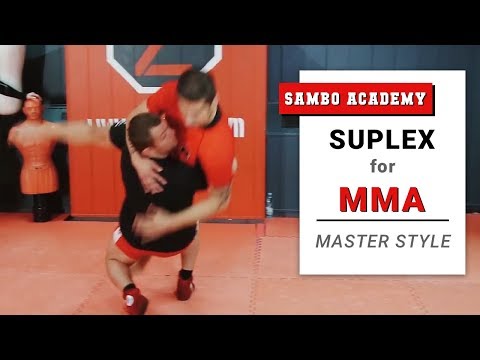
Suplex without the jacket for MMA
0
Suplex·IVAN VASYLCHUK. SILA PARTERA
Suplex without the jacket for MMA. Pay attention to all details how to perform the throw =============================…
Translation: suplex (katakana)
The Suplex is the family of wrestling throws in which the attacker secures a body lock or waist grip, lifts the opponent off the ground using hip and back extension, and arches backward to slam the opponent onto the mat behind the attacker. [1],[2] Suplexes are the quintessential high-amplitude wrestling throws, characterised by the dramatic backward arc that sends the opponent overhead or to the side with tremendous force. [2],[3] The suplex family includes the standard suplex (front body lock with backward arch), the German suplex (rear waist lock with backward bridge), the gut-wrench suplex (belly-down lift and turn), and the salto suplex (an airborne, high-rotation variant). [3],[4] Suplexes are the highest-scoring throws in Greco-Roman wrestling, where upper-body techniques dominate, and have become iconic in mixed martial arts and professional wrestling alike. [4],[5] The biomechanics of suplex execution require extraordinary back strength, hip mobility, and the ability to generate explosive force while bearing the full weight of the opponent. [5]
Suplex-type throws have ancient origins in Greco-Roman wrestling traditions dating back to antiquity. [1] The modern competitive suplex was refined in European wrestling academies during the 19th century and reached its zenith in the Soviet wrestling school of the 20th century. [1],[2] Alexander Karelin's legendary reverse body lift suplex at the 2000 Sydney Olympics, used to defeat opponents who adopted the defensive par terre position, exemplifies the technique's devastating potential at the highest level of competition. [2],[3] Suplexes became a central feature of MMA through wrestlers like Tito Ortiz, Matt Hughes, and later Khabib Nurmagomedov. [3],[4]
No images yet for this technique.
Sign in to suggest an image.
Suplex without the jacket for MMA. Pay attention to all details how to perform the throw =============================…
No instructional courses yet for this technique.
Sign in to suggest a course.
Risk of injury to the person this technique is applied to
High-amplitude backward arch throw; severe head/neck injury risk (UWW injury data)
Skill level needed to execute this technique reliably
Whether this technique is allowed under major competition rule sets
Japanese pro wrestling (プロレス) terminology; Japanese amateur wrestling terminology
Japanese pro wrestling (プロレス) terminology; Japanese amateur wrestling terminology
Standard katakana transliteration of Western martial arts terminology (外来語) — used in Japanese MMA, boxing, and BJJ communities
Standard Japanese pro wrestling terminology
hip rotation speed, core strength, lower back stability
strong hips and core, good flexibility for turning entry
hip rotators, core, quadriceps, latissimus dorsi
Every move, in any martial art, shares a few universal traits. Mix and match below to pinpoint the right tool — or compare equivalents across styles.
The German Suplex is a suplex variation in which the attacker secures a rear waist lock (clasping hands around the opponent's waist from behind), lifts the opponent off the ground, and bridges backward to throw the opponent over the attacker's head and onto the mat behind them. [1,2] The technique is named for its prominence in German and European Greco-Roman wrestling traditions. [2] The German suplex generates extreme amplitude due to the full backward bridge, and when executed with rotation, it can land the opponent directly on their shoulders for maximum scoring. [2,3] In professional wrestling entertainment, the German suplex is one of the most recognisable moves, though the competitive version requires genuine lifting power and bridging strength. [3]
The Gut Wrench Suplex is a suplex variation executed from the par terre (ground) position in which the attacker secures a body lock around the opponent's midsection while the opponent is on all fours, and uses an explosive lifting and rotating action to turn the opponent over and onto their back. [1,2] The 'gut wrench' refers to the tight grip around the opponent's abdomen that provides the leverage for the lift. [2] This technique is a primary scoring method in Greco-Roman wrestling's par terre phase, where the attacking wrestler must turn the defending wrestler from the belly-down position. [2,3] The gut wrench can be executed repeatedly, with the attacker rolling the opponent back and forth to accumulate points. [3]
The Salto Suplex is the most acrobatic variant of the suplex family, in which the attacker generates sufficient lift and rotation to send the opponent through a near-complete aerial arc, often resulting in an airborne rotation before landing. [1,2] The term 'salto' (from Italian/Spanish for 'jump' or 'somersault') reflects the leaping or somersaulting quality of the throw. [2] Salto suplexes require exceptional explosive power, timing, and body control, as the attacker must generate enough force to clear the opponent fully through the air while maintaining control of the landing. [2,3] This variant scores maximum points in wrestling due to its extreme amplitude and the dramatic back exposure it creates. [3]
Standard Suplex is the foundational form of the suplex family, executed from a front body lock in which the attacker wraps both arms around the opponent's torso, lifts them off the ground by driving the hips forward and extending the back, and arches backward to throw the opponent over and onto the mat behind. [1,2] The standard suplex is the most basic and most commonly taught suplex variant, forming the foundation upon which more advanced variations (German suplex, salto, gut wrench) are built. [2,3] In competition, the standard suplex requires the attacker to generate sufficient lift to clear the opponent's feet from the mat and enough backward momentum to complete the arc. [3]
The suplex is banned in IJF judo competition when it lifts the opponent above shoulder height and drives them head-first into the mat (classified as a dangerous technique under IJF rules). Legal in wrestling, MMA, and Combat Sambo. (IJF Sport and Organisation Rules 2025)
According to Ivan Vasylchuk, the suplex starts with your legs—you need to squat well, accelerate your far leg between your opponent's legs, then twist them while maintaining grip control. The throw is executed by lifting with your hips and throwing laterally in a spiral motion rather than arching backward.
Ivan Vasylchuk demonstrates that once an opponent steps between your legs to negate your clinch, you can immediately execute a hip toss or rock them with a powerful step-through. The key is using a power step with acceleration before they can fully establish their position.
No—Ivan Vasylchuk emphasizes that you should throw laterally in a spiral motion rather than arching your back, while using your hips to lift and pop your opponent during the throw.
The Suplex is the family of wrestling throws in which the attacker secures a body lock or waist grip, lifts the opponent off the ground using hip and back extension, and arches backward to slam the opponent onto the mat behind the attacker. Suplexes are the quintessential high-amplitude wrestling throws, characterised by the dramatic backward arc that sends the opponent overhead or to the side with tremendous force.
Suplex-type throws have ancient origins in Greco-Roman wrestling traditions dating back to antiquity. The modern competitive suplex was refined in European wrestling academies during the 19th century and reached its zenith in the Soviet wrestling school of the 20th century.
IJF: legal — Legal throwing technique; IBJJF: banned — Suplex throws prohibited — throwing opponent backwards onto head/neck; UWW: legal — Legal in both freestyle and Greco-Roman; Unified MMA: legal — Legal throwing technique; ADCC: legal — Legal; FIAS Sport Sambo: legal — Legal; FIAS Combat Sambo: legal — Legal
Danger rating 8/10. Very High — high-amplitude backward arch throw; severe head/neck injury risk (UWW injury data)
The standard setup chain: Grip Setup (Kumi-kata) → Off-Balance (Kuzushi) → Entry (Tsukuri) → Execution (Kake).
Standard counters include: Lower Centre of Gravity — bend knees and drop hips to make the throw harder to execute / Block the Hip — post hand on the thrower's hip to prevent loading / Step Around — circle away from the throw direction to avoid being loaded / Grip Break — deny the thrower their preferred gripping configuration.
Common variants: Standard hip throw (full turn-in with hip below the opponent's centre of gravity); No-gi hip throw (adapted without gi grips, using overhook and collar tie); Drop hip throw (dropping to one knee to lower the fulcrum point); Combination hip throw (chaining from a failed foot technique or hand technique).
Suplexes score grand amplitude points (5 points) in Greco-Roman wrestling. In MMA, suplexes are used as fight-ending techniques by wrestlers like Khabib Nurmagomedov and Brock Lesnar.
Top errors to watch for: Locking hands too high on the chest — the body lock must be at or below the waist for leverage / Arching backward without the hip pop — the hips must thrust forward first to create lift / Not rotating during the throw — straight-back suplexes risk landing the opponent on their head (extremely dangerous) / Attempting with a loose body lock — the opponent creates space and blocks the throw.
The Suplex is also known as Sūpurekkusu, Suplexes, Arch throws, Overhead throws.