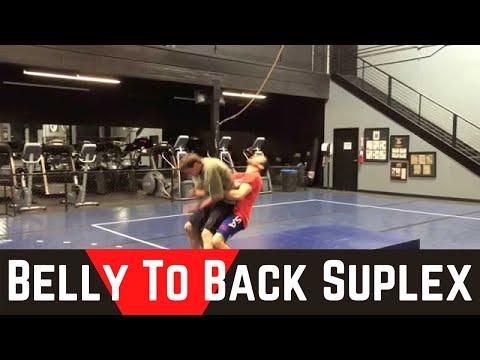
Belly to Back Suplex
0
Standard Suplex·TeachMeGrappling Coach Brian
http://teachmegrappling.com This video demonstrates how to perform a Belly to Back Suplex. Whether you are wrestling gr…
Translation: standard suplex
Standard Suplex is the foundational form of the suplex family, executed from a front body lock in which the attacker wraps both arms around the opponent's torso, lifts them off the ground by driving the hips forward and extending the back, and arches backward to throw the opponent over and onto the mat behind. [1],[2] The standard suplex is the most basic and most commonly taught suplex variant, forming the foundation upon which more advanced variations (German suplex, salto, gut wrench) are built. [2],[3] In competition, the standard suplex requires the attacker to generate sufficient lift to clear the opponent's feet from the mat and enough backward momentum to complete the arc. [3]
The standard suplex is the fundamental backward-arching body lock throw. [1]
The standard suplex is the baseline version taught in Greco-Roman wrestling. [1]
Scored regularly in Greco-Roman competition at all levels. [1]
No images yet for this technique.
Sign in to suggest an image.
http://teachmegrappling.com This video demonstrates how to perform a Belly to Back Suplex. Whether you are wrestling gr…
No instructional courses yet for this technique.
Sign in to suggest a course.
Risk of injury to the person this technique is applied to
High-amplitude backward arch throw; severe head/neck injury risk (UWW injury data)
Skill level needed to execute this technique reliably
Whether this technique is allowed under major competition rule sets
Japanese pro wrestling (プロレス) terminology; Japanese amateur wrestling terminology
Japanese pro wrestling (プロレス) terminology; Japanese amateur wrestling terminology
Standard katakana transliteration of Western martial arts terminology (外来語) — used in Japanese MMA, boxing, and BJJ communities
Standard Japanese pro wrestling terminology
hip rotation speed, core strength, lower back stability
strong hips and core, good flexibility for turning entry
hip rotators, core, quadriceps, latissimus dorsi
Every move, in any martial art, shares a few universal traits. Mix and match below to pinpoint the right tool — or compare equivalents across styles.
According to Coach Brian at TeachMeGrappling, you should arch straight back and turn out at the last moment so your opponent takes the impact instead of you. The key is to pop your hips explosively and ensure the opponent lands first before you make contact with the mat.
Coach Brian recommends progressing from a throwing dummy with a gable grip, where you focus on popping your hips and arching straight back to let the dummy hit first. Once you're confident, move to a crash pad, which Coach Brian emphasizes is better than a regular wrestling mat because it allows you to throw hard without injuring your training partners.
Your partner should keep their chin down with their head neutral—not up—and cross their arms across their chest rather than sticking them out. Coach Brian warns that if the partner's head goes up, they risk hitting the back or top of their head, and extending the arms backward can lead to dislocated elbows or shoulders.
Coach Brian explains that turning out too early prevents your opponent from landing properly on their back, which can cause them to land on their neck, shoulder, or head instead—especially problematic in competition if they don't know how to fall properly.
Coach Brian advises not to wait too long after getting behind someone, as this gives them time to establish hand control or hook your leg with theirs, which will slow down your suplex.
Standard Suplex is the foundational form of the suplex family, executed from a front body lock in which the attacker wraps both arms around the opponent's torso, lifts them off the ground by driving the hips forward and extending the back, and arches backward to throw the opponent over and onto the mat behind. The standard suplex is the most basic and most commonly taught suplex variant, forming the foundation upon which more advanced variations (German suplex, salto, gut wrench) are built.
The standard suplex has been a core technique of Greco-Roman and freestyle wrestling since the sports were formalised in the 19th century. The technique's simplicity and effectiveness have ensured its place as one of the first throws taught in wrestling programs worldwide.
IJF: legal — Legal throwing technique; IBJJF: banned — Suplex throws prohibited — throwing opponent backwards onto head/neck; UWW: legal — Legal in both freestyle and Greco-Roman; Unified MMA: legal — Legal throwing technique; ADCC: legal — Legal; FIAS Sport Sambo: legal — Legal; FIAS Combat Sambo: legal — Legal
Danger rating 8/10. Very High — high-amplitude backward arch throw; severe head/neck injury risk (UWW injury data)
The standard setup chain: Grip Setup (Kumi-kata) → Off-Balance (Kuzushi) → Entry (Tsukuri) → Execution (Kake).
Standard counters include: Lower Centre of Gravity — bend knees and drop hips to make the throw harder to execute / Block the Hip — post hand on the thrower's hip to prevent loading / Step Around — circle away from the throw direction to avoid being loaded / Grip Break — deny the thrower their preferred gripping configuration.
Common variants: Standard hip throw (full turn-in with hip below the opponent's centre of gravity); No-gi hip throw (adapted without gi grips, using overhook and collar tie); Drop hip throw (dropping to one knee to lower the fulcrum point); Combination hip throw (chaining from a failed foot technique or hand technique).
Scored regularly in Greco-Roman competition at all levels.
Top errors to watch for: Not pressing chest-to-chest before the throw — space allows the opponent to block with their hips / Locking hands with fingers interlaced instead of a proper Gable grip (palm-to-palm) — fingers can be peeled / Arching without the hip pop — the sequential hip-then-arch timing is essential / Not rotating to the side during the throw — straight-back suplex risks head/neck injury.
The Standard Suplex is also known as Sūpurekkusu, Classical Suplex, Basic Suplex Throw, Brosok Prognuvshis (бросок прогнувшись).