Standard Shuai Jiao

SubFamily

摔跤投げ技(Shuai Jiāo Nage-waza)

Chinese

Translation: standard Shuai Jiao throw

Overview

Standard Shuai Jiao represents the core throwing repertoire of shuai jiao, encompassing the fundamental trips, sweeps, hip throws, and shoulder wheels that form the basis of the art's competitive curriculum. [1],[2] These techniques are executed from the distinctive shuai jiao jacket grips — typically gripping the opponent's sleeves, collar, and back panel — with an emphasis on speed, circular footwork, and precise timing. [2],[3] Standard shuai jiao throws prioritise efficiency and clean execution, as the stand-up-only competition format demands immediate throwing ability without the option of ground follow-up. [3]

Also known as
Shuāi Jiāo (摔跤)JP[1]Chinese Wrestling Throw[2]Guō Jiā Shuāi Fǎ (国家摔法)JP[3]

History & Origin

The standard shuai jiao techniques have been transmitted through lineage-based teaching systems in China for centuries, with regional variations found in Beijing, Tianjin, Baoding, and other traditional wrestling centres. [1],[2]

Effectiveness

Standard shuai jiao techniques are the fundamental throws of the Chinese wrestling curriculum, using jacket grips and sweeps. [1]

Lineage

Standard shuai jiao techniques date to ancient Chinese wrestling practice and form the foundation of the modern competitive art. [1]

Competition Record

Standard shuai jiao techniques are scored in International Shuai Jiao Association events. [1]

Images

No images yet for this technique.

Sign in to suggest an image.

Biomechanical Mechanism

Primary ActionLoading the opponent onto the hip and rotating them over it — the hip acts as the fulcrum
Joints InvolvedAttacker's hip (fulcrum point), knees (deep bend for loading), core (rotation), opponent's centre of gravity (elevated)
Force VectorRotational — pulling and turning motion loads the opponent, then hip extension and rotation drives them over
Kuzushi (Off-balancing)Forward and upward — breaking opponent's posture forward lifts their centre of gravity onto the attacker's hip

Position & Entry

From judo gripBreak the opponent's balance forward (kuzushi), turn in with hip below their centre of gravity, and rotate to throw
From clinch (overhook or underhook)Secure inside position, turn the hips across the opponent's body, load and throw

Videos

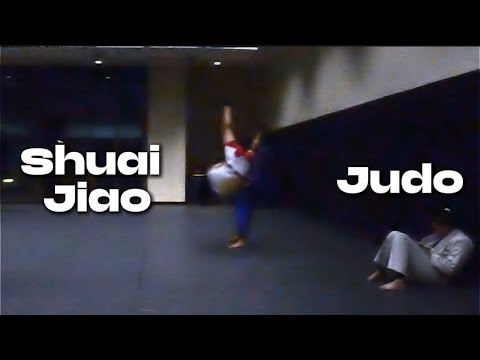
Judo x Chinese Wrestling | Shuai Jiao Tests Judo in Submission Grappling

0
Standard Shuai Jiao·Ryan Liu UMAA United Martial Arts Academy

In this crossover session, two very different foundations meet on the mats. Nathan is a green belt and the current vice

1 video

Learn This Technique

No instructional courses yet for this technique.

Sign in to suggest a course.

Ratings

Danger Rating

Risk of injury to the person this technique is applied to

5
High5/10

Chinese wrestling throws using jacket grips; controlled but powerful

Difficulty

Skill level needed to execute this technique reliably

Intermediate
Competition Legality

Whether this technique is allowed under major competition rule sets

IJF — Legal throwing technique
IJF Sport and Organisation Rules 2025, Article 27PDF
IBJJF — Legal at all belt levels
IBJJF Rules Book v6.0, June 2024PDF
UWW — Legal in both freestyle and Greco-Roman
UWW International Wrestling Rules, January 2026PDF
Unified MMA — Legal throwing technique
Unified Rules of MMA, August 2025PDF
FIAS Sport Sambo — Legal
FIAS International Sambo Competition RulesPDF
FIAS Combat Sambo — Legal
FIAS Combat Sambo RulesPDF

Training Notes

Standard shuai jiao techniques combine jacket gripping with trips, sweeps, and off-balancing footwork
Grip the da lian at the sleeve cuff and collar/back area — maintain active gripping (constantly adjusting and fighting for position)
Use circular footwork to create angles — step to the side or behind the opponent while maintaining grip control
Off-balance the opponent with pull-push grip manipulation before attempting the throw
Common shuai jiao throws include: tie (kick), bai (sweep), gou (hook), kao (lean/press) — categorised by the leg action
In competition, a clean throw where the opponent lands on their back scores the maximum
Shuai jiao emphasises the principle 'use four ounces to move a thousand pounds' — technique and timing over strength

Common Mistakes

!Relying on upper-body strength rather than footwork and timing — shuai jiao punishes muscling
!Not maintaining active grip fighting — passive grips lose in shuai jiao
!Using linear rather than circular movement — shuai jiao is built on angles and circles
!Attempting to throw without first breaking the opponent's balance through grip manipulation
!Not conditioning the legs for the constant circular footwork — shuai jiao is leg-intensive
!Ignoring the short jacket's limitations — you can't grip where there's no fabric
!Standing flat-footed — shuai jiao requires constant weight shifting and light, mobile footwork

Related Techniques

Counter Techniques

Setup Chain

1Grip Setup (Kumi-kata)establish the controlling grips needed for the throw
2Off-Balance (Kuzushi)break the opponent's balance in the throwing direction
3Entry (Tsukuri)position the body for the throw by turning, stepping, or loading
4Execution (Kake)complete the throwing action with full commitment and follow-through

Sources & References

Primary Source

Shuai Jiao (摔跤) traditional Chinese wrestling

1BookShuai Jiao (摔跤) traditional Chinese wrestling

Chinese wrestling terminology used in Japanese martial arts context

2OtherChinese Martial Arts Terminology (中国武術用語)

Original Chinese martial arts term used in Japanese context

3CitationShuai Jiao (摔跤) traditional Chinese wrestling

Chinese wrestling terminology used in Japanese martial arts context

Community

Athletics

Requires

hip rotation speed, core strength, lower back stability

Favours

strong hips and core, good flexibility for turning entry

Key muscles

hip rotators, core, quadriceps, latissimus dorsi

Sub-techniques

Frequently Asked Questions

How does the Standard Shuai Jiao work?

Standard Shuai Jiao represents the core throwing repertoire of shuai jiao, encompassing the fundamental trips, sweeps, hip throws, and shoulder wheels that form the basis of the art's competitive curriculum. These techniques are executed from the distinctive shuai jiao jacket grips — typically gripping the opponent's sleeves, collar, and back panel — with an emphasis on speed, circular footwork, and precise timing.

Where does the Standard Shuai Jiao come from?

The standard shuai jiao techniques have been transmitted through lineage-based teaching systems in China for centuries, with regional variations found in Beijing, Tianjin, Baoding, and other traditional wrestling centres.

Is the Standard Shuai Jiao legal in competition?

IJF: legal — Legal throwing technique; IBJJF: legal — Legal at all belt levels; UWW: legal — Legal in both freestyle and Greco-Roman; Unified MMA: legal — Legal throwing technique; ADCC: legal — Legal; FIAS Sport Sambo: legal — Legal; FIAS Combat Sambo: legal — Legal

How dangerous is the Standard Shuai Jiao?

Danger rating 5/10. High — Chinese wrestling throws using jacket grips; controlled but powerful

How do I set up the Standard Shuai Jiao?

The standard setup chain: Grip Setup (Kumi-kata) → Off-Balance (Kuzushi) → Entry (Tsukuri) → Execution (Kake).

How do I defend against the Standard Shuai Jiao?

Standard counters include: Lower Centre of Gravity — bend knees and drop hips to make the throw harder to execute / Block the Hip — post hand on the thrower's hip to prevent loading / Step Around — circle away from the throw direction to avoid being loaded / Grip Break — deny the thrower their preferred gripping configuration.

What are the variants of the Standard Shuai Jiao?

Common variants: Standard hip throw (full turn-in with hip below the opponent's centre of gravity); No-gi hip throw (adapted without gi grips, using overhook and collar tie); Drop hip throw (dropping to one knee to lower the fulcrum point); Combination hip throw (chaining from a failed foot technique or hand technique).

How effective is the Standard Shuai Jiao in competition?

Standard shuai jiao techniques are scored in International Shuai Jiao Association events.

What are common mistakes when doing the Standard Shuai Jiao?

Top errors to watch for: Relying on upper-body strength rather than footwork and timing — shuai jiao punishes muscling / Not maintaining active grip fighting — passive grips lose in shuai jiao / Using linear rather than circular movement — shuai jiao is built on angles and circles / Attempting to throw without first breaking the opponent's balance through grip manipulation.

What are other names for the Standard Shuai Jiao?

The Standard Shuai Jiao is also known as Shuai Jiāo Nage-waza, Shuāi Jiāo (摔跤), Chinese Wrestling Throw, Guō Jiā Shuāi Fǎ (国家摔法).