Strike & defenceLocksClose rangeFighting multiple people
Distance
CloseMiddleLong
Overview
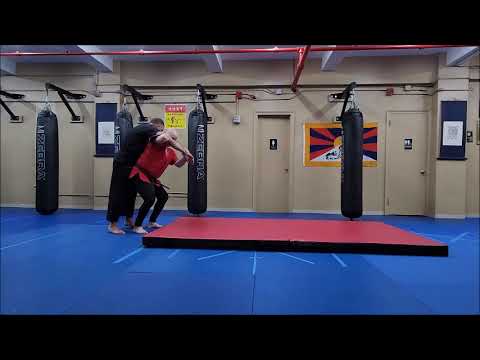
Standard Shuai Jiao Throw Technique is the fundamental throwing execution in shuai jiao in which the practitioner grips the opponent's jacket, uses circular footwork to create an angular off-balance, and applies a trip, sweep, or hip action to throw the opponent cleanly to the ground from the standing position. [1],[2] The technique emphasises the shuai jiao principles of speed, leverage, and the use of the opponent's momentum rather than brute force. [2],[3]
Also known as
Classical Shuāi Jiāo Throw[1]Standard Chinese Wrestling Throw[2]
Shuai jiao throwing technique has been refined over millennia of Chinese martial arts practice, with the modern competitive form standardised under the Chinese Wushu Association in the 20th century. [1],[2]
Country of origin· shown in random order
🇨🇳ChinaShuai Jiao, Wushu, Sanda
Effectiveness
Shuai jiao throws are effective in their competitive context, where the upright throwing mechanics and emphasis on speed produce quick, decisive victories. [1] The techniques are optimised for the shuai jiao jacket (duanda), which provides different grip options than the judo gi. [2]
Lineage
Shuai jiao (Chinese wrestling) is one of the oldest documented martial arts, with origins traditionally dated to 2697 BCE though reliably documented from the Qin dynasty (221-206 BCE). [1] The art was practised in the Chinese imperial court and military for centuries, and the modern competitive form was standardised in the 20th century. [2]
Competition Record
Standard shuai jiao techniques are used in sanctioned competition under ISJA rules. [1]
Images
No images yet for this technique.
Sign in to suggest an image.
Biomechanical Mechanism
Primary Action — Loading the opponent onto the hip and rotating them over it — the hip acts as the fulcrum
Joints Involved — Attacker's hip (fulcrum point), knees (deep bend for loading), core (rotation), opponent's centre of gravity (elevated)
Force Vector — Rotational — pulling and turning motion loads the opponent, then hip extension and rotation drives them over
Kuzushi (Off-balancing) — Forward and upward — breaking opponent's posture forward lifts their centre of gravity onto the attacker's hip
Position & Entry
From judo grip — Break the opponent's balance forward (kuzushi), turn in with hip below their centre of gravity, and rotate to throw
From clinch (overhook or underhook) — Secure inside position, turn the hips across the opponent's body, load and throw
Variants
Standard hip throw — full turn-in with hip below the opponent's centre of gravity
No-gi hip throw — adapted without gi grips, using overhook and collar tie
Drop hip throw — dropping to one knee to lower the fulcrum point
Combination hip throw — chaining from a failed foot technique or hand technique
1Grip Setup (Kumi-kata) — establish the controlling grips needed for the throw
2Off-Balance (Kuzushi) — break the opponent's balance in the throwing direction
3Entry (Tsukuri) — position the body for the throw by turning, stepping, or loading
4Execution (Kake) — complete the throwing action with full commitment and follow-through
Sources & References
Primary Source
Shuai Jiao (摔跤) traditional Chinese wrestling
1BookShuai Jiao (摔跤) traditional Chinese wrestling
Chinese wrestling terminology used in Japanese martial arts context
2OtherChinese Martial Arts Terminology (中国武術用語)
Original Chinese martial arts term used in Japanese context
3CitationShuai Jiao (摔跤) traditional Chinese wrestling
Chinese wrestling terminology used in Japanese martial arts context
Community
Athletics
Requires
hip rotation speed, core strength, lower back stability
Favours
strong hips and core, good flexibility for turning entry
Key muscles
hip rotators, core, quadriceps, latissimus dorsi
Frequently Asked Questions
Why shouldn't I rely on muscle strength to execute a Shuai Jiao throw?
Relying only on muscle assumes you're the stronger person, but a skilled person who is weak will typically defeat a strong person with no technique. Lion's Roar Kung Fu emphasizes that proper technique should work regardless of strength differences.
What's the correct body position to generate power in a shoulder throw?
Get low and underneath your opponent rather than trying to lift them up—the lower your position, the easier the throw becomes. Lion's Roar Kung Fu teaches sinking your weight, a principle shared with tai chi, to maximize leverage.
How do I position my body to avoid getting hit while executing the throw?
Maintain a more upright posture (blending Greco-Roman wrestling style) rather than bending too far forward, as bending too deeply exposes your head. As you step in, bend and move forward slightly so your opponent falls over your hips and then rotates over your shoulder.
How should I control my opponent's arm during the entry?
Roll your blade into the opponent's hand to prevent them from grabbing you, keeping your arm protected as you step across and position your hand underneath their shoulder.
How does the Standard Shuai Jiao Throw Technique work?
Standard Shuai Jiao Throw Technique is the fundamental throwing execution in shuai jiao in which the practitioner grips the opponent's jacket, uses circular footwork to create an angular off-balance, and applies a trip, sweep, or hip action to throw the opponent cleanly to the ground from the standing position. The technique emphasises the shuai jiao principles of speed, leverage, and the use of the opponent's momentum rather than brute force.
Where does the Standard Shuai Jiao Throw Technique come from?
Shuai jiao throwing technique has been refined over millennia of Chinese martial arts practice, with the modern competitive form standardised under the Chinese Wushu Association in the 20th century.
Is the Standard Shuai Jiao Throw Technique legal in competition?
IJF: legal — Legal throwing technique; IBJJF: legal — Legal at all belt levels; UWW: legal — Legal in both freestyle and Greco-Roman; Unified MMA: legal — Legal throwing technique; ADCC: legal — Legal; FIAS Sport Sambo: legal — Legal; FIAS Combat Sambo: legal — Legal
How dangerous is the Standard Shuai Jiao Throw Technique?
Danger rating 5/10. High — Chinese wrestling throws using jacket grips; controlled but powerful
How do I set up the Standard Shuai Jiao Throw Technique?
The standard setup chain: Grip Setup (Kumi-kata) → Off-Balance (Kuzushi) → Entry (Tsukuri) → Execution (Kake).
How do I defend against the Standard Shuai Jiao Throw Technique?
Standard counters include: Lower Centre of Gravity — bend knees and drop hips to make the throw harder to execute / Block the Hip — post hand on the thrower's hip to prevent loading / Step Around — circle away from the throw direction to avoid being loaded / Grip Break — deny the thrower their preferred gripping configuration.
What are the variants of the Standard Shuai Jiao Throw Technique?
Common variants: Standard hip throw (full turn-in with hip below the opponent's centre of gravity); No-gi hip throw (adapted without gi grips, using overhook and collar tie); Drop hip throw (dropping to one knee to lower the fulcrum point); Combination hip throw (chaining from a failed foot technique or hand technique).
How effective is the Standard Shuai Jiao Throw Technique in competition?
Standard shuai jiao techniques are used in sanctioned competition under ISJA rules.
What are common mistakes when doing the Standard Shuai Jiao Throw Technique?
Top errors to watch for: Attacking without first creating the angle through footwork — direct entries are easily blocked in shuai jiao / Pulling without stepping — the grip pull must be coordinated with a directional step / Using the leg technique without the grip pull — both elements are needed for a successful throw / Not following through — incomplete throws don't score; the opponent must land clearly.
What are other names for the Standard Shuai Jiao Throw Technique?
The Standard Shuai Jiao Throw Technique is also known as Shuai Jiāo Nage-waza, Classical Shuāi Jiāo Throw, Standard Chinese Wrestling Throw.