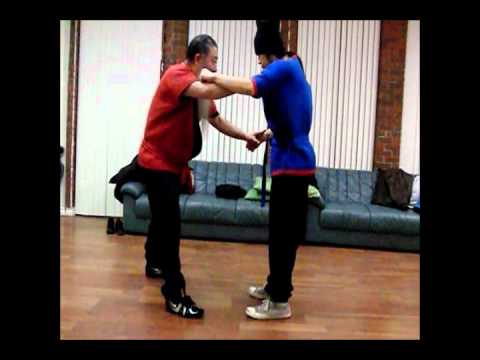
Shuai Jiao - Gaibu Throw
0
Shuai Jiao Throw·ickfa
International Chinese Kung Fu Association, Toronto. Master Zhao, Instructor.
Translation: Shuai Jiao throwing technique
Shuai Jiao Throw is the family of throwing techniques from shuai jiao, the traditional Chinese wrestling art that is widely regarded as one of the oldest martial arts in the world. [1],[2] Shuai jiao throws are executed from standing grappling positions using the traditional jacket (da lian), and emphasise rapid entry, precise footwork, and angular off-balancing to uproot the opponent and throw them to the ground. [2],[3] Unlike judo, shuai jiao competition traditionally does not include ground fighting — bouts are won exclusively by throws, making the throwing art exceptionally refined. [3],[4] Shuai jiao techniques include trips, sweeps, hip throws, and shoulder throws, many of which bear resemblance to judo techniques but are executed with distinctive Chinese grip patterns and entry angles. [4]
Shuai jiao's origins trace back at least 4,000 years to the ancient Chinese wrestling art of jiao di, which was practised during the Zhou Dynasty. [1],[2] Over centuries, it evolved through military training, imperial court competitions, and regional folk wrestling traditions into the modern competitive format governed by the Chinese Wushu Association and international shuai jiao federations. [2],[3] Many historians consider shuai jiao to be a direct ancestor of judo, as Japanese jujutsu traditions were influenced by Chinese martial arts transmitted through cultural exchange. [3],[4]
Shuai jiao has its own international competition circuit under the International Shuai Jiao Association. [1]
No images yet for this technique.
Sign in to suggest an image.
International Chinese Kung Fu Association, Toronto. Master Zhao, Instructor.
No instructional courses yet for this technique.
Sign in to suggest a course.
Risk of injury to the person this technique is applied to
Chinese wrestling throws using jacket grips; controlled but powerful
Skill level needed to execute this technique reliably
Whether this technique is allowed under major competition rule sets
Shuai Jiao (摔跤) traditional Chinese wrestling
Chinese wrestling terminology used in Japanese martial arts context
Original Chinese martial arts term used in Japanese context
Chinese wrestling terminology used in Japanese martial arts context
hip rotation speed, core strength, lower back stability
strong hips and core, good flexibility for turning entry
hip rotators, core, quadriceps, latissimus dorsi
Every move, in any martial art, shares a few universal traits. Mix and match below to pinpoint the right tool — or compare equivalents across styles.
Shuai jiao appears in 10 passages across 8 books. KYOKUSHINJUTSU documents it as 'the Chinese national free-style wrestling' and traces it as 'the first phase of the historical genesis of ju jutsu.' One of the oldest documented wrestling systems — pre-dates judo by centuries. (8 books; KYOKUSHINJUTSU)
Shuai Jiao Throw is the family of throwing techniques from shuai jiao, the traditional Chinese wrestling art that is widely regarded as one of the oldest martial arts in the world. Shuai jiao throws are executed from standing grappling positions using the traditional jacket (da lian), and emphasise rapid entry, precise footwork, and angular off-balancing to uproot the opponent and throw them to the ground.
Shuai jiao's origins trace back at least 4,000 years to the ancient Chinese wrestling art of jiao di, which was practised during the Zhou Dynasty. Over centuries, it evolved through military training, imperial court competitions, and regional folk wrestling traditions into the modern competitive format governed by the Chinese Wushu Association and international shuai jiao federations.
IJF: legal — Legal throwing technique; IBJJF: legal — Legal at all belt levels; UWW: legal — Legal in both freestyle and Greco-Roman; Unified MMA: legal — Legal throwing technique; ADCC: legal — Legal; FIAS Sport Sambo: legal — Legal; FIAS Combat Sambo: legal — Legal
Danger rating 5/10. High — Chinese wrestling throws using jacket grips; controlled but powerful
The standard setup chain: Grip Setup (Kumi-kata) → Off-Balance (Kuzushi) → Entry (Tsukuri) → Execution (Kake).
Standard counters include: Lower Centre of Gravity — bend knees and drop hips to make the throw harder to execute / Block the Hip — post hand on the thrower's hip to prevent loading / Step Around — circle away from the throw direction to avoid being loaded / Grip Break — deny the thrower their preferred gripping configuration.
Common variants: Standard hip throw (full turn-in with hip below the opponent's centre of gravity); No-gi hip throw (adapted without gi grips, using overhook and collar tie); Drop hip throw (dropping to one knee to lower the fulcrum point); Combination hip throw (chaining from a failed foot technique or hand technique).
Shuai jiao has its own international competition circuit under the International Shuai Jiao Association.
Top errors to watch for: Gripping shuai jiao's short jacket like a judo gi — the da lian requires different hand positions and depths / Using strength-based judo entries — shuai jiao rewards finesse, timing, and footwork over power / Ignoring the circular footwork that defines shuai jiao — linear entries don't work in this system / Attempting to go to the ground after a throw — shuai jiao is standing only.
The Shuai Jiao Throw is also known as Shuai Jiāo Nage-waza, Chinese wrestling throws, Shuai Jiao, Chinese jacket wrestling.