Engagement and Positioning Fundamentals
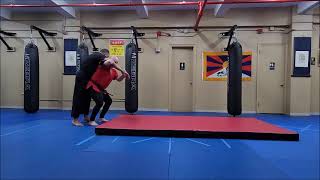
The instructor emphasizes the importance of maintaining realistic positioning rather than relying on cooperative drilling. Practitioners are encouraged to focus on proper mechanics and weight distribution from the initial contact point, establishing a solid base before executing techniques.
Leg and Upper Body Coordination
The instructor demonstrates the integration of leg positioning with upper body control. Proper leg placement and timing are identified as critical elements for executing effective takedowns and transitions in Chinese wrestling.
Defensive Positioning and Counter-Opportunities
When an opponent executes a technique, maintaining awareness of resulting positional vulnerabilities becomes essential. The instructor notes that certain defensive positions can paradoxically create opportunities for the defending wrestler to exploit the attacker's committed stance.
Controlled Dropping Mechanics
The instructor demonstrates a controlled dropping technique with emphasis on proper body positioning during the descent. The movement requires coordination between upper and lower body to execute safely and effectively against resistance.
Pressure Application and Timing
Proper timing of pressure application is highlighted as more important than raw force. The instructor emphasizes maintaining consistent downward and rotational pressure while executing transitions, allowing the technique to develop rather than forcing it prematurely.
Hand Positioning and Body Mechanics
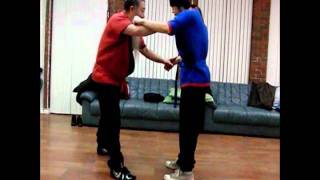
Correct hand placement relative to the opponent's body structure determines execution success. The instructor refines the student's hand positioning and demonstrates how subtle adjustments in placement enable more effective control and smoother transitions.
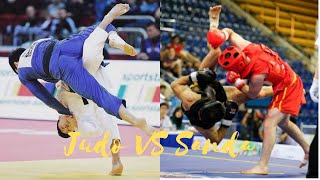
Judo x Chinese Wrestling | Shuai Jiao Tests Judo in Submission Grappling
Key Takeaways
- •Engagement and Positioning Fundamentals
- •Leg and Upper Body Coordination
- •Defensive Positioning and Counter-Opportunities
- •Controlled Dropping Mechanics
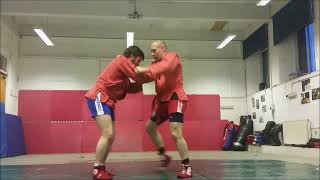
In this crossover session, two very different foundations meet on the mats. Nathan is a green belt and the current vice president of the ASU Judo Club. His background is centered on competition judo, focusing on classic grips, posture discipline, and the standard tactical approach used under IJF rulesets. He is not used to relying on leg attacks, so stepping into this format challenges the habits he has built in traditional shiai environments. Facing him is Ryan, the co president of the ASU Sanda Club, a Sanda National Champion and Pan American Champion. His skill set is unusually broad. He trained in Shanxi style Shuai Jiao without the jacket and in Chin Na under Master Liu Hanren in Taiwan. More recently, he has been developing his jacketed Shuai Jiao under Sifu Yang Pan of Beijing while training in Arizona. This gives him access to angles, entries, and footwork patterns that many judoka rarely encounter. The session brings their backgrounds into a submission grappling setting, where each athlete must adjust and adapt. Grips are less predictable, leg access is greater, and the path from takedown to finish demands a different rhythm. It becomes a genuine test of structure, timing, and transitional control, as classical judo and Chinese wrestling meet in a format where neither holds every advantage. It is an opportunity to see how these two systems collide, blend, and evolve in real time.
Frequently Asked Questions
What does this video teach about standard shuai jiao?
This video covers engagement and positioning fundamentals, leg and upper body coordination, defensive positioning and counter-opportunities. It provides detailed instruction from Ryan Liu UMAA United Martial Arts Academy.
How long does it take to learn standard shuai jiao?
The basic mechanics can be understood in a single session, but developing reliable execution requires consistent drilling over weeks of practice. This 6-part breakdown helps structure your training by isolating each phase of the technique.
What are the key details for finishing standard shuai jiao?
Proper timing of pressure application is highlighted as more important than raw force. The instructor emphasizes maintaining consistent downward and rotational pressure while executing transitions, allowing the technique to develop rather than forcing it prematurely.