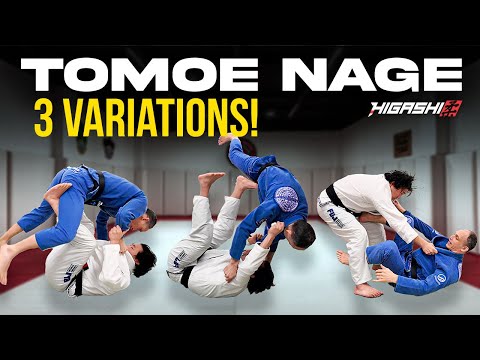
Tomoe Nage Secrets!! – 3 Variations | #judo #nyc #shintarohigashi
0
Standard Tomoe Nage·Shintaro Higashi
Tomoe Nage is one of the most effective sacrifice throws in Judo and BJJ—but what happens when your opponent doesn’t go …
Translation: circle throw
Standard Tomoe Nage is the textbook execution of the circle throw in which tori grips uke's sleeve and lapel, steps one foot between uke's legs, sits down while placing the ball of the other foot on uke's lower abdomen, and extends the leg forcefully while pulling uke forward and overhead. [1],[2] Uke travels in a complete circular arc, landing on their back, while tori follows through to establish a top position. [2],[3]
Tomoe nage is highly effective as a surprise attack, catching opponents who are leaning forward with a technique that uses their own forward momentum to launch them overhead. [1] In BJJ and submission grappling, tomoe nage is valued as both a throw and a guard pull that can transition directly into submissions. [2] The technique carries moderate risk as a failed attempt can leave the thrower on their back in a disadvantageous position. [3]
No images yet for this technique.
Sign in to suggest an image.
Tomoe Nage is one of the most effective sacrifice throws in Judo and BJJ—but what happens when your opponent doesn’t go …
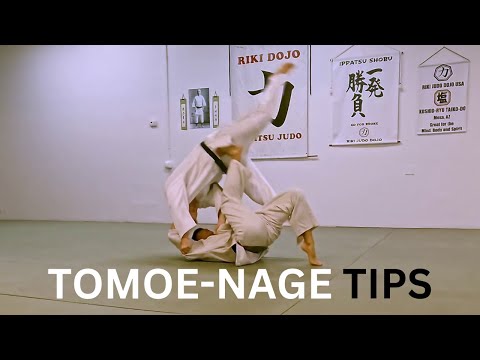
Riki sensei explained tomoe-nage (巴投 - circle throw) during judo class on 4-24-2023. 0:00 definition 0:19 foot details…
Explore 10 different variations of the Tomoe Nage with Shintaro, breaking down each technique for better understanding a…
Standard tomoe nage is a rear sacrifice throw (ama sutemiwaza) in which the thrower abandons upright posture and propels the opponent backward and over their body using foot placement and controlled descent. According to Riki Judo Dojo, the technique's name derives from three crescent shapes created by foot positioning, and execution requires pointing the toes to direct the opponent's trajectory rather than lifting straight upward. Proper hand placement above the shoulders maintains balance during descent, and the throw demands controlled lowering—audible contact indicates poor technique. The foot placement is critical: positioning the sole against the opponent's abdomen rather than shallow contact generates maximum kuzushi and throwing power. Riki Judo Dojo emphasizes that proficiency demands extensive repetition (approximately 1,000 practice throws) and that uke (receiver) positioning and footwork are defensive prerequisites. Shintaro Higashi presents multiple directional variations: yoko tomoe nage (side versions toward sleeve and collar), shio tomoe nage (straight back), and cross-body variants, each with distinct entry angles and hip positioning. Higashi stresses toe alignment to the opponent's belt midline and foot placement on the hip or collar side depending on direction. Both instructors agree that foot placement height and angle fundamentally determine throw effectiveness. For Brazilian Jiu-Jitsu applications, Higashi notes that failed attempts leave the thrower in advantageous positions: guard position with established grips, ashigurami leg entanglement opportunities, or sweep entries. The technique bridges judo and BJJ contexts effectively.
Synthesized from 3 instructors
No instructional courses yet for this technique.
Sign in to suggest a course.
Risk of injury to the person this technique is applied to
Ma-Sutemi-Waza; tori falls backward pulling uke over; spinal compression risk
Skill level needed to execute this technique reliably
Whether this technique is allowed under major competition rule sets
Kodokan Judo — Official Nage-waza Classification
Traditional Judo throwing technique terminology (Kodokan Institute)
Official Kodokan ground technique classification system
Standard Japanese martial arts terminology (kanji/hiragana)
Established Japanese martial arts naming convention — native Japanese term (和語/漢語)
Traditional Judo throwing technique terminology (Kodokan Institute)
commitment, timing, body weight manipulation, falling skill
heavier build (body weight drives the throw), good ukemi
core rotators, hip flexors, abdominals
You should point your toes outward rather than lifting your opponent straight up, which allows them to come over you in the correct direction. Riki Judo Dojo emphasizes this positioning is critical to the throw's mechanics.
Stepping is part of your defense mechanism because it allows you to move and adjust position. Without the step, you become locked in place and unable to move, which limits your options in competition.
In jiu-jitsu, even if tomoe nage fails completely, you typically end up in a distance guard position on your back with grips maintained, so the technique still puts you in a functional position to continue fighting. Shintaro Higashi notes this makes it particularly valuable for BJJ practitioners.
Yes—Shintaro Higashi teaches three main variations: two side tomoe nages and one straight back tomoe nage, which can be mixed together and combined to keep opponents guessing about your direction of attack.
Standard Tomoe Nage is the textbook execution of the circle throw in which tori grips uke's sleeve and lapel, steps one foot between uke's legs, sits down while placing the ball of the other foot on uke's lower abdomen, and extends the leg forcefully while pulling uke forward and overhead. Uke travels in a complete circular arc, landing on their back, while tori follows through to establish a top position.
The standard tomoe nage is taught as a core technique in the Kodokan gokyo no waza and has been demonstrated in judo shiai since the sport's earliest competitive era.
IJF: legal — Legal throwing technique; IBJJF: legal — Legal at all belt levels; UWW: legal — Legal in both freestyle and Greco-Roman; Unified MMA: legal — Legal throwing technique; ADCC: legal — Legal; FIAS Sport Sambo: legal — Legal; FIAS Combat Sambo: legal — Legal
Danger rating 6/10. High — Ma-Sutemi-Waza; tori falls backward pulling uke over; spinal compression risk
The standard setup chain: Grip Setup (Kumi-kata) → Off-Balance (Kuzushi) → Entry (Tsukuri) → Execution (Kake).
Standard counters include: Lower Centre of Gravity — bend knees and drop hips to make the throw harder to execute / Grip Break — deny the thrower their preferred gripping configuration / Stiff-Arm — maintain distance with straight arms to prevent the entry.
Common variants: Rear sacrifice (falling backward while pulling the opponent over); Side sacrifice (falling to the side to project the opponent laterally); Rolling sacrifice (combining a roll with the sacrifice throw for rotation); Counter sacrifice (using the opponent's forward pressure as the driving force).
Tomoe nage is regularly scored at IJF World Tour events, particularly by fighters known for unconventional attacking styles. The technique has seen increased usage in modern judo as fighters seek alternatives to restricted leg-grab techniques.
Top errors to watch for: Stepping too far away from uke before sitting — you can't reach their hip with your foot / Placing the foot and then pausing before falling back — the sit and foot placement must be simultaneous / Landing flat on your back — roll through your shoulder to maintain momentum / Not pulling uke over you with the arms — the leg alone is insufficient.
The Standard Tomoe Nage is also known as Tomoe Nage, Classical Circle Throw, Standard Stomach Throw, Kihon Tomoe Nage.