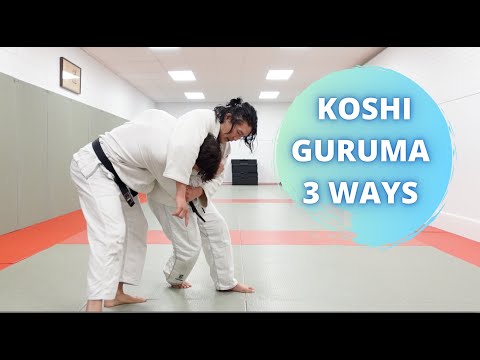
Standard Koshi Guruma

Genus

腰車(Koshi Guruma)

Traditional

Translation: hip wheel

Overview

Standard Koshi Guruma executes the classical hip wheel where the thrower turns in, wraps the throwing arm around the opponent's neck, loads the opponent onto the hip, and rotates forward to wheel the opponent over the hip and to the mat. [1] The neck grip controls the opponent's head throughout the throw, preventing them from posturing up and escaping. [1],[2] The throwing motion combines hip rotation with the arm pulling the opponent's head and upper body forward and over the fulcrum point of the hip. [2],[3]

Also known as
Classical Hip Wheel[1]Standard Hip Wheel Throw[2]Kihon Koshi GurumaJP[3]
Used in

History & Origin

The standard form of koshi guruma has been part of the Kodokan curriculum since the original gokyo, taught as a fundamental hip technique alongside o-goshi. [1] The technique is widely practised in judo schools worldwide as a core koshi-waza technique. [2],[3]

Effectiveness

Koshi guruma (hip wheel) is effective because the arm wrapped around the opponent's neck provides strong rotational control, making it difficult for the opponent to posture up and resist the throw. [1] The neck control creates a tighter connection than the waist grip of o goshi. [2]

Lineage

Koshi guruma was included in the Kodokan gokyo no waza as a koshi-waza technique. [1] The neck-wrapping grip distinguishes it from other hip throws in the Kodokan classification. [2]

Competition Record

The standard koshi guruma is a regular technique in IJF competition. [1]

Images

No images yet for this technique.

Sign in to suggest an image.

Biomechanical Mechanism

Primary ActionLoading the opponent onto the hip and rotating them over it — the hip acts as the fulcrum
Joints InvolvedAttacker's hip (fulcrum point), knees (deep bend for loading), core (rotation), opponent's centre of gravity (elevated)
Force VectorRotational — pulling and turning motion loads the opponent, then hip extension and rotation drives them over
Kuzushi (Off-balancing)Forward and upward — breaking opponent's posture forward lifts their centre of gravity onto the attacker's hip

Position & Entry

From judo gripBreak the opponent's balance forward (kuzushi), turn in with hip below their centre of gravity, and rotate to throw
From clinch (overhook or underhook)Secure inside position, turn the hips across the opponent's body, load and throw

Variants

Standard hip throwfull turn-in with hip below the opponent's centre of gravity
No-gi hip throwadapted without gi grips, using overhook and collar tie
Drop hip throwdropping to one knee to lower the fulcrum point
Combination hip throwchaining from a failed foot technique or hand technique

Videos

Koshi Guruma 3 ways

0
Standard Koshi Guruma·Shintaro Higashi·Added by Admin

Koshi Guruma 3 ways Support my dojo which has been hit hard by the pandemic. https://www.gofundme.com/f/support-kokushi

1 video

Learn This Technique

No instructional courses yet for this technique.

Sign in to suggest a course.

Ratings

Danger Rating

Risk of injury to the person this technique is applied to

6
High6/10

O-Goshi and variants; high amplitude hip throw with significant impact (Kano 1986)

Difficulty

Skill level needed to execute this technique reliably

Beginner
Competition Legality

Whether this technique is allowed under major competition rule sets

IJF — Legal throwing technique
IJF Sport and Organisation Rules 2025, Article 27PDF
IBJJF — Legal at all belt levels
IBJJF Rules Book v6.0, June 2024PDF
UWW — Legal in both freestyle and Greco-Roman
UWW International Wrestling Rules, January 2026PDF
Unified MMA — Legal throwing technique
Unified Rules of MMA, August 2025PDF
FIAS Sport Sambo — Legal
FIAS International Sambo Competition RulesPDF
FIAS Combat Sambo — Legal
FIAS Combat Sambo RulesPDF

Training Notes

Grip the collar or overhook uke's far shoulder, then step in and wrap the arm around the back of their neck
Your forearm should rest across the back of uke's neck, not against the throat
Enter with a deep step — your hip must be below uke's hip, same as o goshi
Pull uke's sleeve strongly forward-and-down while wrapping their head to break balance
Straighten the legs and rotate to complete the throw — uke wheels over your hip guided by the head control
The head wrap gives you superior control over uke's posture compared to waist-grip throws
In competition, koshi guruma scores frequently against opponents who stiff-arm to create distance

Common Mistakes

!Wrapping across the throat — this is illegal in judo and dangerous; aim for the nape of the neck
!Entering half-turned so the neck wrap has no leverage — you must turn fully
!Not controlling the sleeve with the other hand — without hikite, uke can post an arm and block
!Trying to throw with arm strength instead of hip-and-leg drive
!Leaving your hips too high — you must squat below uke's centre of gravity
!Leaning backward during the throw — maintain forward rotation
!Releasing the head control too early, allowing uke to sprawl or turn out

Related Techniques

Counter Techniques

Setup Chain

1Grip Setup (Kumi-kata)establish the controlling grips needed for the throw
2Off-Balance (Kuzushi)break the opponent's balance in the throwing direction
3Entry (Tsukuri)position the body for the throw by turning, stepping, or loading
4Execution (Kake)complete the throwing action with full commitment and follow-through

Sources & References

Primary Source

Kodokan Judo — Official Nage-waza Classification

1BookKodokan Judo — Official Nage-waza Classification

Traditional Judo throwing technique terminology (Kodokan Institute)

Official Kodokan ground technique classification system

Standard Japanese martial arts terminology (kanji/hiragana)

4OtherJapanese Martial Arts Standard Terminology (武道用語)

Established Japanese martial arts naming convention — native Japanese term (和語/漢語)

5CitationKodokan Judo — Official Nage-waza Classification

Traditional Judo throwing technique terminology (Kodokan Institute)

Community

Athletics

Requires

hip rotation speed, core strength, lower back stability

Favours

strong hips and core, good flexibility for turning entry

Key muscles

hip rotators, core, quadriceps, latissimus dorsi

Frequently Asked Questions

What happens if my opponent tries to bail or escape once I've started a Koshi Guruma?

Once you're committed to the technique, you must immediately bring his head forward—if he's able to bring his head back and drop his hips, he can escape and take you straight back. Shintaro Higashi emphasizes that controlling the head forward is critical to prevent this counter.

Why is the initial pull so important in setting up Koshi Guruma?

The pull helps you take your opponent forward first, which commits him toward your technique; once you've pulled him forward and hug his head, it becomes very difficult for him to retract his head and escape, allowing you to elevate and throw him over.

What's the difference between a standard Koshi Guruma and a wider hip version?

The wider hip version involves throwing your hips all the way across with a bigger arching motion, which is harder to counter; this variation is more commonly seen in wrestling and creates more distance, making it difficult for your opponent to chop around your waist.

How does the Standard Koshi Guruma work?

Standard Koshi Guruma executes the classical hip wheel where the thrower turns in, wraps the throwing arm around the opponent's neck, loads the opponent onto the hip, and rotates forward to wheel the opponent over the hip and to the mat. The neck grip controls the opponent's head throughout the throw, preventing them from posturing up and escaping.

Where does the Standard Koshi Guruma come from?

The standard form of koshi guruma has been part of the Kodokan curriculum since the original gokyo, taught as a fundamental hip technique alongside o-goshi. The technique is widely practised in judo schools worldwide as a core koshi-waza technique.

Is the Standard Koshi Guruma legal in competition?

IJF: legal — Legal throwing technique; IBJJF: legal — Legal at all belt levels; UWW: legal — Legal in both freestyle and Greco-Roman; Unified MMA: legal — Legal throwing technique; ADCC: legal — Legal; FIAS Sport Sambo: legal — Legal; FIAS Combat Sambo: legal — Legal

How dangerous is the Standard Koshi Guruma?

Danger rating 6/10. High — O-Goshi and variants; high amplitude hip throw with significant impact (Kano 1986)

How do I set up the Standard Koshi Guruma?

The standard setup chain: Grip Setup (Kumi-kata) → Off-Balance (Kuzushi) → Entry (Tsukuri) → Execution (Kake).

How do I defend against the Standard Koshi Guruma?

Standard counters include: Lower Centre of Gravity — bend knees and drop hips to make the throw harder to execute / Block the Hip — post hand on the thrower's hip to prevent loading / Step Around — circle away from the throw direction to avoid being loaded / Grip Break — deny the thrower their preferred gripping configuration.

What are the variants of the Standard Koshi Guruma?

Common variants: Standard hip throw (full turn-in with hip below the opponent's centre of gravity); No-gi hip throw (adapted without gi grips, using overhook and collar tie); Drop hip throw (dropping to one knee to lower the fulcrum point); Combination hip throw (chaining from a failed foot technique or hand technique).

How effective is the Standard Koshi Guruma in competition?

The standard koshi guruma is a regular technique in IJF competition.

What are common mistakes when doing the Standard Koshi Guruma?

Top errors to watch for: Wrapping across the throat — this is illegal in judo and dangerous; aim for the nape of the neck / Entering half-turned so the neck wrap has no leverage — you must turn fully / Not controlling the sleeve with the other hand — without hikite, uke can post an arm and block / Trying to throw with arm strength instead of hip-and-leg drive.

What are other names for the Standard Koshi Guruma?

The Standard Koshi Guruma is also known as Koshi Guruma, Classical Hip Wheel, Standard Hip Wheel Throw, Kihon Koshi Guruma.