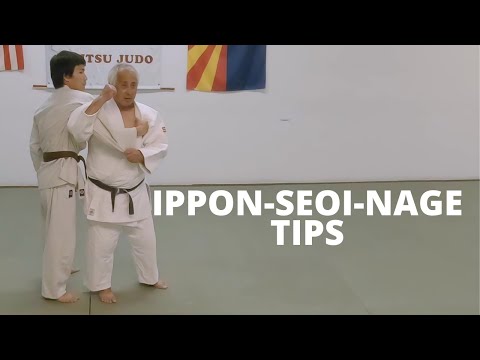
Ippon-Seoi-Nage Tips | Riki Judo Dojo
0
Ippon Seoi Nage·Riki Judo Dojo·Added by Admin
Riki sensei explained ippon-seoi-nage (一本背負投 - one-armed shoulder throw) during judo class on 3-31-2022. 0:00 Te-waza …
Translation: one-arm shoulder throw
Ippon Seoi Nage (single-arm back-carrying throw) is the most widely practised seoi-nage variant, in which the thrower releases the lapel grip, reaches under the opponent's arm to secure it with the throwing arm, turns in, and throws the opponent over the shoulder using the trapped arm as the primary control point. [1] The 'ippon' (one-arm) designation refers to the single arm that secures the opponent's arm, distinguishing it from morote (two-handed) versions. [1],[2] The technique requires explosive rotation, a deep entry under the opponent's centre of gravity, and powerful pulling action with the sleeve hand to complete the throw. [2],[3]
Ippon seoi nage has been a staple of judo competition since the early Kodokan era, particularly associated with lighter-weight fighters who exploit speed and low entry to throw larger opponents. [1] The technique was a signature throw of Toshihiko Koga, whose explosive ippon seoi-nage won him the 1991 World Championship and 1992 Olympic gold medal. [2],[3]
Ippon seoi nage is one of the highest-percentage throwing techniques in judo, particularly effective for lighter-weight fighters who can exploit their lower centre of gravity and speed to turn under taller opponents. [1] Inokuma and Sato describe it as the quintessential forward throw that, when executed with explosive entry and deep kuzushi, produces clean ippon even against resistant opponents. [2] The one-arm grip provides excellent control over the opponent's arm, preventing escape during the throwing arc. [3]
Ippon seoi nage has been part of the Kodokan judo curriculum since the early 20th century, classified under te-waza (hand techniques). [1] The technique has been refined through successive generations of competitive judoka, particularly at Japanese universities where seoi nage specialisation is common. [2]
Ippon seoi nage is the most frequently scored forward throw at Olympic Games and World Championships in the lighter weight categories (60-73 kg). [1] Toshihiko Koga (JPN) won the 1991 World Championship and 1992 Olympic gold at 71 kg with an explosive ippon seoi nage that became one of the most famous throws in judo history. [2] Tadahiro Nomura (JPN) used ippon seoi nage as a core weapon in winning three consecutive Olympic gold medals (1996, 2000, 2004) at 60 kg. [3]
No images yet for this technique.
Sign in to suggest an image.
Riki sensei explained ippon-seoi-nage (一本背負投 - one-armed shoulder throw) during judo class on 3-31-2022. 0:00 Te-waza …
No instructional courses yet for this technique.
Sign in to suggest a course.
Risk of injury to the person this technique is applied to
Seoi-Nage family; high amplitude with rotation over tori's shoulder (Kano 1986)
Skill level needed to execute this technique reliably
Whether this technique is allowed under major competition rule sets
Kodokan Judo — Official Nage-waza Classification
Traditional Judo throwing technique terminology (Kodokan Institute)
Official Kodokan ground technique classification system
Standard Japanese martial arts terminology (kanji/hiragana)
Established Japanese martial arts naming convention — native Japanese term (和語/漢語)
Traditional Judo throwing technique terminology (Kodokan Institute)
explosive turning speed, arm pulling power, deep level change
shorter stature for getting under the opponent, strong back
deltoids, trapezius, quadriceps, core
Ippon seoi nage appears in 25 passages across 6 books in our corpus. Toshihiko Koga's one-arm shoulder throw at the 1992 Barcelona Olympics is considered one of the greatest throws in judo history. The technique is the most commonly attempted throw variation in international judo competition. (Kano, Kodokan Judo; Black Belt magazine archives; IJF competition data)
You want to pull slightly up and forward rather than down, as pulling down forces you to get much lower under your opponent. Riki Judo Dojo emphasizes this is especially effective if you're shorter than your opponent.
You should step with both feet inside your opponent's stance rather than spreading your feet wide, because a wide stance allows them to piggyback you and sink your weight. Riki Judo Dojo explains that keeping your feet positioned this way maintains your strength and leverage.
You need to bend your knees and get below your opponent's center of gravity, as the lower you go, the less of your body blocks them from rotating over your back. Keeping your heels up off the mat helps maintain this low position.
Yes, you can execute Ippon Seoi Nage from either side with the same grip by using either an open hand or fist, allowing you to read your opponent's feet and choose your direction dynamically.
Ippon Seoi Nage (single-arm back-carrying throw) is the most widely practised seoi-nage variant, in which the thrower releases the lapel grip, reaches under the opponent's arm to secure it with the throwing arm, turns in, and throws the opponent over the shoulder using the trapped arm as the primary control point. The 'ippon' (one-arm) designation refers to the single arm that secures the opponent's arm, distinguishing it from morote (two-handed) versions.
Ippon seoi nage has been a staple of judo competition since the early Kodokan era, particularly associated with lighter-weight fighters who exploit speed and low entry to throw larger opponents. The technique was a signature throw of Toshihiko Koga, whose explosive ippon seoi-nage won him the 1991 World Championship and 1992 Olympic gold medal.
IJF: legal — Legal throwing technique; IBJJF: legal — Legal at all belt levels; UWW: legal — Legal in both freestyle and Greco-Roman; Unified MMA: legal — Legal throwing technique; ADCC: legal — Legal; FIAS Sport Sambo: legal — Legal; FIAS Combat Sambo: legal — Legal
Danger rating 6/10. High — Seoi-Nage family; high amplitude with rotation over tori's shoulder (Kano 1986)
The standard setup chain: Grip Setup (Kumi-kata) → Off-Balance (Kuzushi) → Entry (Tsukuri) → Execution (Kake).
Standard counters include: Lower Centre of Gravity — bend knees and drop hips to make the throw harder to execute / Grip Break — deny the thrower their preferred gripping configuration / Stiff-Arm — maintain distance with straight arms to prevent the entry.
Common variants: Morote seoi nage (two-handed shoulder throw with both hands gripping); Ippon seoi nage (one-arm shoulder throw loading the arm over the shoulder); Drop seoi nage (dropping to the knees for a lower entry point); Korean-style shoulder throw (modified entry with deeper level change).
Ippon seoi nage is the most frequently scored forward throw at Olympic Games and World Championships in the lighter weight categories (60-73 kg). Toshihiko Koga (JPN) won the 1991 World Championship and 1992 Olympic gold at 71 kg with an explosive ippon seoi nage that became one of the most famous throws in judo history.
Top errors to watch for: Not driving the arm deep enough under the opponent's armpit — the arm must lock the opponent's arm over your shoulder / Entering with hips too high — the deep hip drop is what makes the lift possible / Not trapping the opponent's arm securely — they pull it free and you have no control / Bending forward instead of sitting back against the opponent.
The Ippon Seoi Nage is also known as One-Arm Shoulder Throw, Single-Arm Back Carry Throw, Ippon Seoi Nage, One-Point Shoulder Throw.