Introduction to Ippon Seoi Nage
Ippon Seoi Nage, meaning "one arm shoulder throw," forms one of judo's foundational techniques. The instruction begins with an overview of this essential throwing technique and its variations across different schools.
Two Fundamental Variations
Ippon Seoi Nage divides into two primary categories: te waza (hand technique), also known as kata seoi, and koshi waza (hip technique), known as koshi seoi. While both techniques involve pulling the opponent over the shoulder, the koshi variation requires lifting the opponent onto the hip first, distinguishing it from the hand-only method.
Maintaining Proper Positioning and Angle
The instructor emphasizes staying below the opponent's center of gravity throughout execution, whether using hand or hip techniques. The direction of pull—slightly upward and forward rather than downward—determines the throw's effectiveness and must be adjusted based on relative heights between partners.
Proper Grip and Arm Positioning
The gripping hand must lock the opponent's arm securely in the crook of the elbow, with the grip brought directly to the shoulder. This positioning creates a mechanical advantage for pulling the opponent forward and prevents gaps that compromise the throw's execution.
Hand Positioning for Defense and Counters
The non-gripping hand must remain free and positioned defensively, enabling rapid response to opponent attacks and execution of counter-techniques. Locking this hand underneath the body prevents defensive options and leaves the thrower vulnerable to counter-attacks.
Footwork and Entry Mechanics
Proper footwork requires stepping along an imaginary line extending from the opponent's toes, positioning both feet inside the opponent's stance. This inside positioning provides mechanical advantage for lifting and prevents the opponent from using a piggyback defense.
Lower Body Mechanics and Weight Distribution
The thrower must bend deeply at the knees while maintaining heels elevated off the mat, creating the mechanical advantage necessary for lifting. This positioning lowers the thrower's center of gravity below the opponent's, facilitating the lifting phase of the throw.
Sequential Execution and Repetitive Training
The complete sequence involves placing the opponent on the shoulder, executing a deep knee bend with heels raised, then driving upward and forward. Repetitive practice of this fundamental sequence—performed forward, backward, and sideways—develops the muscle memory and timing essential for effective execution.
Ippon-Seoi-Nage Tips | Riki Judo Dojo
Key Takeaways
- •Introduction to Ippon Seoi Nage
- •Two Fundamental Variations
- •Maintaining Proper Positioning and Angle
- •Proper Grip and Arm Positioning
Riki sensei explained ippon-seoi-nage (一本背負投 - one-armed shoulder throw) during judo class on 3-31-2022. 0:00 Te-waza vs. koshi-waza 0:44 Riki sensei's first throw 1:04 Hikite details 1:31 Tsurite details 2:24 Left or right? 2:34 Train the hand to defend 3:17 Moving uchikomi 3:27 Where to step 3:52 Make sure the feet are good neighbors 4:02 Bend your knees 4:20 Don't let your heels touch the mat 5:10 Training at Isao Okano's Sekijuku Riki sensei began Judo in Okinawa and is a Shichidan with over 56 years of study, practice, competition and teaching. He competed for 25 years at the local, national and international levels. A few of the great Judoka Riki sensei has studied and practiced with include: Kotani, Daigo, Ito, Inokuma, Okano, Kimura, Kaminaga and Nakatani. See Riki sensei teach every Monday, Wednesday, Thursday and Friday evening at 535 W. Iron Ave, Mesa, AZ 85210. Youth classes are 6 - 6:55 PM, adult classes are 7:00 - 8:30 PM. For more info, please visit rikidojousa.com The purpose of this YouTube channel is to pass on the original, traditional, authentic Kodokan Judo that Riki sensei loves so much. Riki sensei's students maintain this YouTube channel (and are responsible for any errors), but you can find more of his thoughts at the Riki Judo Dojo Facebook page: https://www.facebook.com/Riki-Judo-Dojo-USA-194351210607759 9
Related Techniques
Frequently Asked Questions
What does this video teach about ippon seoi nage?
This video covers introduction to ippon seoi nage, two fundamental variations, maintaining proper positioning and angle. It provides detailed instruction from Riki Judo Dojo.
How long does it take to learn ippon seoi nage?
The basic mechanics can be understood in a single session, but developing reliable execution requires consistent drilling over weeks of practice. This 8-part breakdown helps structure your training by isolating each phase of the technique.
What are the key details for finishing ippon seoi nage?
The thrower must bend deeply at the knees while maintaining heels elevated off the mat, creating the mechanical advantage necessary for lifting. This positioning lowers the thrower's center of gravity below the opponent's, facilitating the lifting phase of the throw.
Related videos
Impress Your Judo Friends With Standing Seoi Nage
Shintaro Higashi
Ilias Illiadis' SECRETS To Ippon Seoi Nage! - With Ilias Illiadis, Travis Stevens, And Judo Fanatics
Travis Stevens
Kata-eri Seoi nage for Judo/BJJ/Sambo
Shintaro Nakano
Judo Legend Jeon Ki Young: Seoi-otoshi Variation (HD)
Singapore Judo Club
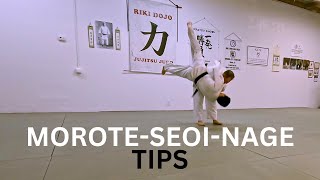
Morote-Seoi-Nage Tips | Riki Judo Dojo
Riki Judo Dojo