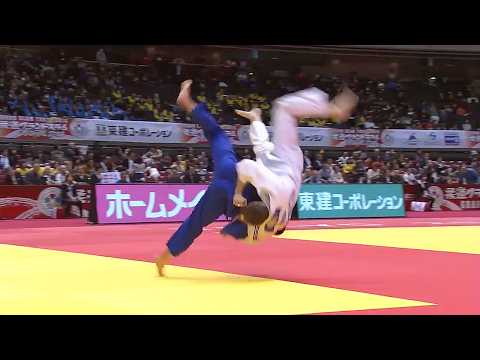
The Shoulder Throw machine - Alexandre Iddir
0
Shoulder Throw·Grappler Kingdom
Alexandre Iddir is a French male judoka who competes in -90 kg (in the past) and -100 kg weight categories. He is a 2-ti…
Translation: shoulder technique
The Shoulder Throw family encompasses the seoi-nage (back-carrying throw) techniques and kata-guruma (shoulder wheel), which are among the most popular and effective throws in judo and grappling. [1] Shoulder throws are characterised by the thrower turning their back to the opponent and loading them onto the shoulders or upper back, then throwing them forward by pulling with the arms and bending or dropping the body. [1],[2] The seoi-nage variants — ippon seoi-nage, morote seoi-nage, eri seoi-nage, and seoi-otoshi — differ in grip configuration and body mechanics but share the fundamental principle of loading the opponent onto the back and projecting them forward. [2],[3] Kata-guruma, the shoulder wheel or fireman's carry, uses a different loading mechanism, placing the opponent across the shoulders, but shares the family's defining characteristic of using the shoulder as the primary fulcrum. [3],[4]
Shoulder throws have been central to judo since Jigoro Kano's founding of the Kodokan, with seoi-nage included in the original 1895 gokyo as a core technique. [1] The seoi-nage family has produced more competition victories than arguably any other group of techniques in judo history, with Olympic and World Championship data consistently showing seoi-nage variants among the top three most scored throws. [2],[3] Kata-guruma was one of the most spectacular throws in judo before the IJF's 2010 rule changes restricting leg grabs, which significantly altered its competitive application. [3],[4]
Seoi nage is consistently the most frequently scored ippon technique in IJF competition across all weight categories. [1]
No images yet for this technique.
Sign in to suggest an image.
Alexandre Iddir is a French male judoka who competes in -90 kg (in the past) and -100 kg weight categories. He is a 2-ti…
No instructional courses yet for this technique.
Sign in to suggest a course.
Risk of injury to the person this technique is applied to
Seoi-Nage family; high amplitude with rotation over tori's shoulder (Kano 1986)
Skill level needed to execute this technique reliably
Whether this technique is allowed under major competition rule sets
Kodokan Judo — Official Nage-waza Classification
Traditional Judo throwing technique terminology (Kodokan Institute)
Official Kodokan ground technique classification system
Standard Japanese martial arts terminology (kanji/hiragana)
Established Japanese martial arts naming convention — native Japanese term (和語/漢語)
Traditional Judo throwing technique terminology (Kodokan Institute)
explosive turning speed, arm pulling power, deep level change
shorter stature for getting under the opponent, strong back
deltoids, trapezius, quadriceps, core
Every move, in any martial art, shares a few universal traits. Mix and match below to pinpoint the right tool — or compare equivalents across styles.
Kata Guruma (shoulder wheel) is a te-waza technique in which the thrower lifts the opponent across the shoulders in a fireman's carry position and then wheels them over to the mat. [1] The classical execution involves the thrower ducking under the opponent's arm, reaching between the legs to grip the inner thigh, and lifting the opponent onto the shoulders before rotating them over. [1,2] Since the IJF's 2010 rule changes prohibiting direct leg grabs in judo competition, kata-guruma has been adapted to versions that do not involve gripping the legs, using the gi or body contact to achieve the loading position. [2,3]
Seoi Nage (back-carrying throw) is one of judo's most iconic and frequently used techniques, in which the thrower turns their back to the opponent, loads them onto the upper back or shoulder, and projects them forward over the shoulder. [1] The seoi-nage family includes multiple variants distinguished by their grip configuration: ippon seoi-nage (single-arm), morote seoi-nage (two-handed lapel), eri seoi-nage (collar grip), and seoi-otoshi (the dropping version). [1,2] All variants share the fundamental mechanic of turning in, loading, and projecting, with the differences lying in how the throwing arm controls the opponent. [2,3] Statistical analyses of judo competition data consistently place seoi-nage variants among the two or three most commonly scored throws at World Championships and Olympic Games. [3]
Seoi-nage is the most commonly attempted throw in international judo competition — it accounts for approximately 25% of all throw attempts in IJF events. (Kano, Kodokan Judo; IJF competition data)
The Shoulder Throw family encompasses the seoi-nage (back-carrying throw) techniques and kata-guruma (shoulder wheel), which are among the most popular and effective throws in judo and grappling. Shoulder throws are characterised by the thrower turning their back to the opponent and loading them onto the shoulders or upper back, then throwing them forward by pulling with the arms and bending or dropping the body.
Shoulder throws have been central to judo since Jigoro Kano's founding of the Kodokan, with seoi-nage included in the original 1895 gokyo as a core technique. The seoi-nage family has produced more competition victories than arguably any other group of techniques in judo history, with Olympic and World Championship data consistently showing seoi-nage variants among the top three most scored throws.
IJF: legal — Legal throwing technique; IBJJF: legal — Legal at all belt levels; UWW: legal — Legal in both freestyle and Greco-Roman; Unified MMA: legal — Legal throwing technique; ADCC: legal — Legal; FIAS Sport Sambo: legal — Legal; FIAS Combat Sambo: legal — Legal
Danger rating 6/10. High — Seoi-Nage family; high amplitude with rotation over tori's shoulder (Kano 1986)
The standard setup chain: Grip Setup (Kumi-kata) → Off-Balance (Kuzushi) → Entry (Tsukuri) → Execution (Kake).
Standard counters include: Lower Centre of Gravity — bend knees and drop hips to make the throw harder to execute / Grip Break — deny the thrower their preferred gripping configuration / Stiff-Arm — maintain distance with straight arms to prevent the entry.
Common variants: Morote seoi nage (two-handed shoulder throw with both hands gripping); Ippon seoi nage (one-arm shoulder throw loading the arm over the shoulder); Drop seoi nage (dropping to the knees for a lower entry point); Korean-style shoulder throw (modified entry with deeper level change).
Seoi nage is consistently the most frequently scored ippon technique in IJF competition across all weight categories.
Top errors to watch for: Not turning the hips fully — a partial turn means the opponent is beside you, not on your back / Entry too high — your hips must be below the opponent's belt level for the throw to work / Bending at the waist instead of sitting the hips down — this raises your centre rather than lowering it / Not pulling the opponent onto your back with the hands — the grip pull loads them onto your frame.
The Shoulder Throw is also known as Kata-waza, Shoulder throws, Over-the-shoulder throws.