Best of JUDO SEOI NAGE【背負投】
0
Seoi Nage·Judo Art
Welcome to the new video about the best of judo seoi nage throws . In this video you could see morote-seoi-nage, drop se…
Translation: shoulder throw
Seoi Nage (back-carrying throw) is one of judo's most iconic and frequently used techniques, in which the thrower turns their back to the opponent, loads them onto the upper back or shoulder, and projects them forward over the shoulder. [1] The seoi-nage family includes multiple variants distinguished by their grip configuration: ippon seoi-nage (single-arm), morote seoi-nage (two-handed lapel), eri seoi-nage (collar grip), and seoi-otoshi (the dropping version). [1],[2] All variants share the fundamental mechanic of turning in, loading, and projecting, with the differences lying in how the throwing arm controls the opponent. [2],[3] Statistical analyses of judo competition data consistently place seoi-nage variants among the two or three most commonly scored throws at World Championships and Olympic Games. [3]
Seoi nage was included in the original 1895 Kodokan gokyo and has been one of the most popular throws in judo since the art's founding. [1] The technique is particularly favoured by lighter-weight judoka who use speed, rotation, and low entry to overcome larger opponents. [2] Champions such as Toshihiko Koga, Tadahiro Nomura, and Shohei Ono have built their competitive careers around devastating seoi-nage attacks. [2],[3]
No images yet for this technique.
Sign in to suggest an image.
Welcome to the new video about the best of judo seoi nage throws . In this video you could see morote-seoi-nage, drop se…
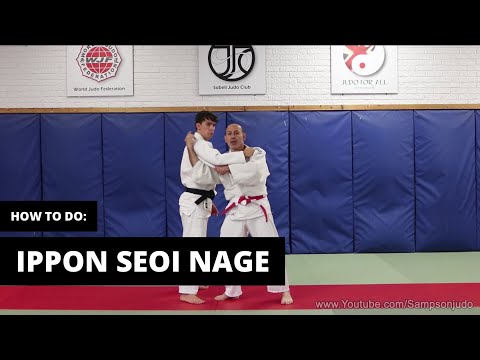
How to do Ippon Seoi Nage - Here I am showing how to do a standard Ippon Seoi Nage. Its important that you get good shou…
No instructional courses yet for this technique.
Sign in to suggest a course.
Risk of injury to the person this technique is applied to
Seoi-Nage family; high amplitude with rotation over tori's shoulder (Kano 1986)
Skill level needed to execute this technique reliably
Whether this technique is allowed under major competition rule sets
Kodokan Judo — Official Nage-waza Classification
Traditional Judo throwing technique terminology (Kodokan Institute)
Official Kodokan ground technique classification system
Standard Japanese martial arts terminology (kanji/hiragana)
Established Japanese martial arts naming convention — native Japanese term (和語/漢語)
Traditional Judo throwing technique terminology (Kodokan Institute)
hip rotation speed, core strength, lower back stability
strong hips and core, good flexibility for turning entry
hip rotators, core, quadriceps, latissimus dorsi
Every move, in any martial art, shares a few universal traits. Mix and match below to pinpoint the right tool — or compare equivalents across styles.
Eri Seoi Nage (collar back-carrying throw) is a seoi-nage variant in which the thrower grips the opponent's collar or lapel deeply with the throwing hand, turns in, and throws the opponent over the shoulder using the collar grip as the primary control. [1] The deep collar grip provides a high control point near the opponent's neck, allowing the thrower to control posture and direction throughout the entry and throw. [1,2] Eri seoi-nage is particularly effective against taller opponents, as the high collar grip can be used to break their posture downward during the turn-in. [2,3]
Ippon Seoi Nage (single-arm back-carrying throw) is the most widely practised seoi-nage variant, in which the thrower releases the lapel grip, reaches under the opponent's arm to secure it with the throwing arm, turns in, and throws the opponent over the shoulder using the trapped arm as the primary control point. [1] The 'ippon' (one-arm) designation refers to the single arm that secures the opponent's arm, distinguishing it from morote (two-handed) versions. [1,2] The technique requires explosive rotation, a deep entry under the opponent's centre of gravity, and powerful pulling action with the sleeve hand to complete the throw. [2,3]
Morote Seoi Nage (two-handed back-carrying throw) is a seoi-nage variant in which the thrower maintains both lapel grips throughout the throw, turning in and loading the opponent across the upper back while pulling with both hands on the lapels or collar. [1] The 'morote' (two-handed) designation distinguishes this from ippon seoi-nage — both hands remain on the gi rather than one arm reaching under the opponent's arm. [1,2] The two-handed grip provides strong control of the opponent's upper body throughout the throw, though it requires the thrower to generate lifting force through hip and leg drive rather than the arm-trapping mechanism of ippon seoi-nage. [2,3]
Seoi Otoshi (back-carrying drop) is a variant of seoi-nage in which the thrower drops to both knees or a deep squat during the turn-in, using the dropping body weight to pull the opponent forward and over the lowered shoulder. [1] The 'otoshi' (drop) element creates a dramatic level change that loads the opponent heavily onto the thrower's back, and the falling action adds downward force that amplifies the arm pull. [1,2] Seoi-otoshi is often used against taller opponents or when the thrower cannot achieve sufficient rotation for a standing seoi-nage, as the drop allows a lower, deeper entry beneath the opponent's centre of gravity. [2,3]
According to Sampson Judo, you must never try to throw someone while they're flat-footed. Always bring them onto their toes or heels first as part of kazushi (breaking balance), and this must be done instantaneously as you step in, not as separate actions.
Sampson Judo emphasizes using a normal kumikata grip with fingers working inward just below the shoulder and at the chest level. For your second hand, hold just underneath the elbow rather than on top—this provides much more control and effectiveness.
Sampson Judo stresses that your hips must be just underneath your opponent's belt, not high. Keep your feet inside theirs with legs not wide apart or uneven, stay on your toes with heels off the mat, and maintain bent knees—this positioning is critical for proper dynamics and allows transitions later.
According to Sampson Judo, your opponent needs to go over your head and land in front of you. If they land to the side, something has gone wrong with your technique execution.
Seoi Nage (back-carrying throw) is one of judo's most iconic and frequently used techniques, in which the thrower turns their back to the opponent, loads them onto the upper back or shoulder, and projects them forward over the shoulder. The seoi-nage family includes multiple variants distinguished by their grip configuration: ippon seoi-nage (single-arm), morote seoi-nage (two-handed lapel), eri seoi-nage (collar grip), and seoi-otoshi (the dropping version).
Seoi nage was included in the original 1895 Kodokan gokyo and has been one of the most popular throws in judo since the art's founding. The technique is particularly favoured by lighter-weight judoka who use speed, rotation, and low entry to overcome larger opponents.
IJF: legal — Legal throwing technique; IBJJF: legal — Legal at all belt levels; UWW: legal — Legal in both freestyle and Greco-Roman; Unified MMA: legal — Legal throwing technique; ADCC: legal — Legal; FIAS Sport Sambo: legal — Legal; FIAS Combat Sambo: legal — Legal
Danger rating 6/10. High — Seoi-Nage family; high amplitude with rotation over tori's shoulder (Kano 1986)
The standard setup chain: Grip Setup (Kumi-kata) → Off-Balance (Kuzushi) → Entry (Tsukuri) → Execution (Kake).
Standard counters include: Lower Centre of Gravity — bend knees and drop hips to make the throw harder to execute / Block the Hip — post hand on the thrower's hip to prevent loading / Step Around — circle away from the throw direction to avoid being loaded / Grip Break — deny the thrower their preferred gripping configuration.
Common variants: Standard hip throw (full turn-in with hip below the opponent's centre of gravity); No-gi hip throw (adapted without gi grips, using overhook and collar tie); Drop hip throw (dropping to one knee to lower the fulcrum point); Combination hip throw (chaining from a failed foot technique or hand technique).
Seoi nage accounts for more ippon scores in IJF competition than any other single technique. Toshihiko Koga won Olympic gold (1992) and three World Championships using ippon seoi nage as his primary technique.
Top errors to watch for: Not dropping the hips low enough — the number one reason seoi nage fails / Turning only the shoulders without the hips — the entire body must rotate / Not pulling the opponent forward before entering — kuzushi is essential for loading them onto your back / Leaving the pulling hand (hikite) passive — it must actively pull the opponent over your shoulder.
The Seoi Nage is also known as Back Carry Throw, Shoulder Throw, Seoi Nage, Brosok Cherez Spinu (бросок через спину).