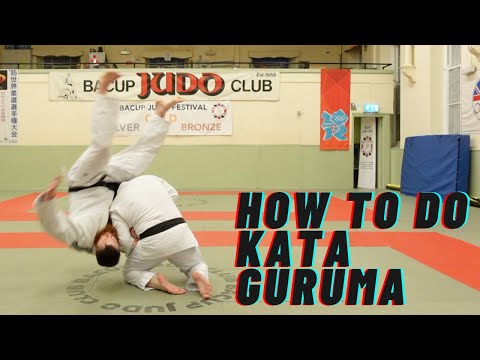
How To Do Kata Guruma || IJF Approved feat Danny Harper
0
Modified Kata Guruma·The Judo Way of Life·Added by Admin
Recently, on a trip to the UK I had the chance of visiting my home Dojo, Bacup Judo Club, and was able to do a couple of…
Translation: shoulder wheel
Modified Kata Guruma encompasses variations of the shoulder wheel that use alternative grips, entries, or body positions to achieve the cross-shoulder loading without the traditional leg grip. [1] These modifications include using belt grips, gi tail grips, over-the-back grips, or underhook configurations to secure the opponent across the shoulders without directly grabbing the legs. [1],[2] Modified kata-guruma techniques were developed primarily in response to competition rule changes and represent the ongoing evolution of traditional techniques under modern rulesets. [2],[3]
Modified kata guruma variants proliferated after the 2010 IJF rule changes, as judo competitors and coaches found creative ways to preserve the shoulder wheel mechanic without using direct leg grabs. [1] These modifications demonstrate the adaptability of judo technique to evolving competitive requirements. [2],[3]
The modified kata guruma adapts the shoulder wheel for post-2010 IJF rules, using drop entries or modified grips to achieve the same effect without a direct leg grab. [1]
Modified kata guruma variations emerged after the IJF's 2010 leg-grab prohibition, representing competitive adaptations that maintain the shoulder-wheel mechanics while complying with current rules. [1]
Modified kata guruma variants are scored in IJF competition under current rules. [1]
No images yet for this technique.
Sign in to suggest an image.
Recently, on a trip to the UK I had the chance of visiting my home Dojo, Bacup Judo Club, and was able to do a couple of…
No instructional courses yet for this technique.
Sign in to suggest a course.
Risk of injury to the person this technique is applied to
Seoi-Nage family; high amplitude with rotation over tori's shoulder (Kano 1986)
Skill level needed to execute this technique reliably
Whether this technique is allowed under major competition rule sets
Kodokan Judo — Official Nage-waza Classification
Traditional Judo throwing technique terminology (Kodokan Institute)
Official Kodokan ground technique classification system
Standard Japanese martial arts terminology (kanji/hiragana)
Established Japanese martial arts naming convention — native Japanese term (和語/漢語)
Traditional Judo throwing technique terminology (Kodokan Institute)
explosive turning speed, arm pulling power, deep level change
shorter stature for getting under the opponent, strong back
deltoids, trapezius, quadriceps, core
You want to posture up with the back of your neck positioned right into your opponent's armpit, rather than bending your back forward. Dropping with poor posture makes it difficult to maintain tension and gives your opponent an easier opportunity to stand up and escape.
Grip at the collar and sleeve, then push the sleeve across your partner's body while tapping the seam on the back of the shoulder. This tight control down that side of their body prevents them from simply dropping and turning to escape.
Position your elbow on the inside of your opponent's thigh, which allows you to use it as a lever point to tip them over during the execution of the technique.
Modified Kata Guruma encompasses variations of the shoulder wheel that use alternative grips, entries, or body positions to achieve the cross-shoulder loading without the traditional leg grip. These modifications include using belt grips, gi tail grips, over-the-back grips, or underhook configurations to secure the opponent across the shoulders without directly grabbing the legs.
Modified kata guruma variants proliferated after the 2010 IJF rule changes, as judo competitors and coaches found creative ways to preserve the shoulder wheel mechanic without using direct leg grabs. These modifications demonstrate the adaptability of judo technique to evolving competitive requirements.
IJF: legal — Legal throwing technique; IBJJF: legal — Legal at all belt levels; UWW: legal — Legal in both freestyle and Greco-Roman; Unified MMA: legal — Legal throwing technique; ADCC: legal — Legal; FIAS Sport Sambo: legal — Legal; FIAS Combat Sambo: legal — Legal
Danger rating 6/10. High — Seoi-Nage family; high amplitude with rotation over tori's shoulder (Kano 1986)
The standard setup chain: Grip Setup (Kumi-kata) → Off-Balance (Kuzushi) → Entry (Tsukuri) → Execution (Kake).
Standard counters include: Lower Centre of Gravity — bend knees and drop hips to make the throw harder to execute / Grip Break — deny the thrower their preferred gripping configuration / Stiff-Arm — maintain distance with straight arms to prevent the entry.
Common variants: Morote seoi nage (two-handed shoulder throw with both hands gripping); Ippon seoi nage (one-arm shoulder throw loading the arm over the shoulder); Drop seoi nage (dropping to the knees for a lower entry point); Korean-style shoulder throw (modified entry with deeper level change).
Modified kata guruma variants are scored in IJF competition under current rules.
Top errors to watch for: Using the traditional leg-grab entry in IJF judo competition — this results in a penalty / Not adapting the grip strategy for the specific ruleset / Attempting the modified version without a secure alternative grip — the belt or gi-back grip must be firm / Not getting low enough — the modified grips require an even lower entry because the leverage is reduced.
The Modified Kata Guruma is also known as Kata Guruma, No-Leg Kata Guruma, Modified Shoulder Wheel, Drop Seoi Kata Guruma.