Nage no Kata - Kata guruma
0
Kata Guruma·Judô Juventus Cascavel
Translation: shoulder wheel
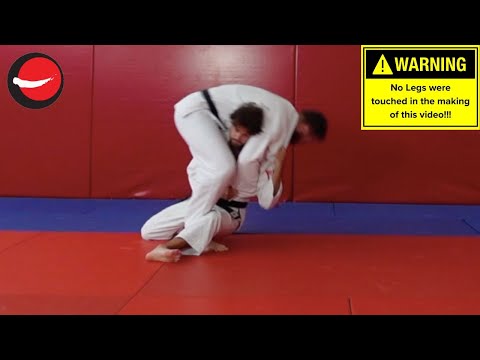
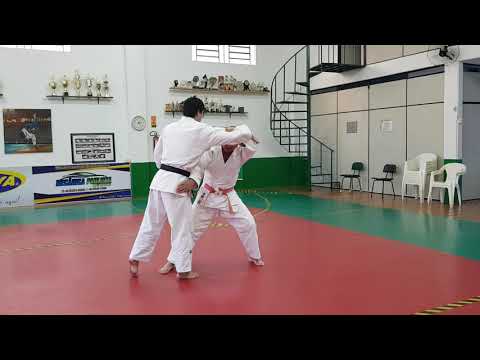
Kata Guruma (shoulder wheel) is a te-waza technique in which the thrower lifts the opponent across the shoulders in a fireman's carry position and then wheels them over to the mat. [1] The classical execution involves the thrower ducking under the opponent's arm, reaching between the legs to grip the inner thigh, and lifting the opponent onto the shoulders before rotating them over. [1],[2] Since the IJF's 2010 rule changes prohibiting direct leg grabs in judo competition, kata-guruma has been adapted to versions that do not involve gripping the legs, using the gi or body contact to achieve the loading position. [2],[3]
Kata guruma was included in the Kodokan gokyo as a hand technique and was one of the most spectacular throws in judo competition for over a century. [1] The technique has parallels in wrestling (fireman's carry) and has been practised across grappling arts worldwide. [2] The 2010 IJF rule changes banning leg grabs in judo forced significant adaptations to kata-guruma's competition application, leading to the development of drop and modified versions. [2],[3]
Classical kata guruma was a common technique before the 2010 IJF leg-grab ban; modified drop versions remain scored in competition. [1]
No images yet for this technique.
Sign in to suggest an image.
Thank you to Isaac for sharing his knowledge on Kata Guruma, as it's not a throw that I particularly use in randori or c…
No instructional courses yet for this technique.
Sign in to suggest a course.
Risk of injury to the person this technique is applied to
Seoi-Nage family; high amplitude with rotation over tori's shoulder (Kano 1986)
Skill level needed to execute this technique reliably
Whether this technique is allowed under major competition rule sets
Kodokan Judo — Official Nage-waza Classification
Traditional Judo throwing technique terminology (Kodokan Institute)
Official Kodokan ground technique classification system
Standard Japanese martial arts terminology (kanji/hiragana)
Established Japanese martial arts naming convention — native Japanese term (和語/漢語)
Traditional Judo throwing technique terminology (Kodokan Institute)
explosive turning speed, arm pulling power, deep level change
shorter stature for getting under the opponent, strong back
deltoids, trapezius, quadriceps, core
Every move, in any martial art, shares a few universal traits. Mix and match below to pinpoint the right tool — or compare equivalents across styles.
Drop Kata Guruma is a modified version in which the thrower drops to one or both knees while loading the opponent across the shoulders, using the dropping body weight to assist the wheeling action. [1] The drop entry lowers the thrower's centre of gravity dramatically, making it easier to get under a defensive opponent, and the falling body weight adds momentum to the throw. [1,2] This variant became popular in judo competition as an adaptation to leg-grab restrictions, using gi grips rather than leg holds to secure the opponent during the drop and wheel. [2,3]
Modified Kata Guruma encompasses variations of the shoulder wheel that use alternative grips, entries, or body positions to achieve the cross-shoulder loading without the traditional leg grip. [1] These modifications include using belt grips, gi tail grips, over-the-back grips, or underhook configurations to secure the opponent across the shoulders without directly grabbing the legs. [1,2] Modified kata-guruma techniques were developed primarily in response to competition rule changes and represent the ongoing evolution of traditional techniques under modern rulesets. [2,3]
Standard Kata Guruma executes the classical shoulder wheel where the thrower drops under the opponent, reaches between the legs with one arm and over the shoulder with the other, lifts the opponent across the shoulders, and rotates them over to the mat. [1] The lifting phase requires the thrower to generate significant upward force from a low position, elevating the opponent's entire body weight onto the shoulders. [1,2] The wheeling action then rotates the opponent over the shoulder axis and drives them to the mat. [2,3]
Kata guruma (shoulder wheel/fireman's carry) appears in 16 passages across 9 books. Banned from IJF judo competition since 2010 when leg-grabbing rules were introduced — previously one of the most spectacular throws. Now primarily used in freestyle wrestling, Sambo, and MMA. (9 books in corpus; Kano, Kodokan Judo; IJF rule changes 2010)
The Judo Way of Life demonstrates a modern approach where you transition from a standard collar and sleeve grip to controlling the lapel on the same side, then drive your head under the opponent's armpit to execute the throw.
According to The Judo Way of Life, maintaining continuous tension and kazushi (off-balance) throughout the movement is critical—if you simply drop straight down without keeping tension, you won't complete the throw.
The Judo Way of Life emphasizes that all drive comes from your back foot as you finish the throw; you sit on your opposite hip and push off explosively to complete the technique.
Kata Guruma (shoulder wheel) is a te-waza technique in which the thrower lifts the opponent across the shoulders in a fireman's carry position and then wheels them over to the mat. The classical execution involves the thrower ducking under the opponent's arm, reaching between the legs to grip the inner thigh, and lifting the opponent onto the shoulders before rotating them over.
Kata guruma was included in the Kodokan gokyo as a hand technique and was one of the most spectacular throws in judo competition for over a century. The technique has parallels in wrestling (fireman's carry) and has been practised across grappling arts worldwide.
IJF: banned — Banned since 2010 leg grab prohibition — direct hansoku-make; IBJJF: legal — Legal at all belt levels; UWW: legal — Legal in both freestyle and Greco-Roman; Unified MMA: legal — Legal throwing technique; ADCC: legal — Legal; FIAS Sport Sambo: legal — Legal; FIAS Combat Sambo: legal — Legal
Danger rating 6/10. High — Seoi-Nage family; high amplitude with rotation over tori's shoulder (Kano 1986)
The standard setup chain: Grip Setup (Kumi-kata) → Off-Balance (Kuzushi) → Entry (Tsukuri) → Execution (Kake).
Standard counters include: Lower Centre of Gravity — bend knees and drop hips to make the throw harder to execute / Grip Break — deny the thrower their preferred gripping configuration / Stiff-Arm — maintain distance with straight arms to prevent the entry.
Common variants: Morote seoi nage (two-handed shoulder throw with both hands gripping); Ippon seoi nage (one-arm shoulder throw loading the arm over the shoulder); Drop seoi nage (dropping to the knees for a lower entry point); Korean-style shoulder throw (modified entry with deeper level change).
Classical kata guruma was a common technique before the 2010 IJF leg-grab ban; modified drop versions remain scored in competition.
Top errors to watch for: Trying to muscle the opponent up with the back instead of standing up through the legs / Not getting deep enough under the opponent — your hips must be well below their centre of gravity / Attempting kata guruma without first pulling the opponent forward to break their posture / Not controlling both the arm and the leg/body — losing either grip means the opponent slides off.
The Kata Guruma is also known as Shoulder Wheel, Fireman's Carry Throw, Kata Guruma, Brosok Cherez Plechi (бросок через плечи).