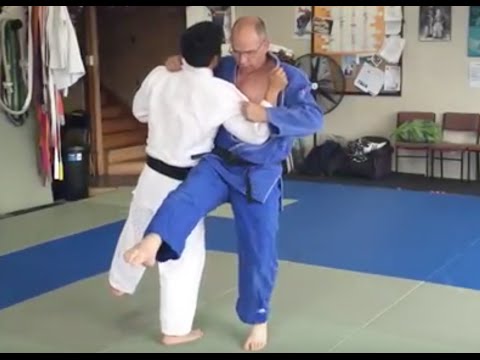
Osoto Gari 大外刈 Major Outer Reap TECHNIQUE study video
0
Major Outer Reap·Judo Life
This video is about o soto gari osotogari. Ōsotogari Static entry, moving forwards, combination technique coache…
Translation: major outer reap/drop
The Major Outer Reap family covers ashi-waza techniques in which the thrower reaps the opponent's leg from the outside, driving the attacking leg against the back of the opponent's supporting leg to sweep it away while forcing the upper body backward. [1] Outer reaping techniques (soto-gari and soto-otoshi) are among the most powerful throws in judo, generating tremendous force through the combination of a sweeping leg action and strong rearward upper-body drive. [1],[2] The family includes o-soto-gari (major outer reap), one of judo's most iconic and frequently taught throws, along with o-soto-otoshi (major outer drop), which uses a blocking rather than sweeping leg action. [2],[3]
Outer reaping techniques were among the first throws classified in the Kodokan system, with o-soto-gari included in the original 1895 gokyo as a first-set technique. [1] The family represents some of judo's most fundamental mechanics, and o-soto-gari has been a standard teaching technique in every judo school worldwide since the art's founding. [2],[3]
Outer reap techniques are part of the Kodokan judo ashi-waza syllabus and are considered among the 'big six' fundamental judo throws. [1]
O soto gari is one of the most commonly scored ippon techniques in IJF competition. [1]
No images yet for this technique.
Sign in to suggest an image.
This video is about o soto gari osotogari. Ōsotogari Static entry, moving forwards, combination technique coache…
No instructional courses yet for this technique.
Sign in to suggest a course.
Risk of injury to the person this technique is applied to
O-Soto-Gari is one of judo's most dangerous throws; direct backward fall onto head/spine (Mifune 1956)
Skill level needed to execute this technique reliably
Whether this technique is allowed under major competition rule sets
Kodokan Judo — Official Nage-waza Classification
Traditional Judo throwing technique terminology (Kodokan Institute)
Official Kodokan ground technique classification system
Standard Japanese martial arts terminology (kanji/hiragana)
Established Japanese martial arts naming convention — native Japanese term (和語/漢語)
Traditional Judo throwing technique terminology (Kodokan Institute)
precise timing, ankle coordination, upper body kuzushi ability
excellent balance and quick reflexes
tibialis anterior, calves, hip rotators, forearms (grip)
Every move, in any martial art, shares a few universal traits. Mix and match below to pinpoint the right tool — or compare equivalents across styles.
O Guruma is a judo throw where the attacker sweeps across both of the opponent's legs with the extended leg while turning, creating a large wheel effect that topples the opponent backward. [1] The attacker enters deeply, extending the rear leg across the front of both of the opponent's legs while pulling and turning. [1] Distinguished from O Soto Guruma by the depth of entry and the angle of the sweep. [1]
O Soto Gari (major outer reap) is one of judo's most fundamental and powerful throws, in which the thrower steps alongside the opponent, drives the leg behind the opponent's supporting leg, and reaps it forward with a powerful sweeping action of the calf while pushing the opponent's upper body backward. [1] The throw creates a rotational force where the leg sweeps in one direction and the upper body is driven in the opposite direction, with the fulcrum at the point of contact between the thrower's reaping leg and the opponent's supporting leg. [1,2] O-soto-gari is classified as a first-set technique in the Kodokan gokyo, taught to beginners for its clear demonstration of kuzushi (balance breaking) to the rear corner. [2,3]
O Soto Guruma is a judo throwing technique classified as ashi waza (foot/leg technique) in the Kodokan syllabus. [1] The attacker breaks the opponent's balance to the rear and sweeps both legs simultaneously by driving the attacking leg across both of the opponent's legs in a wheel-like motion, rather than reaping a single leg as in O Soto Gari. [1,2] The key distinction from O Soto Gari is that the reaping leg contacts across both legs, creating a wheel effect that topples the opponent directly backward. [2] It is classified in the Gokyo no Waza (five groups of instruction) and appears in multiple Kodokan judo references as a fundamental ashi waza technique. [1]
O Soto Otoshi (major outer drop) is an ashi-waza technique closely related to o-soto-gari in which the thrower places the leg behind the opponent's supporting leg as a block or prop rather than reaping it, then drives the opponent backward over the obstruction. [1] The key distinction from o-soto-gari is the leg action — in o-soto-otoshi, the attacking leg does not sweep or reap but simply blocks the opponent's leg in place, and the throwing force comes entirely from the upper-body drive pushing the opponent over the blocked leg. [1,2] The 'otoshi' (drop) designation indicates that the opponent drops or falls over the blocking leg rather than being swept away by it. [2,3]
O-soto-gari is one of the first throws taught in judo and one of the highest-scoring in competition. Jigoro Kano considered it one of the most important throws in the curriculum. (Kano, Kodokan Judo)
Judo Life emphasizes chest contact, drawing your opponent's body weight, arcing it over your body, and accentuating the hip as your leg comes up and sweeps through.
Rather than reaching for a distant contact point, use your forearm as the contact point and lock it in tight with a shrug action, similar to a Wakeshima grip.
You can switch to Sasai, or feint a Sasai Surikami Ash before transitioning back into the Major Outer Reap.
The Major Outer Reap family covers ashi-waza techniques in which the thrower reaps the opponent's leg from the outside, driving the attacking leg against the back of the opponent's supporting leg to sweep it away while forcing the upper body backward. Outer reaping techniques (soto-gari and soto-otoshi) are among the most powerful throws in judo, generating tremendous force through the combination of a sweeping leg action and strong rearward upper-body drive.
Outer reaping techniques were among the first throws classified in the Kodokan system, with o-soto-gari included in the original 1895 gokyo as a first-set technique. The family represents some of judo's most fundamental mechanics, and o-soto-gari has been a standard teaching technique in every judo school worldwide since the art's founding.
IJF: legal — Legal throwing technique; IBJJF: legal — Legal at all belt levels; UWW: restricted — Legal in freestyle, banned in Greco-Roman (no leg attacks below waist); Unified MMA: legal — Legal throwing technique; ADCC: legal — Legal; FIAS Sport Sambo: legal — Legal; FIAS Combat Sambo: legal — Legal
Danger rating 7/10. Very High — O-Soto-Gari is one of judo's most dangerous throws; direct backward fall onto head/spine (Mifune 1956)
The standard setup chain: Grip Setup (Kumi-kata) → Off-Balance (Kuzushi) → Entry (Tsukuri) → Execution (Kake).
Standard counters include: Lower Centre of Gravity — bend knees and drop hips to make the throw harder to execute / Lift the Targeted Leg — raise the foot being attacked above the sweeping action / Counter-Throw — exploit the attacker's committed weight to throw them instead / Grip Break — deny the thrower their preferred gripping configuration.
Common variants: Forward sweep (sweeping the foot in the direction the opponent is stepping); Rear sweep (sweeping the foot backward as the opponent retreats); Combination sweep (chaining sweeps to both feet); Counter sweep (timing the sweep as the opponent initiates their own attack).
O soto gari is one of the most commonly scored ippon techniques in IJF competition.
Top errors to watch for: Reaping the unweighted leg — you must drive the opponent's weight onto the target leg before reaping / Not getting chest-to-chest before reaping — distance kills the throw / Reaping with a straight, stiff leg instead of swinging through with a pendulum-like arc / Bending at the waist to reach the reap, which raises your centre and weakens the throw.
The Major Outer Reap is also known as O Soto Gari / O Soto Otoshi, Outer reap throws, O soto techniques.