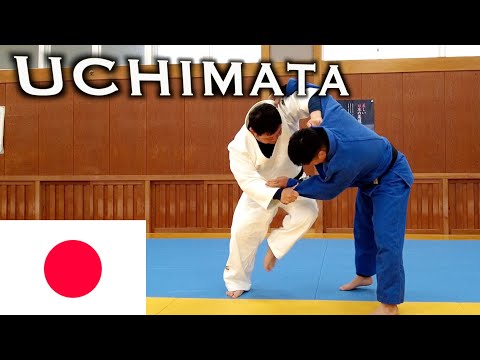
Easy judo throw in kenka yotsu. Maruyama style super Uchi mata.
0
Ashi Uchi Mata·FLUID JUDO JAPAN
This style Uchimata will make it easy to throw you opponent, very little leg strength required. This will make it easier…
Translation: inner thigh throw
Ashi Uchi Mata (leg-style inner thigh throw) is a variation in which the sweeping action is performed primarily with the lower leg rather than the thigh, with the thrower's foot or shin contacting the opponent's inner thigh to create a scooping, upward sweep. [1] This version emphasises the leg action over the hip rotation, making it particularly effective for taller judoka who can generate lifting force with a longer lever arm. [1],[2] Ashi uchi-mata typically involves less turning than the standard version, with the thrower facing more sideways and relying on the extended leg reach to generate the throw. [2],[3]
Ashi uchi mata (the leg-driven variant) is considered slightly less powerful than the hip-driven form but more accessible for lighter fighters who rely on speed and leg reach rather than hip rotation. [1] Daigo describes it as an effective variation for tall, long-legged judoka who can generate sufficient upward sweeping force without deep hip entry. [2]
Ashi uchi mata is a recognised variation within the Kodokan uchi mata classification, distinguished by the primary use of the leg sweep rather than the hip as the main force generator. [1] The variation has been particularly developed within Japanese university judo programs where competitive specialisation demands technical differentiation. [2]
The leg-lift uchi mata variant (ashi uchi mata) is a commonly scored technique in IJF competition. [1]
No images yet for this technique.
Sign in to suggest an image.
This style Uchimata will make it easy to throw you opponent, very little leg strength required. This will make it easier…
If you already know the traditional Uchimata methodology and have watched countless highlight reels, this might be the p…
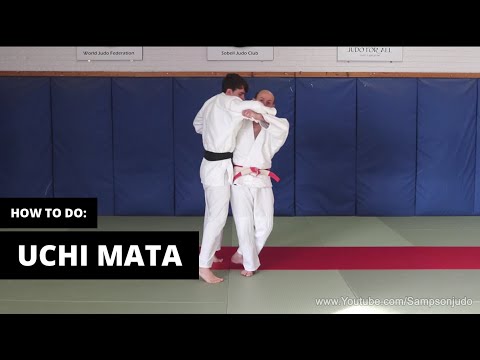
How to do Uchi Mata. In this video I am showing how to do one of the most popular throws in judo - Uchi Mata, Inner Thig…
Ashi Uchi Mata is an inner-thigh throw executed by placing the attacking leg between the opponent's thighs, with technical emphasis varying by context and opponent configuration. Shintaro Higashi presents an intermediate-level approach emphasizing arm positioning and hip mechanics for resistance scenarios: he stresses retracting the sleeve-hand elbow to the opposite hip to prevent the opponent's arm retraction, maintaining forward tension on the collar hand with an inverted elbow, and opening the hips laterally before elevating the leg—a departure from traditional straight-leg mechanics that prioritizes hip flexibility demands. FLUID JUDO JAPAN teaches the technique in Kenka Yotsu (same-side stance), where the opponent's front leg obstructs the throw; this variation attacks the front leg using two-stage footwork, with the back of the knee driving into the opponent's kneecap to open their legs sideways, and emphasizes that the throw does not require lifting the opponent high off the ground. Sampson Judo presents the classical approach: breaking balance by bringing the opponent forward onto their toes, feeding the right hip to the right hip, stepping the left foot inward between the opponent's thighs, and sweeping upward with the leg while maintaining hip-to-hip contact and controlling via lapel grip with the elbow positioned low for leverage. All instructors agree on hip-to-hip contact as foundational, though they diverge on arm mechanics (Higashi's modern resistance approach versus Sampson's traditional lapel control) and leg trajectory (Higashi's lateral hip opening versus standard forward mechanics).
Synthesized from 3 instructors
No instructional courses yet for this technique.
Sign in to suggest a course.
Risk of injury to the person this technique is applied to
Inner thigh reaping action; knee ligament strain risk on defender
Skill level needed to execute this technique reliably
Whether this technique is allowed under major competition rule sets
Kodokan Judo — Official Nage-waza Classification
Traditional Judo throwing technique terminology (Kodokan Institute)
Official Kodokan ground technique classification system
Standard Japanese martial arts terminology (kanji/hiragana)
Established Japanese martial arts naming convention — native Japanese term (和語/漢語)
Traditional Judo throwing technique terminology (Kodokan Institute)
hip rotation speed, core strength, lower back stability
strong hips and core, good flexibility for turning entry
hip rotators, core, quadriceps, latissimus dorsi
Shintaro Higashi recommends opening your hand and bringing it across to your opposite hip to prevent your opponent from retracting their elbow, which creates the necessary tension and control needed for the entry.
According to Sampson Judo, holding onto the traditional lapel gives you control—when you break your opponent's balance, your hand comes underneath to elevate them, and keeping your elbow low provides extra leverage for the throw.
Sampson Judo explains that you step your right foot across, then bring your left foot inward between your opponent's legs—the leg guides the throw with a sweeping action, and you must keep your opponent on their toes without letting them slide backwards.
Maruyama-style uchi mata can be performed even by people with weak legs, making it an accessible technique for practitioners of varying physical capabilities.
Ashi Uchi Mata (leg-style inner thigh throw) is a variation in which the sweeping action is performed primarily with the lower leg rather than the thigh, with the thrower's foot or shin contacting the opponent's inner thigh to create a scooping, upward sweep. This version emphasises the leg action over the hip rotation, making it particularly effective for taller judoka who can generate lifting force with a longer lever arm.
The ashi (leg) variation of uchi-mata developed as taller competitors adapted the technique to exploit their longer limbs, creating a more leg-dominant throwing style. This variant became common in heavier weight categories where the leg reach advantage is more pronounced.
IJF: legal — Legal throwing technique; IBJJF: legal — Legal at all belt levels; UWW: restricted — Legal in freestyle, banned in Greco-Roman (no leg attacks below waist); Unified MMA: legal — Legal throwing technique; ADCC: legal — Legal; FIAS Sport Sambo: legal — Legal; FIAS Combat Sambo: legal — Legal
Danger rating 5/10. High — inner thigh reaping action; knee ligament strain risk on defender
The standard setup chain: Grip Setup (Kumi-kata) → Off-Balance (Kuzushi) → Entry (Tsukuri) → Execution (Kake).
Standard counters include: Lower Centre of Gravity — bend knees and drop hips to make the throw harder to execute / Block the Hip — post hand on the thrower's hip to prevent loading / Step Around — circle away from the throw direction to avoid being loaded / Grip Break — deny the thrower their preferred gripping configuration.
Common variants: Standard hip throw (full turn-in with hip below the opponent's centre of gravity); No-gi hip throw (adapted without gi grips, using overhook and collar tie); Drop hip throw (dropping to one knee to lower the fulcrum point); Combination hip throw (chaining from a failed foot technique or hand technique).
The leg-lift uchi mata variant (ashi uchi mata) is a commonly scored technique in IJF competition.
Top errors to watch for: Sweeping too low at the ankle — even the leg version should target the inner knee or calf area / Not maintaining the upper body pull — the hands must still drive the opponent forward / Over-relying on the leg sweep without any upper body kuzushi / Confusing ashi uchi mata with a simple inside leg sweep — the body must still turn into the throw.
The Ashi Uchi Mata is also known as Uchi Mata, Leg Uchi Mata, Foot Inner Thigh, Ashi Uchi Mata.