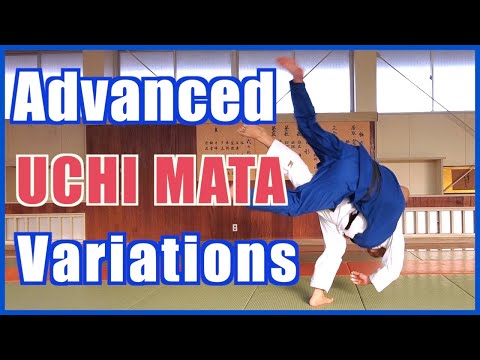
Advanced UCHI MATA variations
0
Uchi Mata·FLUID JUDO JAPAN
Learn advanced UCHI MATA variations to add more colours to your judo. Also, finally learn why japanese judoka call Hane…
Translation: inner thigh throw
Uchi Mata (inner thigh throw) is a judo technique classified as ashi-waza in which the thrower turns in, lifts the attacking leg between the opponent's thighs, and sweeps upward with the back of the thigh while rotating the upper body to throw the opponent over the hip. [1] The throw combines rotation, lifting, and sweeping into a single explosive action, with the thrower typically entering on one foot and driving the sweeping leg upward to lever the opponent off the ground. [1],[2] Uchi-mata exists on a spectrum between a hip throw and a leg throw depending on the practitioner's body type and preferred entry, with taller fighters tending toward a leg-dominant (ashi) version and shorter fighters using more hip rotation. [2],[3]
Uchi-mata has been a core Kodokan technique since the original gokyo, listed in the third set as an advanced throw requiring coordination of turning, lifting, and sweeping. [1] It rose to prominence in the mid-20th century as judo competition evolved, and by the 1970s had become the single most commonly scored throw at the highest levels of international competition. [2],[3]
No images yet for this technique.
Sign in to suggest an image.
Learn advanced UCHI MATA variations to add more colours to your judo. Also, finally learn why japanese judoka call Hane…
The most beautiful technique in judo is Uchi-mata (内股). That is the favourite technique of many judo lovers. Now you can…
No instructional courses yet for this technique.
Sign in to suggest a course.
Risk of injury to the person this technique is applied to
Inner thigh reaping action; knee ligament strain risk on defender
Skill level needed to execute this technique reliably
Whether this technique is allowed under major competition rule sets
Kodokan Judo — Official Nage-waza Classification
Traditional Judo throwing technique terminology (Kodokan Institute)
Official Kodokan ground technique classification system
Standard Japanese martial arts terminology (kanji/hiragana)
Established Japanese martial arts naming convention — native Japanese term (和語/漢語)
Traditional Judo throwing technique terminology (Kodokan Institute)
hip rotation speed, core strength, lower back stability
strong hips and core, good flexibility for turning entry
hip rotators, core, quadriceps, latissimus dorsi
Every move, in any martial art, shares a few universal traits. Mix and match below to pinpoint the right tool — or compare equivalents across styles.
Ashi Uchi Mata (leg-style inner thigh throw) is a variation in which the sweeping action is performed primarily with the lower leg rather than the thigh, with the thrower's foot or shin contacting the opponent's inner thigh to create a scooping, upward sweep. [1] This version emphasises the leg action over the hip rotation, making it particularly effective for taller judoka who can generate lifting force with a longer lever arm. [1,2] Ashi uchi-mata typically involves less turning than the standard version, with the thrower facing more sideways and relying on the extended leg reach to generate the throw. [2,3]
Ken Ken Uchi Mata (hopping inner thigh throw) is a dynamic variation in which the thrower hops forward on the supporting leg while driving the sweeping leg upward between the opponent's thighs, using the forward hopping momentum to generate additional throwing force. [1] The 'ken-ken' refers to the characteristic hopping motion on one foot that propels the thrower and opponent forward while the attacking leg sweeps. [1,2] This version is used when the initial uchi-mata entry does not fully break the opponent's balance, allowing the thrower to continue driving forward with hopping steps until the throw is completed. [2,3]
Standard Uchi Mata is the classical execution where the thrower grips the opponent's lapel and sleeve, turns in with the back to the opponent, and drives the sweeping leg upward between the opponent's thighs while pulling strongly with both hands to rotate the opponent over the hip and attacking leg. [1] The entry requires the thrower to pivot on the support foot, loading the opponent onto the hip and sweeping leg simultaneously. [1,2] The throw is completed when the sweeping leg lifts the opponent's centre of gravity past the point of no return, and the hand action wheels them over into a full rotation. [2,3]
According to Fluid Judo Japan, the key is to tilt your opponent on their axis to shift their balance and lower the target in the thigh, since a tall opponent's center of gravity is high and harder to reach with a standard entry. Use a circular stepping pattern instead of a straight entry, point your supporting foot's toes outward, and use both hands to twist the opponent out of shape while pulling forward to break their posture.
Fluid Judo Japan teaches that when your opponent stretches their elbow to brace against your uchi mata, swing your supporting elbow up to remove their hikite (sleeve hand) grip and block their counter. You can also try a pulling or dragging uchi mata with a top grip, bouncing the opponent's head up and down to make them brace forward instead of backward.
Fluid Judo Japan emphasizes identifying your opponent's reaction to uchi mata and using it to transition into different techniques based on how they defend. For example, if they defend by bringing their knee in, you can use the same stepping pattern to switch to harigoshi and attack the outside of the knee instead of the inner thigh.
Uchi Mata (inner thigh throw) is a judo technique classified as ashi-waza in which the thrower turns in, lifts the attacking leg between the opponent's thighs, and sweeps upward with the back of the thigh while rotating the upper body to throw the opponent over the hip. The throw combines rotation, lifting, and sweeping into a single explosive action, with the thrower typically entering on one foot and driving the sweeping leg upward to lever the opponent off the ground.
Uchi-mata has been a core Kodokan technique since the original gokyo, listed in the third set as an advanced throw requiring coordination of turning, lifting, and sweeping. It rose to prominence in the mid-20th century as judo competition evolved, and by the 1970s had become the single most commonly scored throw at the highest levels of international competition.
IJF: legal — Legal throwing technique; IBJJF: legal — Legal at all belt levels; UWW: legal — Legal in both freestyle and Greco-Roman; Unified MMA: legal — Legal throwing technique; ADCC: legal — Legal; FIAS Sport Sambo: legal — Legal; FIAS Combat Sambo: legal — Legal
Danger rating 5/10. High — inner thigh reaping action; knee ligament strain risk on defender
The standard setup chain: Grip Setup (Kumi-kata) → Off-Balance (Kuzushi) → Entry (Tsukuri) → Execution (Kake).
Standard counters include: Lower Centre of Gravity — bend knees and drop hips to make the throw harder to execute / Block the Hip — post hand on the thrower's hip to prevent loading / Step Around — circle away from the throw direction to avoid being loaded / Grip Break — deny the thrower their preferred gripping configuration.
Common variants: Standard hip throw (full turn-in with hip below the opponent's centre of gravity); No-gi hip throw (adapted without gi grips, using overhook and collar tie); Drop hip throw (dropping to one knee to lower the fulcrum point); Combination hip throw (chaining from a failed foot technique or hand technique).
Uchi mata is the most frequently scored ippon technique in IJF World Championship and Olympic competition combined. Yasuhiro Yamashita used uchi mata en route to his undefeated streak of 203 consecutive victories (1977–1985) and Olympic gold (1984).
Top errors to watch for: Not entering deeply enough — your hip must be past the centre line of the opponent's body / Sweeping the near leg instead of the far leg (inner thigh of the far leg is the target) / Not pulling the opponent's weight forward onto their toes before sweeping — they sit back and resist / Sweeping with a straight leg from too low — the sweep must arc upward between the legs with the back of your thigh.
The Uchi Mata is also known as Inner Thigh Reaping Throw, Inner Thigh, Uchi Mata, Podkhvat Iznutri (подхват изнутри).