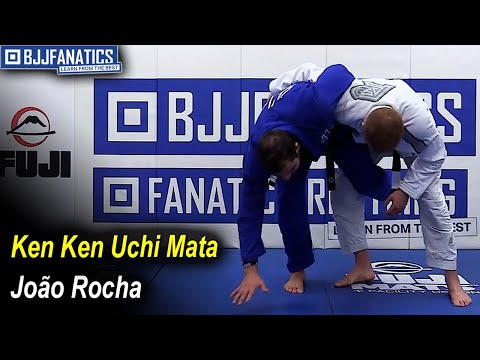
Ken Ken Uchi Mata by João Rocha
0
Ken Ken Uchi Mata·BJJ Fanatics·Added by Admin
KEN KEN UCHI MATA https://bjjfanatics.com João Rocha demonstrates how to do the Ken Ken Uchi Mata BJJ Technique in this…
Translation: inner thigh throw
Ken Ken Uchi Mata (hopping inner thigh throw) is a dynamic variation in which the thrower hops forward on the supporting leg while driving the sweeping leg upward between the opponent's thighs, using the forward hopping momentum to generate additional throwing force. [1] The 'ken-ken' refers to the characteristic hopping motion on one foot that propels the thrower and opponent forward while the attacking leg sweeps. [1],[2] This version is used when the initial uchi-mata entry does not fully break the opponent's balance, allowing the thrower to continue driving forward with hopping steps until the throw is completed. [2],[3]
Ken ken uchi-mata evolved as a competitive adaptation when judoka discovered that continuing to hop forward on the support leg could overcome an opponent's defensive resistance to the initial uchi-mata entry. [1] The technique became a signature of aggressive, forward-driving judo competition styles. [2],[3]
Ken ken uchi mata (the hopping variant) is highly effective as a pursuit technique when the initial uchi mata entry is partially blocked, allowing the thrower to hop forward on the supporting leg while maintaining the sweeping action until the throw succeeds. [1] Kashiwazaki identifies it as a key competition adaptation that transforms a static throw into a dynamic, chasing attack. [2]
Ken ken uchi mata developed as a competition adaptation within the Kodokan judo system, with the hopping chase mechanic becoming increasingly common in international competition from the 1970s onward. [1]
The ken ken (hopping) version of uchi mata has been particularly associated with Japanese and Korean competitors at the World Championships and Olympics, where the aggressive forward-driving style creates strong scoring opportunities. [1]
No images yet for this technique.
Sign in to suggest an image.
KEN KEN UCHI MATA https://bjjfanatics.com João Rocha demonstrates how to do the Ken Ken Uchi Mata BJJ Technique in this…
No instructional courses yet for this technique.
Sign in to suggest a course.
Risk of injury to the person this technique is applied to
Inner thigh reaping action; knee ligament strain risk on defender
Skill level needed to execute this technique reliably
Whether this technique is allowed under major competition rule sets
Kodokan Judo — Official Nage-waza Classification
Traditional Judo throwing technique terminology (Kodokan Institute)
Official Kodokan ground technique classification system
Standard Japanese martial arts terminology (kanji/hiragana)
Established Japanese martial arts naming convention — native Japanese term (和語/漢語)
Traditional Judo throwing technique terminology (Kodokan Institute)
precise timing, ankle coordination, upper body kuzushi ability
excellent balance and quick reflexes
tibialis anterior, calves, hip rotators, forearms (grip)
According to João Rocha, you place one leg between your opponent's legs, then position your second leg to touch your first one. Both legs work together to create the setup for the technique.
João Rocha explains that the can-can is a jumping motion you use to put your opponent down. After placing your hands on the mat, you execute this jump to complete the technique.
João Rocha emphasizes timing the jump in the same direction as your opponent's foot arm placement, and stresses the importance of executing the leg positioning quickly before initiating the jump.
João Rocha recommends closing the space by focusing on your ankle position, noting that 99% of the time you'll end up halfway through if you don't actively manage this distance and maintain a strong position.
Ken Ken Uchi Mata (hopping inner thigh throw) is a dynamic variation in which the thrower hops forward on the supporting leg while driving the sweeping leg upward between the opponent's thighs, using the forward hopping momentum to generate additional throwing force. The 'ken-ken' refers to the characteristic hopping motion on one foot that propels the thrower and opponent forward while the attacking leg sweeps.
Ken ken uchi-mata evolved as a competitive adaptation when judoka discovered that continuing to hop forward on the support leg could overcome an opponent's defensive resistance to the initial uchi-mata entry. The technique became a signature of aggressive, forward-driving judo competition styles.
IJF: legal — Legal throwing technique; IBJJF: legal — Legal at all belt levels; UWW: legal — Legal in both freestyle and Greco-Roman; Unified MMA: legal — Legal throwing technique; ADCC: legal — Legal; FIAS Sport Sambo: legal — Legal; FIAS Combat Sambo: legal — Legal
Danger rating 5/10. High — inner thigh reaping action; knee ligament strain risk on defender
The standard setup chain: Grip Setup (Kumi-kata) → Off-Balance (Kuzushi) → Entry (Tsukuri) → Execution (Kake).
Standard counters include: Lower Centre of Gravity — bend knees and drop hips to make the throw harder to execute / Lift the Targeted Leg — raise the foot being attacked above the sweeping action / Counter-Throw — exploit the attacker's committed weight to throw them instead / Grip Break — deny the thrower their preferred gripping configuration.
Common variants: Forward sweep (sweeping the foot in the direction the opponent is stepping); Rear sweep (sweeping the foot backward as the opponent retreats); Combination sweep (chaining sweeps to both feet); Counter sweep (timing the sweep as the opponent initiates their own attack).
The ken ken (hopping) version of uchi mata has been particularly associated with Japanese and Korean competitors at the World Championships and Olympics, where the aggressive forward-driving style creates strong scoring opportunities.
Top errors to watch for: Hopping without maintaining the sweeping leg in contact with the opponent's thigh — each hop must maintain the sweep … / Hopping backward away from the opponent instead of forward into them / Losing balance on the hopping leg — each hop must land on a stable, bent-knee support / Hopping too many times without the throw developing — three hops maximum before reassessing.
The Ken Ken Uchi Mata is also known as Uchi Mata, Hopping Uchi Mata, One-Leg Hopping Inner Thigh, Ken Ken Uchi Mata.