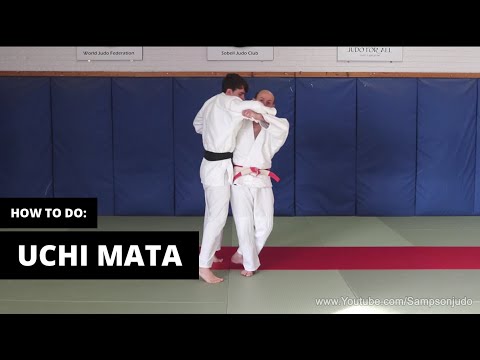
How to do Uchi Mata
0
Standard Uchi Mata·Sampson Judo·Added by Admin
How to do Uchi Mata. In this video I am showing how to do one of the most popular throws in judo - Uchi Mata, Inner Thig…
Translation: inner thigh throw
Standard Uchi Mata is the classical execution where the thrower grips the opponent's lapel and sleeve, turns in with the back to the opponent, and drives the sweeping leg upward between the opponent's thighs while pulling strongly with both hands to rotate the opponent over the hip and attacking leg. [1] The entry requires the thrower to pivot on the support foot, loading the opponent onto the hip and sweeping leg simultaneously. [1],[2] The throw is completed when the sweeping leg lifts the opponent's centre of gravity past the point of no return, and the hand action wheels them over into a full rotation. [2],[3]
Uchi mata is widely regarded as the single most effective throw in judo competition, consistently ranking as the highest-scoring technique at World Championships and Olympic Games across multiple decades. [1] Daigo notes that uchi mata's versatility — adaptable to virtually any grip configuration and effective against opponents of all body types — makes it the most universally applicable throwing technique. [2] The throw generates exceptionally high impact force due to the combination of hip rotation and the upward lever action of the sweeping leg, producing clean ippon scores at a higher rate than most other techniques. [3]
Uchi mata was codified by Jigoro Kano as part of the original Kodokan nage-waza curriculum and is classified as an ashi-waza technique in the Kodokan gokyo. [1] The technique was refined into a dominant competition weapon by successive generations of Kodokan and university judo practitioners, with notable contributions from Kyuzo Mifune (10th dan), who demonstrated its application with extraordinary timing. [2] In the modern era, the technique has been carried forward through virtually every Kodokan-lineage school worldwide. [3]
Uchi mata has produced more ippon victories at the Olympic Games and World Judo Championships than any other single technique. [1] Notably, Kosei Inoue (JPN) used uchi mata as his primary technique to win the 2000 Sydney Olympics gold medal at 100 kg and three consecutive World Championship titles (1999, 2001, 2003). [2] Shohei Ono (JPN) won the 2016 Rio Olympics gold at 73 kg with uchi mata as a core weapon. [3] Statistical analyses of IJF World Tour events consistently place uchi mata among the top three scoring techniques across all weight categories. [1]
No images yet for this technique.
Sign in to suggest an image.
How to do Uchi Mata. In this video I am showing how to do one of the most popular throws in judo - Uchi Mata, Inner Thig…
No instructional courses yet for this technique.
Sign in to suggest a course.
Risk of injury to the person this technique is applied to
Inner thigh reaping action; knee ligament strain risk on defender
Skill level needed to execute this technique reliably
Whether this technique is allowed under major competition rule sets
Kodokan Judo — Official Nage-waza Classification
Traditional Judo throwing technique terminology (Kodokan Institute)
Official Kodokan ground technique classification system
Standard Japanese martial arts terminology (kanji/hiragana)
Established Japanese martial arts naming convention — native Japanese term (和語/漢語)
Traditional Judo throwing technique terminology (Kodokan Institute)
hip rotation speed, core strength, lower back stability
strong hips and core, good flexibility for turning entry
hip rotators, core, quadriceps, latissimus dorsi
Sampson Judo recommends holding onto the traditional lapel grip because it gives you better control—when you break your opponent's balance, your hand can come underneath to elevate and control them more effectively.
Once you break someone's balance to their toes, it's critical to keep them there and not let them slide backwards. Maintain that position while you execute the foot work for the throw.
Your left foot should come inward and step roughly inside your opponent's thigh of the leg you're sweeping—this leg action guides the throw as a sweeping motion, even though the power comes from the hips.
Keep your elbow nice and low—this position creates extra leverage for elevating and controlling your opponent during the throw.
Standard Uchi Mata is the classical execution where the thrower grips the opponent's lapel and sleeve, turns in with the back to the opponent, and drives the sweeping leg upward between the opponent's thighs while pulling strongly with both hands to rotate the opponent over the hip and attacking leg. The entry requires the thrower to pivot on the support foot, loading the opponent onto the hip and sweeping leg simultaneously.
The standard form of uchi-mata is the foundational version taught in all Kodokan-lineage judo schools, representing the classical mechanics as codified by the Kodokan. It has been the competition technique of choice for numerous Olympic and World Champions across weight categories.
IJF: legal — Legal throwing technique; IBJJF: legal — Legal at all belt levels; UWW: legal — Legal in both freestyle and Greco-Roman; Unified MMA: legal — Legal throwing technique; ADCC: legal — Legal; FIAS Sport Sambo: legal — Legal; FIAS Combat Sambo: legal — Legal
Danger rating 5/10. High — inner thigh reaping action; knee ligament strain risk on defender
The standard setup chain: Grip Setup (Kumi-kata) → Off-Balance (Kuzushi) → Entry (Tsukuri) → Execution (Kake).
Standard counters include: Lower Centre of Gravity — bend knees and drop hips to make the throw harder to execute / Block the Hip — post hand on the thrower's hip to prevent loading / Step Around — circle away from the throw direction to avoid being loaded / Grip Break — deny the thrower their preferred gripping configuration.
Common variants: Standard hip throw (full turn-in with hip below the opponent's centre of gravity); No-gi hip throw (adapted without gi grips, using overhook and collar tie); Drop hip throw (dropping to one knee to lower the fulcrum point); Combination hip throw (chaining from a failed foot technique or hand technique).
Uchi mata has produced more ippon victories at the Olympic Games and World Judo Championships than any other single technique. Notably, Kosei Inoue (JPN) used uchi mata as his primary technique to win the 2000 Sydney Olympics gold medal at 100 kg and three consecutive World Championship titles (1999, 2001, 2003).
Top errors to watch for: Stepping too far to the side instead of between the opponent's feet — the entry must be central / Not sweeping upward with enough force — the thigh must drive up with explosive leg extension / Bending at the waist during the entry, which lowers your head and weakens the throw / Not turning the back fully to the opponent — incomplete rotation results in a weak, off-angle throw.
The Standard Uchi Mata is also known as Uchi Mata, Classical Inner Thigh Reaping Throw, Standard Uchi Mata, Kihon Uchi Mata.