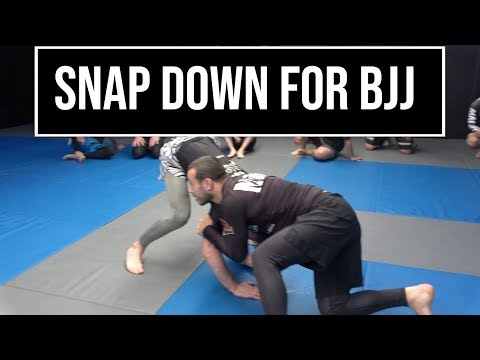
Snap down for BJJ (Lachlan Giles)
0
Two-On-One Snap Down·Absolute MMA St Kilda - Melbourne
Thank you to my wrestling coaches at Absolute MMA, who teach this much better than I do. SAVE on my highly reviewed ins…
Translation: two-on-one snap down (katakana)
The Two-On-One Snap Down subfamily uses a two-on-one arm control (both hands gripping one of the opponent's arms) to snap the opponent's posture down, using the controlled arm as a lever to break posture. [1] The two-on-one grip gives the attacker dominant control of one side of the opponent's body, and snapping down on this controlled arm forces the opponent's upper body forward and down. [1],[2] The two-on-one snap is particularly effective because it simultaneously controls the opponent's arm (preventing defensive framing) and breaks their posture. [2],[3]
The two-on-one snap down uses both hands controlling one side of the opponent to pull them downward, combining the Russian tie grip with a snap-down action. [1]
This technique combines the Russian tie grip system with the snap down, blending Russian and American wrestling techniques. [1]
The two-on-one snap down is used in wrestling and MMA competition. [1]
No images yet for this technique.
Sign in to suggest an image.
Thank you to my wrestling coaches at Absolute MMA, who teach this much better than I do. SAVE on my highly reviewed ins…
No instructional courses yet for this technique.
Sign in to suggest a course.
Risk of injury to the person this technique is applied to
Snap down forces opponent to mat; neck strain risk
Skill level needed to execute this technique reliably
Whether this technique is allowed under major competition rule sets
Japanese amateur wrestling terminology
Japanese amateur wrestling terminology
Standard katakana transliteration of Western martial arts terminology (外来語) — used in Japanese MMA, boxing, and BJJ communities
Standard katakana transliteration used in Japanese wrestling (レスリング)
grip strength, explosive downward pull, core stability
strong neck and traps for controlling the clinch
latissimus dorsi, biceps, forearms, core
Every move, in any martial art, shares a few universal traits. Mix and match below to pinpoint the right tool — or compare equivalents across styles.
According to Lachlan Giles, grip the back of the head with one hand and place your other hand on the top of the tricep, with both hands pulling together to drive your opponent's hands to the mat or face down to lower their level.
Lachlan Giles recommends disengaging and re-entering with better grips rather than trying to snap through their grip, as they can hang off your head or shoulder and prevent the technique. The key is to establish inside position—where your hand is on the inside—to prevent them from gripping you in the first place.
Instead of going straight for the snap, Lachlan Giles advises using pushing and blocking pressure with your hands in front, then coming behind only when you feel a reaction. This prevents your opponent from immediately postured up and knowing what you want to do.
Once they're down, grip the chin and pull your shoulder in front of their shoulder to control them. If they try to back away, the chin grip keeps you attached; if they drive forward, your shoulder blocks their access to your legs. From here you can transition to back control with a seat belt grip.
The Two-On-One Snap Down subfamily uses a two-on-one arm control (both hands gripping one of the opponent's arms) to snap the opponent's posture down, using the controlled arm as a lever to break posture. The two-on-one grip gives the attacker dominant control of one side of the opponent's body, and snapping down on this controlled arm forces the opponent's upper body forward and down.
Two-on-one snap downs developed within the broader Russian tie and two-on-one wrestling system, where controlling one arm provided multiple offensive options including the snap down. The technique is standard in freestyle wrestling training.
IJF: legal — Legal takedown technique; IBJJF: legal — Legal at all belt levels, scored as takedown (2 points); UWW: legal — Legal in both freestyle and Greco-Roman; Unified MMA: legal — Legal takedown technique; ADCC: legal — Legal, scored 2-4 points in second half of match; FIAS Sport Sambo: legal — Legal — all takedowns permitted; FIAS Combat Sambo: legal — Legal; NCAA Folkstyle: legal — Legal, scored as takedown (2 points)
Danger rating 4/10. Moderate — snap down forces opponent to mat; neck strain risk
The standard setup chain: Establish Contact → Create Off-Balance → Execute the Takedown → Follow to Ground.
Standard counters include: Sprawl — drop hips back and drive weight down to stuff the takedown attempt / Underhook — establish inside position to control distance and prevent the takedown entry / Post and Circle — post on the attacker's head and circle away to break their angle / Level Change Defence — recognize the shot early and react with appropriate hip defence.
Common variants: Collar tie snap-down (snapping with hand on the nape of the neck); Two-on-one snap (using two-on-one grip to snap the posture down); Snap-down to front headlock (following the snap with a front headlock for further attacks).
The two-on-one snap down is used in wrestling and MMA competition.
Top errors to watch for: Snapping downward while the opponent's arm is retracted and light — snap the weight-bearing arm / Holding the two-on-one too long before snapping — the opponent adjusts and braces / Pulling toward yourself instead of downward, bringing the opponent into you / Not releasing the arm after the snap to transition to the next attack — don't hold a dead position.
The Two-On-One Snap Down is also known as Tsū On Wan Sunappu Daun, Two-On-One Snap, Russian Tie Snap, Arm Control Snap Down.