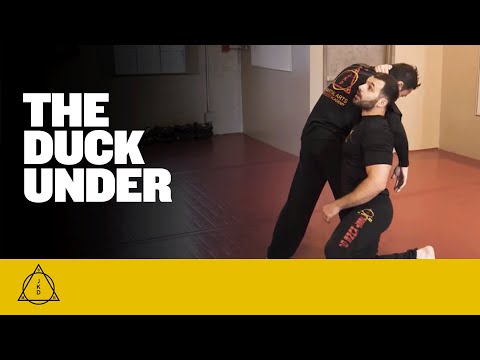
How to Take Down Your Opponent with the Duck Under
0
Standard Duck Under Technique·NY Martial Arts Academy·Added by Admin
https://www.nymaa.com/ Adult program https://bit.ly/2G4cMJ2 Kids program https://bit.ly/2X3B64G Private lessons https:/…
Translation: standard duck under technique
The Standard Duck Under Technique executes the fundamental duck under where the attacker, from a clinch or tie-up position, pushes the opponent's near arm upward, drops the level by bending the knees, ducks the head under the raised arm, and steps through to the opponent's side or back. [1] The technique requires coordinated timing of the arm push, level drop, and step-through — all three must happen nearly simultaneously. [1],[2] The attacker emerges on the other side of the opponent's arm with an angular advantage, ready to attack with whatever takedown is available from the new position. [2] The duck under is one of the most fundamental and frequently used set-up techniques in wrestling. [2],[3]
The duck under is a fundamental wrestling technique valued for its low energy cost and high success rate when the opponent is engaged in the clinch with a high posture. [1] The technique works by changing the angle of attack rather than relying on explosive level changes, making it effective for wrestlers who prefer finesse over power. [1] In MMA, the duck under is a safe entry because the attacker moves to the side or back of the opponent, minimising exposure to strikes. [2]
The duck under has been a staple of American folkstyle and freestyle wrestling for over a century. [1] Ben Askren, 2008 NCAA champion and multiple-time All-American, became known for his exceptionally effective duck under, which he used as a primary technique throughout his collegiate and MMA career. [2]
No images yet for this technique.
Sign in to suggest an image.
https://www.nymaa.com/ Adult program https://bit.ly/2G4cMJ2 Kids program https://bit.ly/2X3B64G Private lessons https:/…
No instructional courses yet for this technique.
Sign in to suggest a course.
Risk of injury to the person this technique is applied to
Duck under to rear; minimal impact, position-based
Skill level needed to execute this technique reliably
Whether this technique is allowed under major competition rule sets
Japanese amateur wrestling terminology
Japanese amateur wrestling terminology
Standard katakana transliteration of Western martial arts terminology (外来語) — used in Japanese MMA, boxing, and BJJ communities
Standard katakana transliteration used in Japanese wrestling (レスリング)
level change speed, agility, flexibility to duck under the arm
shorter stature for easier level change
quadriceps, core, neck, hip flexors
The collar tie is critical because you're dragging your opponent down to the mat from their neck, so you must keep it tight throughout the technique. According to NY Martial Arts Academy, you lock your hand on the opponent and pinch your forearm in to close the gap and maintain control from setup through the takedown.
The level change must come from your knees, never from bending at your hips or neck. NY Martial Arts Academy emphasizes that you dip slightly by dropping your knees while keeping your head up and your neck strong throughout the movement.
You need to become perpendicular to your opponent as you come around, with your knees bent, hips in, and back straight to maintain good posture. From this position, you grab the inside of the crotch and explode upward using your legs and hips to complete the takedown.
Pinch their arm tight between your shoulder and ear like you're holding a telephone, and maintain this pressure as you transition. NY Martial Arts Academy stresses keeping this grip secure because your opponent will try to pull their arm free.
The Standard Duck Under Technique executes the fundamental duck under where the attacker, from a clinch or tie-up position, pushes the opponent's near arm upward, drops the level by bending the knees, ducks the head under the raised arm, and steps through to the opponent's side or back. The technique requires coordinated timing of the arm push, level drop, and step-through — all three must happen nearly simultaneously.
The standard duck under technique has been taught in wrestling programmes worldwide as a basic offensive tool since the formalisation of modern wrestling curricula. Its universal applicability across clinch positions makes it one of the most practised wrestling movements.
IJF: legal — Legal takedown technique; IBJJF: legal — Legal at all belt levels, scored as takedown (2 points); UWW: legal — Legal in both freestyle and Greco-Roman; Unified MMA: legal — Legal takedown technique; ADCC: legal — Legal, scored 2-4 points in second half of match; FIAS Sport Sambo: legal — Legal — all takedowns permitted; FIAS Combat Sambo: legal — Legal; NCAA Folkstyle: legal — Legal, scored as takedown (2 points)
Danger rating 3/10. Moderate — duck under to rear; minimal impact, position-based
The standard setup chain: Establish Contact → Create Off-Balance → Execute the Takedown → Follow to Ground.
Standard counters include: Sprawl — drop hips back and drive weight down to stuff the takedown attempt / Underhook — establish inside position to control distance and prevent the takedown entry / Post and Circle — post on the attacker's head and circle away to break their angle / Level Change Defence — recognize the shot early and react with appropriate hip defence.
Common variants: Standard duck under (level changing under the opponent's arm to take the back); Duck under to single leg (using the duck under to transition to a single-leg attack); Duck under from overhook (ducking under when the opponent holds an overhook).
The duck under is one of the most commonly drilled and scored techniques in NCAA folkstyle wrestling. Ben Askren's funk-style wrestling, centred on the duck under and other unorthodox techniques, produced a 153-8 collegiate record and 2008 NCAA championship at 174 lbs.
Top errors to watch for: Pushing the arm and ducking simultaneously — push first, then duck for proper timing / Not bending the knees, so you duck by rounding your back (slow, weak, exposed) / Emerging on the other side and standing still without attacking — the angle disappears in a second / Head leading without the body following — your whole body must commit to the lateral movement.
The Standard Duck Under Technique is also known as Dakku Andā, Standard Duck Under TD, Dip-Under Takedown, Level-Drop Duck.