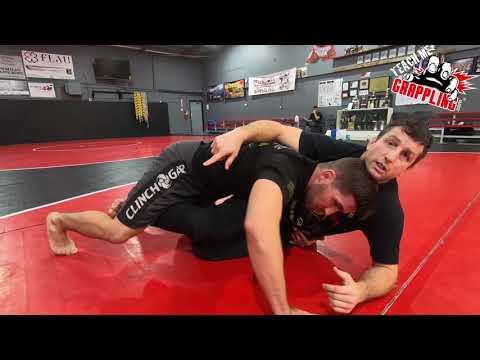
Passing that ANNOYING HOOK!!
0
Standard Russian Tie Drag·TeachMeGrappling Coach Brian
In this video, I demonstrate a common problem when passing the butterfly hooks. When you pressure smash the hooks to on…
Translation: standard Russian tie drag
The Standard Russian Tie Drag executes the fundamental two-on-one drag where the attacker secures a Russian tie on the opponent's arm, pulls the arm sharply across the body and past the hip, then follows the dragging motion to achieve a back position or angle for a takedown finish. [1] The attacker grips the wrist with one hand and the tricep/elbow with the other, then steps offline while pulling the arm to drag the opponent's body past. [1],[2] The opponent, pulled forward by their controlled arm, rotates and exposes their back. [2] The attacker can then finish with a back take, body lock, or single-leg entry from the dominant angle. [2],[3]
The Russian tie (two-on-one) drag creates a powerful angle for takedown entries because controlling both the opponent's wrist and triceps area negates their ability to post or defend with that arm. [1] The technique is effective as both a direct takedown entry and as a set-up for single legs, doubles, and go-behinds. [1]
The Russian tie (also called the Russian two-on-one) became prominent in international wrestling through Soviet and Russian freestyle wrestlers, who developed sophisticated attack chains from this controlling grip. [1] The grip control concept has been adopted into BJJ and MMA grappling curricula. [2]
The standard Russian tie drag is a regular technique in international freestyle competition. [1]
No images yet for this technique.
Sign in to suggest an image.
In this video, I demonstrate a common problem when passing the butterfly hooks. When you pressure smash the hooks to on…
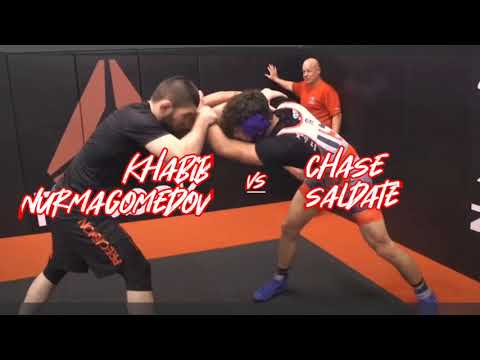
Chase Saldate vs Khabib "EAGLE" Nurmagomedov.. #chasesaldate #khahibnurmagomedov
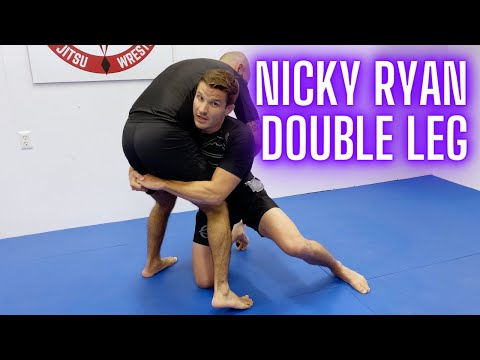
This past July, Nicky Ryan went head-to-head with fellow ADCC veteran, Dante Leon. Nicky put on a wresting clinic both f…
The Standard Russian Tie Drag is a takedown technique that leverages upper-body control to drive an opponent downward and backward. Merge Grappling's analysis of Nicky Ryan's execution demonstrates the foundational mechanics: after securing a collar tie or front headlock position, the attacker clears the opponent's arm by popping it upward—using either a palm strike or C-grip—which simultaneously lowers the attacker's level and removes the opponent's defensive posture. The attacker then establishes a double-leg connection, ideally with hands clasped in an S-grip on the hamstrings and thighs, which prevents the opponent from opening their legs to establish closed guard and makes sprawling ineffective as a defense. During the drag phase, the attacker maintains hip control while transitioning toward a body lock position, keeping their head centered to maintain posture and prevent the opponent from turning into them. TeachMeGrappling Coach Brian emphasizes the importance of directional footwork during drag execution: rather than continuously moving away from defensive hooks, the attacker should walk backward toward the hook, allowing the hips to drop and neutralize the opponent's leverage before clearing the leg with a windshield-wiper motion or underhook. This positional awareness prevents the attacker from getting caught in a stalled position. The technique culminates in side control or a dominant grappling position. HiLander Farm's footage provides live competitive context showing the intensity and timing demands of the technique under match conditions.
Synthesized from 3 instructors
No instructional courses yet for this technique.
Sign in to suggest a course.
Risk of injury to the person this technique is applied to
Drag/snap motion for off-balancing; low impact
Skill level needed to execute this technique reliably
Whether this technique is allowed under major competition rule sets
Japanese amateur wrestling terminology
Japanese amateur wrestling terminology
Standard katakana transliteration of Western martial arts terminology (外来語) — used in Japanese MMA, boxing, and BJJ communities
Standard katakana transliteration used in Japanese wrestling (レスリング)
upper body squeeze strength, lifting power, hip drive
thick chest and arms for tight lock, strong lower back for lifts
pectorals, biceps, erector spinae, glutes
Coach Brian recommends walking your hips back after getting the opponent's knee moving, which allows you to clear the hook and reposition to the other side to maintain control.
Coach Brian notes you can use either a leg weave or, alternatively, push the opponent's knee and fold the other way while blocking with your chest to get their back to the mat.
The Standard Russian Tie Drag executes the fundamental two-on-one drag where the attacker secures a Russian tie on the opponent's arm, pulls the arm sharply across the body and past the hip, then follows the dragging motion to achieve a back position or angle for a takedown finish. The attacker grips the wrist with one hand and the tricep/elbow with the other, then steps offline while pulling the arm to drag the opponent's body past.
The standard Russian tie drag was developed in Soviet wrestling programmes and has been a staple of international freestyle wrestling competition for decades. The technique was widely adopted in MMA and BJJ through cross-training with wrestlers.
IJF: legal — Legal takedown technique; IBJJF: legal — Legal at all belt levels, scored as takedown (2 points); UWW: legal — Legal in both freestyle and Greco-Roman; Unified MMA: legal — Legal takedown technique; ADCC: legal — Legal, scored 2-4 points in second half of match; FIAS Sport Sambo: legal — Legal — all takedowns permitted; FIAS Combat Sambo: legal — Legal; NCAA Folkstyle: legal — Legal, scored as takedown (2 points)
Danger rating 3/10. Moderate — drag/snap motion for off-balancing; low impact
The standard setup chain: Establish Contact → Create Off-Balance → Execute the Takedown → Follow to Ground.
Standard counters include: Sprawl — drop hips back and drive weight down to stuff the takedown attempt / Underhook — establish inside position to control distance and prevent the takedown entry / Post and Circle — post on the attacker's head and circle away to break their angle / Level Change Defence — recognize the shot early and react with appropriate hip defence.
Common variants: Front body lock (securing the lock face-to-face and driving laterally or b…); Rear body lock (securing from behind for mat returns or lifts); Side body lock (angled body lock for trips and throws); Body lock to trip (combining the lock with a foot trip for the finish).
The standard Russian tie drag is a regular technique in international freestyle competition.
Top errors to watch for: Holding the Russian tie without attacking — it's a transitional control, not a stalling position / Dragging the arm across your front instead of past your hip — doesn't create enough angle / Not pivoting your body during the drag, so you end up face-to-face / Releasing both hands from the arm before securing the body lock — they escape in the gap.
The Standard Russian Tie Drag is also known as Roshian Tai Doraggu, Standard Russian Tie Takedown, Two-On-One to Back Take, Russian Arm Drag.