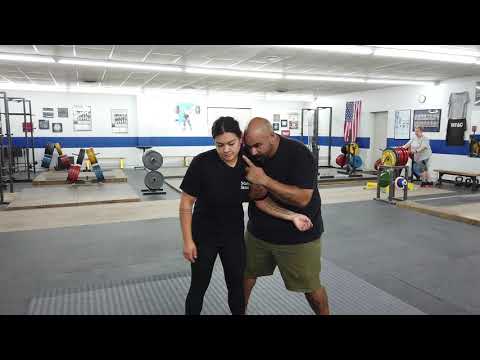
6. Arm Drag to Russian Tie
0
Russian Tie Drag·Lift. Fight. Win.
Learning the arm drag and introduction to the Russian Tie.
Translation: Russian tie drag (katakana)
The Russian Tie Drag subfamily uses the Russian tie grip — a two-on-one control where both hands grip the opponent's one arm at the wrist and above the elbow — to drag the opponent past the attacker and create a takedown opportunity. [1] The Russian tie provides powerful leverage against a single arm, allowing the attacker to redirect the opponent's body by pulling that arm in the desired direction. [1],[2] The drag motion pulls the opponent forward and past the attacker, typically leading to a back take, single-leg entry, or snap-down finish. [2],[3]
The Russian tie (also called 2-on-1) is a grip originating from Russian freestyle and Greco-Roman wrestling, widely adopted in international competition. [1]
The Russian tie is a common setup in Olympic freestyle and Greco-Roman wrestling. [1]
No images yet for this technique.
Sign in to suggest an image.
Learning the arm drag and introduction to the Russian Tie.
No instructional courses yet for this technique.
Sign in to suggest a course.
Risk of injury to the person this technique is applied to
Drag/snap motion for off-balancing; low impact
Skill level needed to execute this technique reliably
Whether this technique is allowed under major competition rule sets
Japanese amateur wrestling terminology
Japanese amateur wrestling terminology
Standard katakana transliteration of Western martial arts terminology (外来語) — used in Japanese MMA, boxing, and BJJ communities
Standard katakana transliteration used in Japanese wrestling (レスリング)
grip strength, explosive downward pull, core stability
strong neck and traps for controlling the clinch
latissimus dorsi, biceps, forearms, core
Every move, in any martial art, shares a few universal traits. Mix and match below to pinpoint the right tool — or compare equivalents across styles.
You want to catch right above the elbow with your whole hand formed as a hook. According to Lift. Fight. Win., aim slightly above the elbow rather than directly at it, since aiming for the elbow itself makes you more likely to miss if your opponent pulls their arm back quickly.
Head control prevents your opponent from turning inward and helps you maintain the position. Lift. Fight. Win. emphasizes applying gentle forward pressure with your head while making contact, and notes that head control becomes less critical once you transition to controlling posture with your shoulder and hand on the hip.
Trying to throw or pull your opponent across your body in one motion typically doesn't work, especially against larger or stronger opponents. Lift. Fight. Win. notes that if someone is bigger or stronger, they simply won't move using that approach, so you need to focus on control rather than raw pulling force.
Yes, it's a good idea to occupy both hands and get them doing something. Lift. Fight. Win. emphasizes wanting contact as quickly as possible and feeling your opponent rather than trying to catch them in the air.
The Russian Tie Drag subfamily uses the Russian tie grip — a two-on-one control where both hands grip the opponent's one arm at the wrist and above the elbow — to drag the opponent past the attacker and create a takedown opportunity. The Russian tie provides powerful leverage against a single arm, allowing the attacker to redirect the opponent's body by pulling that arm in the desired direction.
The Russian tie is a foundational wrestling control position developed in Soviet and Russian wrestling programmes, where it was used as a primary offensive tool in both freestyle and Greco-Roman competition. The drag application became standard wrestling technique taught worldwide.
IJF: legal — Legal takedown technique; IBJJF: legal — Legal at all belt levels, scored as takedown (2 points); UWW: legal — Legal in both freestyle and Greco-Roman; Unified MMA: legal — Legal takedown technique; ADCC: legal — Legal, scored 2-4 points in second half of match; FIAS Sport Sambo: legal — Legal — all takedowns permitted; FIAS Combat Sambo: legal — Legal; NCAA Folkstyle: legal — Legal, scored as takedown (2 points)
Danger rating 3/10. Moderate — drag/snap motion for off-balancing; low impact
The standard setup chain: Establish Contact → Create Off-Balance → Execute the Takedown → Follow to Ground.
Standard counters include: Sprawl — drop hips back and drive weight down to stuff the takedown attempt / Underhook — establish inside position to control distance and prevent the takedown entry / Post and Circle — post on the attacker's head and circle away to break their angle / Level Change Defence — recognize the shot early and react with appropriate hip defence.
Common variants: Collar tie snap-down (snapping with hand on the nape of the neck); Two-on-one snap (using two-on-one grip to snap the posture down); Snap-down to front headlock (following the snap with a front headlock for further attacks).
The Russian tie is a common setup in Olympic freestyle and Greco-Roman wrestling.
Top errors to watch for: Gripping the Russian tie too loosely — you need firm wrist and elbow control / Pulling the arm toward you instead of past your body — they just bump into your chest / Standing still during the drag instead of circling behind them / Not transitioning to a takedown after achieving the angle — the Russian tie is a means, not an end.
The Russian Tie Drag is also known as Roshian Tai Doraggu, Russian Tie, Two-On-One Drag, Russkiy Zakhvat.