Kani basami
0
Kani Basami·Energia Martial Arts
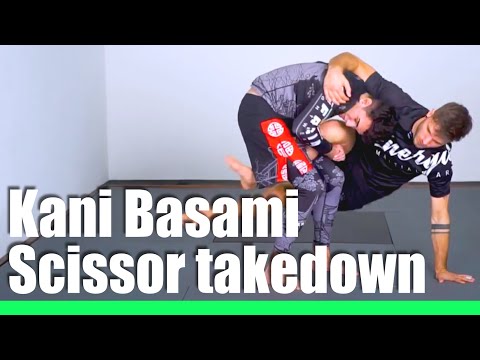
Kani basami The scissor takedown! We are sharing part of our DVD 'Leglocks Unlocked'; available at BJJ Fanatics. In th…
Translation: scissor throw (crab pinch)
Kani Basami (crab scissors) is a scissor takedown subfamily where the attacker jumps or drops beside the opponent and scissors their legs around the opponent's legs — one leg sweeping forward at the knees and the other sweeping backward at the ankles — to topple the opponent sideways. [1] The scissoring action creates a powerful rotational force that is nearly impossible to resist once the legs are in position. [1],[2] Despite its effectiveness, kani basami carries significant injury risk because the scissoring force can hyperextend or laterally stress the opponent's knee joint. [2] The technique has been banned in judo (IJF) competition since 1980 but remains legal in certain sambo, submission grappling, and some MMA rulesets. [2],[3]
Kani basami is a classical judo technique that was once commonly used in competition before the IJF banned it following a series of serious knee injuries. [1] The technique's dramatic effectiveness ensured its survival in sambo and no-gi grappling competitions where it remains a legal and effective weapon. [2],[3]
No images yet for this technique.
Sign in to suggest an image.
Kani basami The scissor takedown! We are sharing part of our DVD 'Leglocks Unlocked'; available at BJJ Fanatics. In th…
No instructional courses yet for this technique.
Sign in to suggest a course.
Risk of injury to the person this technique is applied to
Broke Yasuhiro Yamashita's fibula at 1980 All Japan Championships. Scissoring action can fracture tibia/fibula, tear ACL/MCL/PCL, and dislocate the knee instantaneously with no opportunity to tap. Banned from judo, IBJJF, and ADCC for causing career-ending injuries. [1,2,3]
Skill level needed to execute this technique reliably
Whether this technique is allowed under major competition rule sets
Kodokan Judo — Official Nage-waza Classification
Traditional Judo throwing/takedown terminology (Kodokan Institute)
Official Kodokan ground technique classification system
Standard Japanese martial arts terminology (kanji/hiragana)
Established Japanese martial arts naming convention — native Japanese term (和語/漢語)
Traditional Judo throwing/takedown terminology (Kodokan Institute)
timing, balance, upper body control for push-pull
good coordination and sense of opponent's weight distribution
core stabilisers, hip adductors/abductors, calves
Every move, in any martial art, shares a few universal traits. Mix and match below to pinpoint the right tool — or compare equivalents across styles.
Your rear leg makes a back step on your opponent's secondary leg while your primary leg goes across their thigh, creating a scissor on both a high and low point. Keep yourself high and positioned close to their hip as you execute the technique.
Lean in a bit as you fall—doing it in one continuous motion rather than step-by-step will make it much easier to reach. Just be careful not to drop your hip during the movement.
Keep control of your opponent's armpit or shoulder to prevent them from pushing their knee to the outside. Since your leg is already on the inside, lean into them and swing your other leg back to maintain the scissor position.
When your opponent shoots for the single leg, keep your body weight close to them and control their head or armpit, then throw your leg back to transition into the Kani Basami. You can also tempt them into taking the single leg by staying in a grip-fighting position with one foot forward.
Kani Basami (crab scissors) is a scissor takedown subfamily where the attacker jumps or drops beside the opponent and scissors their legs around the opponent's legs — one leg sweeping forward at the knees and the other sweeping backward at the ankles — to topple the opponent sideways. The scissoring action creates a powerful rotational force that is nearly impossible to resist once the legs are in position.
Kani basami is a classical judo technique that was once commonly used in competition before the IJF banned it following a series of serious knee injuries. The technique's dramatic effectiveness ensured its survival in sambo and no-gi grappling competitions where it remains a legal and effective weapon.
IJF: banned — Scissor takedowns prohibited; IBJJF: banned — Scissor takedown prohibited at all belt levels; UWW: banned — Scissor holds on body prohibited in both freestyle and Greco-Roman; Unified MMA: legal — Legal takedown technique; ADCC: banned — Scissor takedowns banned in all divisions except adult advanced; FIAS Sport Sambo: legal — Legal — all takedowns permitted; FIAS Combat Sambo: legal — Legal; NCAA Folkstyle: legal — Legal, scored as takedown (2 points)
Danger rating 10/10. Extreme — broke Yasuhiro Yamashita's fibula at 1980 All Japan Championships. Scissoring action can fracture tibia/fibula, tear ACL/MCL/PCL, and dislocate the knee instantaneously with no opportunity to tap. Banned from judo, IBJJF, and ADCC for causing career-ending injuries.
The standard setup chain: Establish Contact → Create Off-Balance → Execute the Takedown → Follow to Ground.
Standard counters include: Sprawl — drop hips back and drive weight down to stuff the takedown attempt / Underhook — establish inside position to control distance and prevent the takedown entry / Post and Circle — post on the attacker's head and circle away to break their angle / Level Change Defence — recognize the shot early and react with appropriate hip defence.
Common variants: Standard trip (blocking or sweeping the support leg while driving the up…); Combination trip (chaining an inside trip with an outside trip when the opp…); Counter trip (using the trip as a counter when the opponent attacks); Clinch trip (executing the trip from a tight clinch position).
Kani basami was banned from IJF judo competition in 1980 after causing multiple serious knee injuries. It remains legal in IBJJF competition for brown and black belts and in some sambo rule sets.
Top errors to watch for: Dropping straight in front of the opponent instead of to the side — they fall on top of you / Scissoring at the same level (both legs at the knees) instead of one high and one low / Not controlling the upper body, so the opponent can step over your legs / Applying too much lateral force to the knee joint — control the power to protect training partners.
The Kani Basami is also known as Kani Basami, Crab Scissors, Flying Scissors Takedown, Nozhnitsy.