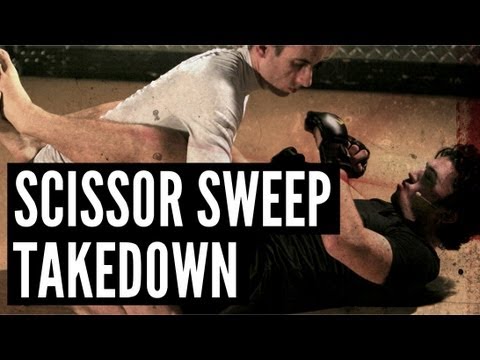
The Scissor Sweep Takedown MMA Surge, Episode 20
0
Scissor Takedown·mahalodotcom
Get Squid's 10 secret moves! http://goo.gl/hizGB How to Pull It Off: 1. Hook your right arm through opponent's left arm…
Translation: scissor takedown
The Scissor Takedown family covers techniques where the attacker uses a scissors-like leg action — one leg attacking high and the other attacking low simultaneously — to take the opponent to the ground. [1] The scissoring motion creates opposing forces on the opponent's body: one leg sweeps or blocks above the knee while the other sweeps or blocks below, creating an irresistible rotational force. [1],[2] The most notable technique in this family is kani basami (scissors sweep/crab scissors), which is one of the most controversial throws in judo due to its effectiveness but significant injury risk. [2] Scissor takedowns have been banned or restricted in several competition rulesets due to the knee injury potential of the scissoring action on the opponent's legs. [2],[3]
Scissor takedowns have been part of judo and various wrestling traditions, with kani basami being classified as a judo technique in the Kodokan system. [1] The IJF banned kani basami from judo competition in 1980 after multiple knee injuries, though the technique remains legal in some sambo and submission grappling rulesets. [2],[3]
No images yet for this technique.
Sign in to suggest an image.
Get Squid's 10 secret moves! http://goo.gl/hizGB How to Pull It Off: 1. Hook your right arm through opponent's left arm…
No instructional courses yet for this technique.
Sign in to suggest a course.
Risk of injury to the person this technique is applied to
Kani basami broke Yasuhiro Yamashita's fibula at the 1980 All Japan Championships, ending his competition career and leading to a worldwide ban. The scissoring action can fracture the tibia/fibula, tear ACL/MCL/PCL, and dislocate the knee. Unlike submissions where the defender can tap, injury occurs instantaneously during the takedown — there is no opportunity to submit. Multiple broken legs documented in judo and sambo competition. [1,2,3]
Skill level needed to execute this technique reliably
Whether this technique is allowed under major competition rule sets
Kodokan Judo — Official Nage-waza Classification
Kodokan — Kani-basami (蟹挟) classification
Official Kodokan ground technique classification system
Standard Japanese martial arts terminology (kanji/hiragana)
Established Japanese martial arts naming convention — native Japanese term (和語/漢語)
Kodokan — Kani-basami (蟹挟) classification
timing, balance, upper body control for push-pull
good coordination and sense of opponent's weight distribution
core stabilisers, hip adductors/abductors, calves
Every move, in any martial art, shares a few universal traits. Mix and match below to pinpoint the right tool — or compare equivalents across styles.
The scissor takedown (kani basami) was banned from IJF judo competition after causing severe knee injuries — the attacker scissors their legs around the opponent's legs, which can trap and torque the knee. Still legal in Sambo and some MMA rulesets. (IJF Sport and Organisation Rules; Kano, Kodokan Judo)
According to MMA Surge, you can use the underhook as an opportunity to initiate the takedown by securing an overhook and grabbing the inner thigh, then stepping between their legs and sweeping them down while maintaining the overhook.
Make sure your legs cross completely during the sweep, as this ensures you get the takedown; when you hit the mat, keep the overhook if you still have it and advance to a better position.
Turn to the side and get both of your feet to line up with your opponent's feet, place your hand to the mat, bring your leg up, and sweep like a scissor motion.
The Scissor Takedown family covers techniques where the attacker uses a scissors-like leg action — one leg attacking high and the other attacking low simultaneously — to take the opponent to the ground. The scissoring motion creates opposing forces on the opponent's body: one leg sweeps or blocks above the knee while the other sweeps or blocks below, creating an irresistible rotational force.
Scissor takedowns have been part of judo and various wrestling traditions, with kani basami being classified as a judo technique in the Kodokan system. The IJF banned kani basami from judo competition in 1980 after multiple knee injuries, though the technique remains legal in some sambo and submission grappling rulesets.
IJF: banned — Scissor takedowns prohibited; IBJJF: banned — Scissor takedown prohibited at all belt levels; UWW: banned — Scissor holds on body prohibited in both freestyle and Greco-Roman; Unified MMA: legal — Legal takedown technique; ADCC: banned — Scissor takedowns banned in all divisions except adult advanced; FIAS Sport Sambo: legal — Legal — all takedowns permitted; FIAS Combat Sambo: legal — Legal; NCAA Folkstyle: legal — Legal, scored as takedown (2 points)
Danger rating 10/10. Extreme — kani basami broke Yasuhiro Yamashita's fibula at the 1980 All Japan Championships, ending his competition career and leading to a worldwide ban. The scissoring action can fracture the tibia/fibula, tear ACL/MCL/PCL, and dislocate the knee. Unlike submissions where the defender can tap, injury occurs instantaneously during the takedown — there is no opportunity to submit. Multiple broken legs documented in judo and sambo competition.
The standard setup chain: Establish Contact → Create Off-Balance → Execute the Takedown → Follow to Ground.
Standard counters include: Sprawl — drop hips back and drive weight down to stuff the takedown attempt / Underhook — establish inside position to control distance and prevent the takedown entry / Post and Circle — post on the attacker's head and circle away to break their angle / Level Change Defence — recognize the shot early and react with appropriate hip defence.
Common variants: Standard trip (blocking or sweeping the support leg while driving the up…); Combination trip (chaining an inside trip with an outside trip when the opp…); Counter trip (using the trip as a counter when the opponent attacks); Clinch trip (executing the trip from a tight clinch position).
Kani basami was banned from IJF judo competition after multiple serious knee injuries. It is still permitted in some sambo rule sets.
Top errors to watch for: Half-committing to the scissor, which leaves you on the ground with the opponent standing / Both legs going in the same direction instead of opposing directions / Not controlling the upper body during the entry, so the opponent can jump over your legs / Attempting scissors against a wide-stanced opponent who is difficult to topple.
The Scissor Takedown is also known as Kani-basami, Scissor Sweep, Leg Scissors, Flying Scissors.