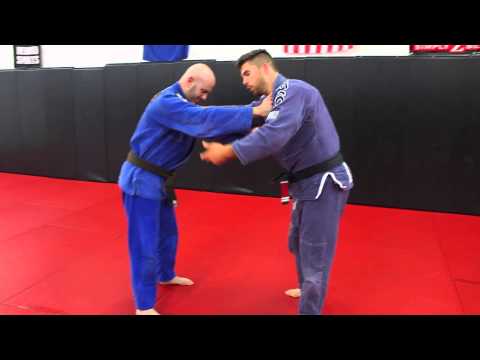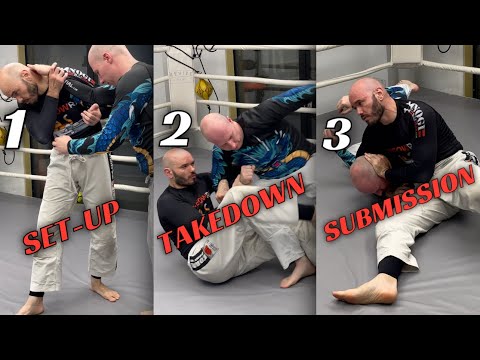
Takedown to instant Submission: Russian tie up to sacrifice throw to Bulldog choke
0
TKD Sacrifice Throw·Ramsey Dewey
Another video in my series on takedowns that lead directly to fight ending submissions. I got a few questions about how …
Translation: Taekwondo sacrifice throw
Cross-style technique adapted for modern combat sports. [1]
Effective in modern MMA and cross-style competition. [1]
Cross-style martial arts. [1]
Used in modern MMA and combat sports
No images yet for this technique.
Sign in to suggest an image.
Not yet documented
Another video in my series on takedowns that lead directly to fight ending submissions. I got a few questions about how …
www.Chewjitsu.net In this video I demonstrate a technique that I've used a ton over the years. My student's have also h…
The TKD sacrifice throw is a takedown technique that leverages a two-on-one grip (Russian tie-up) to execute a lateral drop, transitioning seamlessly into ground control or submission. Ramsey Dewey emphasizes the mechanics of chaining the Russian two-on-one into a sacrifice throw by sitting out behind the opponent, securing a butterfly hook on one leg, and accelerating the opponent's rotation to complete the throw. He demonstrates how this technique naturally flows into submissions, particularly the bulldog choke, where the controlling arm loops around the opponent's neck as they rotate. Chewjitsu presents the sacrifice throw as a higher-percentage takedown for Brazilian jiu-jitsu contexts, teaching it progressively from a ground-based butterfly guard sweep position before building to standing execution. Both instructors agree on core mechanics: establishing grips (Dewey favors the Russian two-on-one with torsion knot configurations; Chewjitsu uses straight or cross-collar grips), stepping in to move the opponent forward, and falling to the side while pulling the opponent's body over in a controlled manner. Dewey highlights submission applications and notes that larger opponents may not rotate as dramatically, potentially reducing choke effectiveness. Chewjitsu frames the throw as a tactical option against wrestler-type opponents, noting that failed attempts leave the thrower in butterfly guard—a reasonable fallback position. Both instructors stress maintaining grips throughout the execution and emphasize the importance of body mechanics over raw strength.
Synthesized from 2 instructors
No instructional courses yet for this technique.
Sign in to suggest a course.
Risk of injury to the person this technique is applied to
Technique varies by application
Skill level needed to execute this technique reliably
Whether this technique is allowed under major competition rule sets
Lukasz, T. Taekwondo Grappling Techniques: Hone Your Competitive Edge for Mixed Martial Arts.
[1] Lukasz, Taekwondo Grappling Techniques — technique description and application
Good timing
Explosive movement
The TKD sacrifice throw is documented in Lukasz's Taekwondo Grappling Techniques — adapting sacrifice throw mechanics into the TKD competitive framework. (Lukasz, Taekwondo Grappling Techniques)
From a Russian two-on-one grip, sit back to your side (not flat on your back), hook one of your opponent's legs with a butterfly hook, then kick them over while accelerating their rotation. Ramsey Dewey emphasizes that this setup creates a handle to pull your opponent around and put them on the floor.
Chewjitsu recommends starting by drilling the motion from the ground first, using a butterfly guard sweep to get the feel for the movement before attempting it on the feet. This allows you to understand the body mechanics before adding the standing component.
Yes—the hand controlling your opponent's arm in the Russian two-on-one can transition into a choking arm that loops around their neck for a bulldog choke as you sit out in front to finish, according to Ramsey Dewey.
Leaning to your side (rather than flat to your back) keeps your opponent's body extended and in the proper position for the leg turn and throw, as Chewjitsu demonstrates.
The TKD Sacrifice Throw uses a falling-backward motion to throw the opponent over, adapted from judo sacrifice throws for TKD competition.
Cross-style technique adapted for modern combat sports.
IJF: legal — Legal takedown technique; IBJJF: legal — Legal at all belt levels, scored as takedown (2 points); UWW: legal — Legal in freestyle, may be restricted in Greco-Roman depending on technique; Unified MMA: legal — Legal takedown technique; ADCC: legal — Legal, scored 2-4 points in second half of match; FIAS Sport Sambo: legal — Legal — all takedowns permitted; FIAS Combat Sambo: legal — Legal; NCAA Folkstyle: legal — Legal, scored as takedown (2 points)
Danger rating 4/10. Technique varies by application
The standard setup chain: Engagement → TKD Sacrifice Throw → Follow-up.
Standard counters include: Sprawl / Block / Counter-attack.
Used in modern MMA and combat sports
Top errors to watch for: Poor timing / Over-committing.
The TKD Sacrifice Throw is also known as Tekondō Sutemi Waza, Taekwondo Sacrifice, TKD Pull Throw.