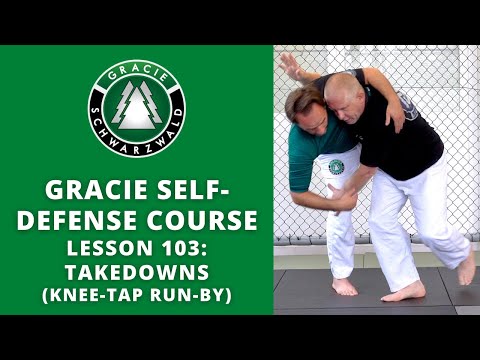
BJJ Self-Defense Course | Lesson 103: Run-By Knee-Tap Takedown
0
Knee Tap·Gracie Schwarzwald Jiu-Jitsu·Added by Admin
We hope everyone is enjoying our Gracie Jiu-Jitsu Self-Defense Course. We are offering these lessons for free, but If y…
Translation: knee tap (katakana)
The Knee Tap is a sweep single genus where the attacker pushes the opponent's weight to one side using upper body control, then taps or blocks the loaded knee from the outside, collapsing the leg and causing the opponent to fall. [1] The attacker uses a collar tie, post, or push to shift the opponent's weight onto one leg, then reaches down and taps the outside of that knee while simultaneously pushing the opponent over the collapsing leg. [1],[2] The knee tap requires minimal level change and is one of the lowest-energy takedowns available. [2] The technique is effective from standard tie-up positions and is often chained with snap-downs and ankle picks. [2],[3]
The knee tap is a high-percentage takedown because it requires minimal level change and can be executed from standard tie-up positions without a deep penetration step. [1] The technique exploits the opponent's forward weight shift by redirecting them to the mat with a pull-and-tap motion. [1] In MMA, the knee tap is valued for its speed and the minimal exposure to counterattacks during execution. [2]
The knee tap is a close-range takedown from wrestling that blocks or redirects the opponent's knee while driving their upper body, causing them to collapse. [1]
Georges St-Pierre frequently employed knee taps in UFC competition, using the technique as part of his takedown-heavy game plan during his welterweight championship reign (2006-2013). [1] The knee tap is widely used in collegiate wrestling as both a primary attack and a secondary finish from single-leg and tie-up positions. [2]
No images yet for this technique.
Sign in to suggest an image.
We hope everyone is enjoying our Gracie Jiu-Jitsu Self-Defense Course. We are offering these lessons for free, but If y…
No instructional courses yet for this technique.
Sign in to suggest a course.
Risk of injury to the person this technique is applied to
Single leg is one of the safest takedowns; controlled descent (John Smith methodology)
Skill level needed to execute this technique reliably
Whether this technique is allowed under major competition rule sets
Japanese amateur wrestling terminology
Japanese amateur wrestling terminology
Standard katakana transliteration of Western martial arts terminology (外来語) — used in Japanese MMA, boxing, and BJJ communities
Standard katakana transliteration used in Japanese wrestling (レスリング)
penetration step speed, upper body endurance for finishing, balance
longer arms for reach, quick hips for level change
quadriceps, hip flexors, shoulders, grip/forearms
According to Gracie Schwarzwald Jiu-Jitsu, the critical error is stopping after the initial block instead of continuing to move. The instructor emphasizes: don't stop after you step and block—keep running past your opponent to achieve a control position, as stopping requires more effort even if they fall.
You need to put weight on the leg you're about to block while controlling it with your hand, which prevents your opponent from being able to pick it up or shoot underneath you, according to Gracie Schwarzwald Jiu-Jitsu.
Lift the arm toward the ceiling rather than pushing outward, says Gracie Schwarzwald Jiu-Jitsu. This positioning, combined with maintaining your head in contact with their jaw, keeps them controlled while you move through.
The Knee Tap is a sweep single genus where the attacker pushes the opponent's weight to one side using upper body control, then taps or blocks the loaded knee from the outside, collapsing the leg and causing the opponent to fall. The attacker uses a collar tie, post, or push to shift the opponent's weight onto one leg, then reaches down and taps the outside of that knee while simultaneously pushing the opponent over the collapsing leg.
The knee tap has roots in various folk wrestling traditions and was refined as a standard technique in both wrestling and judo (similar to kibisu-gaeshi concepts). Its minimal energy expenditure and high success rate from the clinch made it popular in MMA.
IJF: banned — Banned since 2010 leg grab prohibition — direct hansoku-make for touching opp…; IBJJF: legal — Legal at all belt levels, scored as takedown (2 points); UWW: restricted — Legal in freestyle (2-4 points), banned in Greco-Roman (no attacks below waist); Unified MMA: legal — Legal takedown technique; ADCC: legal — Legal, scored 2-4 points in second half of match; FIAS Sport Sambo: legal — Legal — all takedowns permitted; FIAS Combat Sambo: legal — Legal; NCAA Folkstyle: legal — Legal, scored as takedown (2 points)
Danger rating 3/10. Moderate — single leg is one of the safest takedowns; controlled descent (John Smith methodology)
The standard setup chain: Establish Contact → Create Off-Balance → Execute the Takedown → Follow to Ground.
Standard counters include: Sprawl — drop hips back and drive weight down to stuff the takedown attempt / Underhook — establish inside position to control distance and prevent the takedown entry / Post and Circle — post on the attacker's head and circle away to break their angle / Level Change Defence — recognize the shot early and react with appropriate hip defence.
Common variants: Inside single (shooting to the inside of the lead leg, head inside position); Outside single (attacking from the outside of the lead leg); High crotch (securing the thigh above the knee with head in the hip); Low single (attacking the ankle from outside range without deep penet…).
Georges St-Pierre frequently employed knee taps in UFC competition, using the technique as part of his takedown-heavy game plan during his welterweight championship reign (2006-2013). The knee tap is widely used in collegiate wrestling as both a primary attack and a secondary finish from single-leg and tie-up positions.
Top errors to watch for: Tapping the knee without first loading weight onto it — the tap alone has no effect on an unloaded leg / Pushing and tapping at the same time instead of push first, then tap / Bending over to reach the knee instead of squatting — exposes the neck / Tapping the inside of the knee (pushing it outward) when the tap should go outside-in.
The Knee Tap is also known as Nī Tappu, Knee Pick, Knee Tap Takedown, Hiza Guruma (knee).