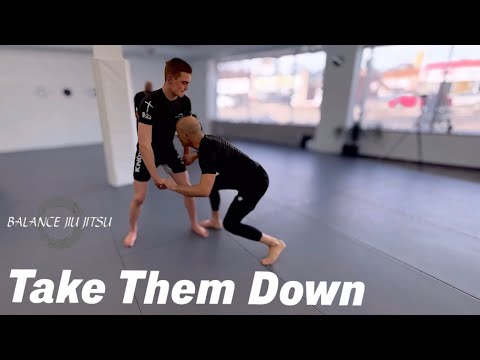
Double + Single Entry +Snatch Single Finish
0
Standard Snatch Double·BALANCE JIU JITSU·Added by Admin
Coach Derek Brignell shares information on double and single leg takedown entries and finishing information on a sweep s…
Translation: standard snatch double
The Standard Snatch Double executes the fundamental quick-pull double leg where the attacker, from a short distance, drops the level slightly and snatches both of the opponent's legs simultaneously with a sharp pulling motion directed toward the attacker's own body. [1] Rather than driving forward through the opponent, the snatch double pulls the opponent's legs out from under them, causing them to fall backward. [1],[2] The key is hand speed and timing — the snatch must coincide with a moment when the opponent's weight is centred or shifting forward. [2] The attacker typically finishes by following the collapsing opponent to the mat. [2],[3]
The snatch double is effective as a reactive takedown because it capitalises on the opponent's forward momentum or lowered hand position. [1] Unlike the blast double which relies on the attacker's explosive forward drive, the snatch double uses a quick drop-and-grab motion that can be executed from closer range with less telegraphing. [1]
The standard snatch double is the baseline version of this pulling double leg variant. [1]
Seen in freestyle wrestling competition at international level. [1]
No images yet for this technique.
Sign in to suggest an image.
Coach Derek Brignell shares information on double and single leg takedown entries and finishing information on a sweep s…
No instructional courses yet for this technique.
Sign in to suggest a course.
Risk of injury to the person this technique is applied to
Double leg drives through opponent; moderate impact on landing
Skill level needed to execute this technique reliably
Whether this technique is allowed under major competition rule sets
Japanese amateur wrestling terminology
Japanese amateur wrestling terminology
Standard katakana transliteration of Western martial arts terminology (外来語) — used in Japanese MMA, boxing, and BJJ communities
Standard katakana transliteration used in Japanese wrestling (レスリング)
explosive lower body power, level change speed, forward drive
stocky build with strong legs and low centre of gravity
quadriceps, glutes, hamstrings, core, shoulders
Keep your head on the outside and in line with your spine—never curved. Your back should be straight with your butt out as you change levels. Balance JiuJitsu emphasizes that your head being down will make you go down because it's heavy, so maintaining proper spinal alignment is critical.
Step into a triangle zone toward the center without stepping too deep, keeping your toes matched up roughly in a straight line with your opponent's toes. Stay close enough to your partner that you have a point of contact—never step far back and then come forward, as your opponent will see the attack coming.
The level change comes from your legs, not your upper body. Drive forward and up into your opponent's body rather than just going down; your shoulders should pop up as you generate power from your legs to remove space between you and your opponent.
Bring the arm above mid-thigh with your palm facing down. Step on the outside of your opponent's leg while keeping your head in line with your spine as you drive the attack.
The Standard Snatch Double executes the fundamental quick-pull double leg where the attacker, from a short distance, drops the level slightly and snatches both of the opponent's legs simultaneously with a sharp pulling motion directed toward the attacker's own body. Rather than driving forward through the opponent, the snatch double pulls the opponent's legs out from under them, causing them to fall backward.
The snatch double has been used in wrestling competition as a quick-score technique, particularly in freestyle wrestling where reaction-based attacks are rewarded. Its speed and low commitment made it popular among MMA fighters seeking to minimise exposure time during the shot.
IJF: banned — Banned since 2010 leg grab prohibition — direct hansoku-make for touching opp…; IBJJF: legal — Legal at all belt levels, scored as takedown (2 points); UWW: restricted — Legal in freestyle (2-4 points), banned in Greco-Roman (no attacks below waist); Unified MMA: legal — Legal takedown technique; ADCC: legal — Legal, scored 2-4 points in second half of match; FIAS Sport Sambo: legal — Legal — all takedowns permitted; FIAS Combat Sambo: legal — Legal; NCAA Folkstyle: legal — Legal, scored as takedown (2 points)
Danger rating 4/10. Moderate — double leg drives through opponent; moderate impact on landing
The standard setup chain: Establish Contact → Create Off-Balance → Execute the Takedown → Follow to Ground.
Standard counters include: Sprawl — drop hips back and drive weight down to stuff the takedown attempt / Underhook — establish inside position to control distance and prevent the takedown entry / Post and Circle — post on the attacker's head and circle away to break their angle / Level Change Defence — recognize the shot early and react with appropriate hip defence.
Common variants: Blast double (high-impact forward drive through the opponent without ch…); Snatch double (pulling both legs together and driving laterally); Run-the-pipe double (running through the opponent in a linear drive); Low double (deep penetration step attacking below the knees).
Seen in freestyle wrestling competition at international level.
Top errors to watch for: Snatching too slowly — this technique depends on surprising the opponent with speed / Pulling the knees apart instead of together — together eliminates their base / Not following up with forward pressure after the pull — the opponent recovers quickly / Head dropping below their hips during the snatch, inviting a guillotine or snap-down.
The Standard Snatch Double is also known as Sunatchi Daburu, Quick-Pull Double TD, Snatch-And-Go Double, Speed Double Leg.