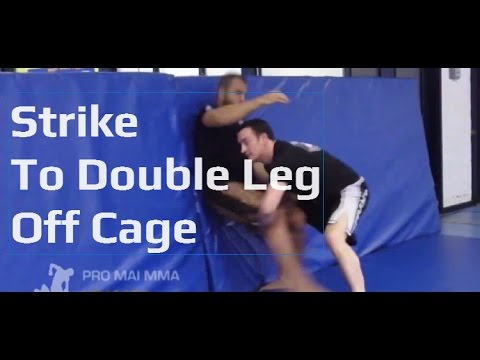
Double Leg Off Cage With Striking Set Up
0
Double Leg From Cage·MMA COACH
http://www.mma121.com | In this MMA Wrestling video we show you how to get a Double Leg Takedown off the cage by using y…
Translation: double leg from cage
The Double Leg From Cage subfamily covers double-leg takedown entries executed while the opponent is pressed against the cage wall, using the fence as a backstop. [1] Unlike open-mat double legs that require a penetration step across distance, the cage double leg starts from a clinch position against the wall, where the attacker drops level and attacks both legs from close range. [1],[2] The cage prevents the opponent from circling away or sprawling backward, forcing them to fight the takedown through grip fighting, hip position, and underhooks alone. [2] This is a fundamental MMA cage wrestling technique. [2],[3]
The cage double leg was developed by MMA wrestlers who adapted the open-mat double leg for cage fighting. [1]
The double leg from the cage is a high-percentage takedown in UFC competition, commonly used by wrestling-based fighters. [1]
No images yet for this technique.
Sign in to suggest an image.
http://www.mma121.com | In this MMA Wrestling video we show you how to get a Double Leg Takedown off the cage by using y…
No instructional courses yet for this technique.
Sign in to suggest a course.
Risk of injury to the person this technique is applied to
Cage/wall-assisted takedowns; controlled descent against structure
Skill level needed to execute this technique reliably
Whether this technique is allowed under major competition rule sets
Japanese MMA standard terminology
Japanese MMA standard terminology
Mixed Japanese-Western terminology — combines traditional Japanese terms with katakana loanwords
Katakana transliteration used in Japanese MMA/Shooto
explosive lower body power, level change speed, forward drive
stocky build with strong legs and low centre of gravity
quadriceps, glutes, hamstrings, core, shoulders
Every move, in any martial art, shares a few universal traits. Mix and match below to pinpoint the right tool — or compare equivalents across styles.
No—when shooting a double leg from the cage, prioritize a quick, dynamic snatch rather than the most technically perfect version. The MMA Coach emphasizes that proficiency matters less than speed and getting a clean result from there.
Maintain good posture throughout, execute a quick pass with your legs once you have hold, and immediately establish solid ground position. The MMA Coach stresses being dynamic rather than overly technical at this stage.
First get your opponent to lift their hands by disengaging and attacking upstairs, then perform a level change while maintaining good posture. Once you force their legs together and stretch them off the wall, pass as quickly as possible.
The Double Leg From Cage subfamily covers double-leg takedown entries executed while the opponent is pressed against the cage wall, using the fence as a backstop. Unlike open-mat double legs that require a penetration step across distance, the cage double leg starts from a clinch position against the wall, where the attacker drops level and attacks both legs from close range.
Double legs from the cage evolved as wrestlers adapted their shot-based takedowns to the cage environment in early MMA competition. The technique became standard MMA curriculum once fighters realised the fence eliminated most open-mat double-leg defences.
IJF: banned — Banned since 2010 leg grab prohibition — direct hansoku-make for touching opp…; IBJJF: legal — Legal at all belt levels, scored as takedown (2 points); UWW: restricted — Legal in freestyle (2-4 points), banned in Greco-Roman (no attacks below waist); Unified MMA: legal — Legal takedown technique; ADCC: legal — Legal, scored 2-4 points in second half of match; FIAS Sport Sambo: legal — Legal — all takedowns permitted; FIAS Combat Sambo: legal — Legal; NCAA Folkstyle: legal — Legal, scored as takedown (2 points)
Danger rating 4/10. Moderate — cage/wall-assisted takedowns; controlled descent against structure
The standard setup chain: Setup with Strikes or Feint → Level Change → Penetration Step → Head in Chest → Lift and Drive.
Standard counters include: Sprawl — drop hips back and drive weight down to stuff the takedown attempt / Sprawl and Cross-Face — combine hip drop with head push to flatten the attacker / Guillotine Choke — wrap the head during the shot attempt and apply front headlock pressure / Knee Strike — time a rising knee to meet the incoming level change.
Common variants: Blast double (high-impact forward drive through the opponent without ch…); Snatch double (pulling both legs together and driving laterally); Run-the-pipe double (running through the opponent in a linear drive); Low double (deep penetration step attacking below the knees).
The double leg from the cage is a high-percentage takedown in UFC competition, commonly used by wrestling-based fighters.
Top errors to watch for: Taking a penetration step against the cage when the opponent is already pinned — wastes time and telegraphs / Head on the outside against the cage, where the opponent can guillotine or knee you / Wrapping too low (around the knees instead of thighs) against the cage — no lifting leverage / Not maintaining upper body pressure during the level change, letting them pummel.
The Double Leg From Cage is also known as Daburu Reggu (Kēji kara), Cage Double Leg, Wall Double, Fence Double Leg.