ABOUT THE LOADING PHASE by Mihai Cozmei
0
Standard Front Body Lock TD·COZ archery, clothing and horses·Added by Admin
ABOUT THE LOADING PHASE In mounted archery, the nocking operation is supposed to bring the archer how fast possible in …
Translation: standard front body lock takedown
The Standard Front Body Lock TD is the fundamental genus-level execution of the front body lock takedown, where the attacker locks the grip around the opponent's waist, drops the level slightly, lifts the opponent's hips off the mat, and turns to deposit them on the ground. [1] The key mechanical principles are grip security (Gable grip or S-grip), hip displacement through lifting or lateral torque, and directional commitment — the attacker must choose a side and drive decisively. [1],[2] The technique finishes with the attacker landing in a dominant top position, typically side control or half guard. [2] Proper execution requires the attacker to keep their hips underneath the opponent's centre of mass throughout the lift. [2],[3]
This fundamental body lock technique has been taught in wrestling rooms worldwide for generations, forming part of the basic curriculum in Greco-Roman and freestyle wrestling. [1] Its application in MMA was popularised by clinch-heavy fighters who used it as a primary scoring and positioning tool. [2],[3]
The front body lock takedown is highly effective in clinch-heavy combat sports because the locked grip provides direct control of the opponent's centre of gravity. [1] In Greco-Roman wrestling, the front body lock is one of the primary offensive tools since leg attacks are prohibited. [1] In MMA, the technique has proven effective against the cage, where the wall prevents the opponent from retreating away from the lift. [2]
The front body lock takedown is foundational in Greco-Roman wrestling, which became an Olympic sport in 1896. [1] The technique is particularly associated with Russian and Eastern European Greco-Roman traditions, where clinch wrestling receives extensive training emphasis. [1] Alexander Karelin's dominance in Greco-Roman wrestling (1988-2000) showcased body lock techniques at the highest level. [2]
No images yet for this technique.
Sign in to suggest an image.
ABOUT THE LOADING PHASE In mounted archery, the nocking operation is supposed to bring the archer how fast possible in …
► Become a Member via Patreon: https://www.patreon.com/dpsbreakdowns ► Become a Member via YouTube Memberships: https:/…
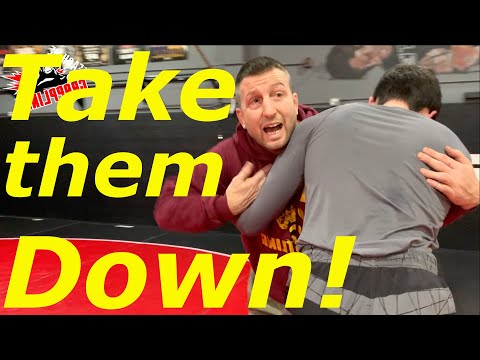
This video I teach my morning class a basic series I like from the pummel position. Check out the details and you are s…
The standard front body lock takedown is a clinch-based throwing technique executed from a double underhook position, primarily used in folkstyle wrestling and sport grappling. TeachMeGrappling Coach Brian and DPS Breakdowns provide complementary technical frameworks. Coach Brian emphasizes the entry sequence: securing the clinch, pummeling to establish double underhooks while maintaining an upright posture with hips driven in, then executing the takedown via either a lift-and-trip combination or a throw-by (rotating pivot that deepens the grip and cinches the lock). Critical defensive considerations include maintaining a solid base to prevent counter-headlocks, managing head position to avoid creating escape space, and controlling the opponent's hips. DPS Breakdowns, analyzing elite wrestler Zhumashbek's execution, details the underhook entry mechanics—exploiting elbow space gaps during handfighting or opponent leg attacks—and emphasizes the locking sequence, where throw-by pivots deepen arm positioning before the throw. The primary finishing method both instructors reference is the front uchimata (front inside thigh throw), combining upper-body twisting with knee elevation and rotation to elevate and rotate the opponent horizontally. Coach Brian notes secondary variations including direct hip lifts and knee blocks depending on opponent positioning and defensive responses to the initial lock setup.
Synthesized from 2 instructors
No instructional courses yet for this technique.
Sign in to suggest a course.
Risk of injury to the person this technique is applied to
Front body lock with trip/lift; moderate impact
Skill level needed to execute this technique reliably
Whether this technique is allowed under major competition rule sets
Japanese amateur wrestling terminology
Japanese amateur wrestling terminology
Mixed Japanese-Western terminology — combines traditional Japanese terms with katakana loanwords
Standard katakana transliteration used in Japanese wrestling (レスリング)
upper body squeeze strength, lifting power, hip drive
thick chest and arms for tight lock, strong lower back for lifts
pectorals, biceps, erector spinae, glutes
Coach Brian emphasizes maintaining a solid base and staying up when coming into the double under position, which prevents opponents from successfully securing a headlock against you.
If the opponent head blocks, take both hands and turn up facing upward, then execute a hard snap on the back of the shoulders with both hands.
Look for when your opponent's elbow space opens on one side, then use underhook entries to establish the bodylock position, as demonstrated by Zhumashbek's clinic approach.
The Standard Front Body Lock TD is the fundamental genus-level execution of the front body lock takedown, where the attacker locks the grip around the opponent's waist, drops the level slightly, lifts the opponent's hips off the mat, and turns to deposit them on the ground. The key mechanical principles are grip security (Gable grip or S-grip), hip displacement through lifting or lateral torque, and directional commitment — the attacker must choose a side and drive decisively.
This fundamental body lock technique has been taught in wrestling rooms worldwide for generations, forming part of the basic curriculum in Greco-Roman and freestyle wrestling. Its application in MMA was popularised by clinch-heavy fighters who used it as a primary scoring and positioning tool.
IJF: legal — Legal takedown technique; IBJJF: legal — Legal at all belt levels, scored as takedown (2 points); UWW: legal — Legal in both freestyle and Greco-Roman; Unified MMA: legal — Legal takedown technique; ADCC: legal — Legal, scored 2-4 points in second half of match; FIAS Sport Sambo: legal — Legal — all takedowns permitted; FIAS Combat Sambo: legal — Legal; NCAA Folkstyle: legal — Legal, scored as takedown (2 points)
Danger rating 5/10. High — front body lock with trip/lift; moderate impact
The standard setup chain: Close Distance → Establish the Lock → Hip Pressure → Lift or Trip.
Standard counters include: Sprawl — drop hips back and drive weight down to stuff the takedown attempt / Underhook Pummeling — fight for inside position to neutralize the lock / Hip Switch — rotate hips to break the grip angle and create separation / Knee Tap — redirect opponent's momentum with a quick leg attack.
Common variants: Front body lock (securing the lock face-to-face and driving laterally or b…); Rear body lock (securing from behind for mat returns or lifts); Side body lock (angled body lock for trips and throws); Body lock to trip (combining the lock with a foot trip for the finish).
Body lock takedowns are among the most frequently scored techniques in Greco-Roman wrestling at Olympic and World Championship level. In MMA, Daniel Cormier used front body lock takedowns extensively during his UFC heavyweight and light heavyweight championship reigns (2015-2019).
Top errors to watch for: Trying to muscle the lift without using hip extension — burns out the arms and fails against equal-sized opponents / Not stepping offline, resulting in a stalemate chest-to-chest / Head too high during the lift, allowing the opponent to snap you down / Releasing the grip too early on the landing, letting them recover guard.
The Standard Front Body Lock TD is also known as Shōmen Bodi Rokku, Front Bear Hug TD, Front Waist Lock Takedown, Pas Zakhvat Speredi.