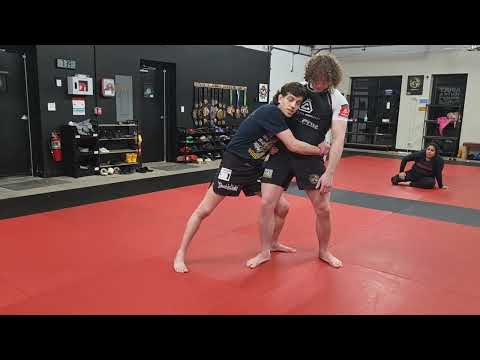
Front Body Lock Takedowns. Mat Return, Throw By, and more.
0
Front Body Lock Takedown·Pica Pau Jiu Jitsu & Grappling
Front Body Lock Takedowns. The Front Body Lock is a common takedown position where your opponent often has an Overhook …
Translation: front body lock takedown
The Front Body Lock Takedown family covers all takedowns executed from a front-facing body lock position where the attacker's arms encircle the opponent's torso from the front. [1] The attacker typically secures a Gable grip or clasp around the opponent's midsection, then uses a combination of lifting, rotating, and driving forces to bring the opponent to the mat. [1],[2] Front body lock entries commonly arise from clinch exchanges where the attacker achieves double underhooks or transitions from head-and-arm control to a locked body position. [2] This family is particularly effective against opponents who maintain an upright posture, as the locked grip allows the attacker to displace the opponent's hips directly. [2],[3]
No images yet for this technique.
Sign in to suggest an image.
Front Body Lock Takedowns. The Front Body Lock is a common takedown position where your opponent often has an Overhook …
No instructional courses yet for this technique.
Sign in to suggest a course.
Risk of injury to the person this technique is applied to
Front body lock with trip/lift; moderate impact
Skill level needed to execute this technique reliably
Whether this technique is allowed under major competition rule sets
Japanese amateur wrestling terminology
Japanese amateur wrestling terminology
Mixed Japanese-Western terminology — combines traditional Japanese terms with katakana loanwords
Standard katakana transliteration used in Japanese wrestling (レスリング)
upper body squeeze strength, lifting power, hip drive
thick chest and arms for tight lock, strong lower back for lifts
pectorals, biceps, erector spinae, glutes
Every move, in any martial art, shares a few universal traits. Mix and match below to pinpoint the right tool — or compare equivalents across styles.
The front body lock takedown uses double underhooks around the opponent's torso to drive them to the ground. Khabib Nurmagomedov's front body lock was the most dominant clinch takedown in UFC history — he used it to control and ground virtually every opponent. (MMA competition records; The Ultimate MMA Training Guide)
Make a wrist-to-wrist grip and pull your elbows in tightly—the tighter you lock this and the more you pull your elbows in, the better control you have over your opponent's hips. This prevents their hip from escaping to the side.
Pica Pau Jiu Jitsu & Grappling emphasizes that you must master the hip contact and walking pattern: get hip contact first, give a pop with the hip to lift them, then immediately start walking to keep their weight suspended rather than relying on one big lift.
Make sure your shoulder is under the opponent's body or you'll lose a lot of power. Additionally, ensure you have hip contact with minimal space between your hips—step in close to properly execute the mat return portion of the technique.
Don't overcommit or try to overpower if your opponent has a wizard, as this will cause you to compromise your own position and overcompensate. Instead, test their upper body by pushing your head into theirs to disrupt their balance.
The Front Body Lock Takedown family covers all takedowns executed from a front-facing body lock position where the attacker's arms encircle the opponent's torso from the front. The attacker typically secures a Gable grip or clasp around the opponent's midsection, then uses a combination of lifting, rotating, and driving forces to bring the opponent to the mat.
Front body lock takedowns are foundational in Greco-Roman wrestling and have been competition techniques since the sport's Olympic inclusion in 1896. The techniques were adapted for MMA competition where they serve as reliable takedowns from the clinch, particularly against the cage.
IJF: legal — Legal takedown technique; IBJJF: legal — Legal at all belt levels, scored as takedown (2 points); UWW: legal — Legal in both freestyle and Greco-Roman; Unified MMA: legal — Legal takedown technique; ADCC: legal — Legal, scored 2-4 points in second half of match; FIAS Sport Sambo: legal — Legal — all takedowns permitted; FIAS Combat Sambo: legal — Legal; NCAA Folkstyle: legal — Legal, scored as takedown (2 points)
Danger rating 5/10. High — front body lock with trip/lift; moderate impact
The standard setup chain: Close Distance → Establish the Lock → Hip Pressure → Lift or Trip.
Standard counters include: Sprawl — drop hips back and drive weight down to stuff the takedown attempt / Underhook Pummeling — fight for inside position to neutralize the lock / Hip Switch — rotate hips to break the grip angle and create separation / Knee Tap — redirect opponent's momentum with a quick leg attack.
Common variants: Front body lock (securing the lock face-to-face and driving laterally or b…); Rear body lock (securing from behind for mat returns or lifts); Side body lock (angled body lock for trips and throws); Body lock to trip (combining the lock with a foot trip for the finish).
Front body lock takedowns are a staple of Greco-Roman competition at all levels. In MMA, Randy Couture used the front body lock clinch extensively in his UFC title fights.
Top errors to watch for: Standing too upright with the lock — you need to be lower than the opponent's hips to lift effectively / Pulling the opponent onto you instead of driving into them / Trying to lift a much heavier opponent straight up instead of using angles and trips / Locking too loosely and having the grip broken by the opponent's hip movement.
The Front Body Lock Takedown is also known as Shōmen Bodi Rokku Teikudaun, Front Bear Hug, Front Clinch Takedown, Front Body Lock.