Bump & Dig – Body Lock Takedown Defense
0
Standard Front Body Lock Takedown·Spartan Fitness MMA Birmingham, AL (SBG Alabama)
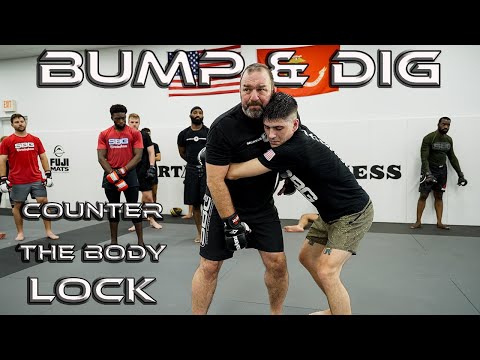
Bump & Dig - Coach Chris goes over defense to the body lock in MMA class. Shuffle step and mule kick (BUMP) to create th…
Translation: standard front body lock
The Standard Front Body Lock Takedown subfamily represents the classical front body lock technique where the attacker secures a locked grip around the opponent's waist from the front and drives them to the mat using a combination of lifting and lateral displacement. [1] The attacker typically establishes the lock after achieving double underhooks, clasping the hands behind the opponent's lower back, then lifts and turns to dump the opponent sideways or backward. [1],[2] This technique relies on the attacker's ability to control the opponent's hip line — once the hips are elevated or displaced past the base of support, the takedown becomes inevitable. [2],[3]
The standard front body lock takedown has been a core Greco-Roman wrestling technique for over a century, with systematic instruction appearing in early 20th-century European wrestling manuals. [1] It remains one of the most commonly taught clinch takedowns in both wrestling and MMA programmes. [2],[3]
The standard front body lock takedown is the fundamental chest-to-chest body lock drive, using forward pressure and hip engagement to off-balance and ground the opponent. [1]
This is the basic body lock takedown taught in Greco-Roman wrestling programmes worldwide. [1]
The standard front body lock is one of the most commonly executed takedowns in Greco-Roman competition. [1]
No images yet for this technique.
Sign in to suggest an image.
Bump & Dig - Coach Chris goes over defense to the body lock in MMA class. Shuffle step and mule kick (BUMP) to create th…
No instructional courses yet for this technique.
Sign in to suggest a course.
Risk of injury to the person this technique is applied to
Front body lock with trip/lift; moderate impact
Skill level needed to execute this technique reliably
Whether this technique is allowed under major competition rule sets
Japanese amateur wrestling terminology
Japanese amateur wrestling terminology
Mixed Japanese-Western terminology — combines traditional Japanese terms with katakana loanwords
Standard katakana transliteration used in Japanese wrestling (レスリング)
upper body squeeze strength, lifting power, hip drive
thick chest and arms for tight lock, strong lower back for lifts
pectorals, biceps, erector spinae, glutes
Every move, in any martial art, shares a few universal traits. Mix and match below to pinpoint the right tool — or compare equivalents across styles.
Cover their head while stuffing the takedown attempt. This defensive positioning prevents them from completing the technique when their head is positioned low.
Use the bump and dig technique: anchor your hips down and turn slightly to your side rather than staying squared up, which makes it harder for them to step and track you in either direction.
Turn away from their head to make the defense more effective, as this positioning is particularly important when defending against the fence.
The Standard Front Body Lock Takedown subfamily represents the classical front body lock technique where the attacker secures a locked grip around the opponent's waist from the front and drives them to the mat using a combination of lifting and lateral displacement. The attacker typically establishes the lock after achieving double underhooks, clasping the hands behind the opponent's lower back, then lifts and turns to dump the opponent sideways or backward.
The standard front body lock takedown has been a core Greco-Roman wrestling technique for over a century, with systematic instruction appearing in early 20th-century European wrestling manuals. It remains one of the most commonly taught clinch takedowns in both wrestling and MMA programmes.
IJF: legal — Legal takedown technique; IBJJF: legal — Legal at all belt levels, scored as takedown (2 points); UWW: legal — Legal in both freestyle and Greco-Roman; Unified MMA: legal — Legal takedown technique; ADCC: legal — Legal, scored 2-4 points in second half of match; FIAS Sport Sambo: legal — Legal — all takedowns permitted; FIAS Combat Sambo: legal — Legal; NCAA Folkstyle: legal — Legal, scored as takedown (2 points)
Danger rating 5/10. High — front body lock with trip/lift; moderate impact
The standard setup chain: Close Distance → Establish the Lock → Hip Pressure → Lift or Trip.
Standard counters include: Sprawl — drop hips back and drive weight down to stuff the takedown attempt / Underhook Pummeling — fight for inside position to neutralize the lock / Hip Switch — rotate hips to break the grip angle and create separation / Knee Tap — redirect opponent's momentum with a quick leg attack.
Common variants: Front body lock (securing the lock face-to-face and driving laterally or b…); Rear body lock (securing from behind for mat returns or lifts); Side body lock (angled body lock for trips and throws); Body lock to trip (combining the lock with a foot trip for the finish).
The standard front body lock is one of the most commonly executed takedowns in Greco-Roman competition.
Top errors to watch for: Gripping at the mid-back instead of the waist — reduces lifting leverage significantly / Attempting a straight-back takedown which lets the opponent sprawl or re-balance / Lifting with the arms instead of popping the hips — exhausting and easy to defend / Losing head position during the turn, allowing the opponent to circle away.
The Standard Front Body Lock Takedown is also known as Shōmen Bodi Rokku, Front Bear Hug Takedown, Front Clinch Lock, Maedaki Body Lock.