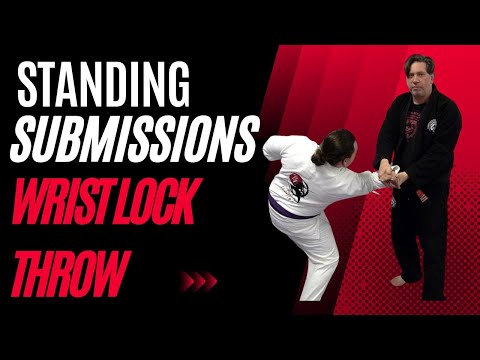
Mastering the Wrist Lock Throw - Standing Submissions
0
From Standing·Team Third Heaven
The Jiujitsu outside wrist lock also known as Omote Gyaku is a high percentage self defense technique from standing posi…
Translation: from standing
The two-on-one wrist lock from standing uses both hands to control and bend the opponent's wrist into flexion while both fighters are on their feet. [1],[2] One hand grips the back of the opponent's hand while the other controls the forearm, and the attacker applies flexion by pushing the hand toward the inner forearm with coordinated two-handed force. [1] The standing position allows the attacker to add body weight and rotational torque to the wrist bend by stepping and turning. [1],[2]
Standing two-on-one wrist locks are foundational techniques in aikido (nikkyo and sankyo variants), hapkido, and classical jujutsu, where they serve as primary standing control and submission methods. [1],[2] The two-on-one principle ensures that the attacker's grip strength always exceeds the defender's single-wrist resistance. [1] This standing application is one of the most widely taught self-defense wrist lock techniques across martial arts worldwide. [1],[2]
Standing submissions (guillotines, standing kimuras, standing arm triangles) are applied from the feet and are high-percentage in MMA where the opponent's guard pull attempt exposes them. [1]
Standing submissions come from judo (tachi-waza ne-waza transitions) and catch wrestling. [1]
Standing submissions, particularly guillotine chokes, are among the most common finishes in UFC competition. [1]
No images yet for this technique.
Sign in to suggest an image.
The Jiujitsu outside wrist lock also known as Omote Gyaku is a high percentage self defense technique from standing posi…
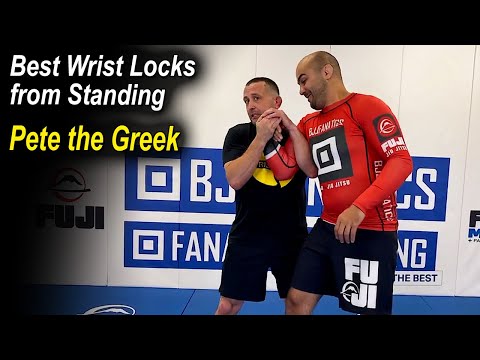
Best Wrist Locks from Standing by Pete the Greek - Click Here To Check Out Pete Letsos' Instructional Videos - https://b…
No instructional courses yet for this technique.
Sign in to suggest a course.
Risk of injury to the person this technique is applied to
Wrist lock variant targeting carpal and radioulnar joints through forced deviation or torsion
Skill level needed to execute this technique reliably
Whether this technique is allowed under major competition rule sets
Japanese wrestling/BJJ standard terminology
Japanese wrestling/BJJ standard terminology
Standard Japanese martial arts terminology (kanji/hiragana)
Established Japanese martial arts naming convention — native Japanese term (和語/漢語)
Japanese terminology sourced from Japanese wrestling/BJJ standard terminology
fine motor control, grip sensitivity, quick hand transitions
dexterous hands with strong fingers
forearm flexors and extensors, intrinsic hand muscles
Wrist locks are very effective but extremely dangerous, which is why many tournaments ban them. Team Third Heaven notes they work exceptionally well in self-defense against an unsuspecting opponent, but the injury risk means they're rarely seen in professional MMA competition.
Once you have the wrist lock established and are on the ground, slide your knee over to your opponent's bicep and continue rotating the wrist to complete the submission.
According to Pete the Greek Letsos, stepping from the inside when your opponent tries to push you exposes you to naked chokes—instead, step to the outside and use a chop motion to defend.
The ground stabilizes and immobilizes your opponent, giving you a base so they can't move, whereas from standing your opponent retains mobility and can more easily escape.
The two-on-one wrist lock from standing uses both hands to control and bend the opponent's wrist into flexion while both fighters are on their feet. One hand grips the back of the opponent's hand while the other controls the forearm, and the attacker applies flexion by pushing the hand toward the inner forearm with coordinated two-handed force.
Standing two-on-one wrist locks are foundational techniques in aikido (nikkyo and sankyo variants), hapkido, and classical jujutsu, where they serve as primary standing control and submission methods. The two-on-one principle ensures that the attacker's grip strength always exceeds the defender's single-wrist resistance.
IBJJF: legal — Legal at all belt levels; IJF: banned — Only elbow joint locks (kansetsu-waza) permitted in judo — all other joint lo…; ADCC: legal — Legal — all submissions legal in ADCC; Unified MMA: legal — Legal submission technique; FIAS Sport Sambo: legal — Legal; FIAS Combat Sambo: legal — Legal
Danger rating 5/10. Wrist lock variant targeting carpal and radioulnar joints through forced deviation or torsion
The standard setup chain: Establish Position → Create the Threat → Secure the Hold → Finish.
Standard counters include: Early Recognition — identify the submission attempt early and begin defence immediately / Posture and Base — maintain strong posture and base to prevent submission setups / Grip Fight — deny the attacker their preferred gripping configuration.
Common variants: Standard wrist lock (kote gaeshi) (two-handed rotational lock on the wrist); Gooseneck wrist lock (flexion lock bending the wrist down toward the forearm); Standing wrist lock (applied during grip fighting or a standing exchange); Ground wrist lock (catching the opponent's posted hand from mount, side cont…).
Standing submissions, particularly guillotine chokes, are among the most common finishes in UFC competition.
Top errors to watch for: Attempting standing wrist locks against a mobile opponent — the opponent must be momentarily committed (gripping, pus… / Not controlling the elbow — a free elbow allows the opponent to retract the arm; control the forearm and elbow while … / Using standing wrist locks as primary attacks — they work best as opportunistic attacks during grip fighting transitions / Holding the wrist lock standing when it isn't finishing — if the standing lock doesn't tap, transition to a takedown ….
The From Standing is also known as Tachi-waza kara, Standing Two-on-One Wrist Lock, Tachi Double Wrist Lock.