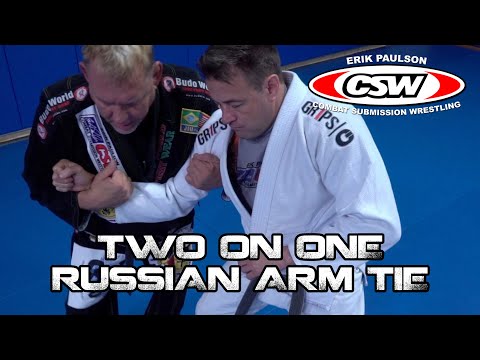
Two On One - Russian Arm Tie
0
Two-On-One·CSW Association·Added by Admin
00:00 Start 00:24 Grip Breaking 00:46 Capture The Arm 01:18 Foot Placement 01:25 Front Headlock - Snap Down To Side Cont…
Translation: two-on-one
The two-on-one wrist lock from seated guard is a flexion submission where the attacker uses both hands to control and bend a single wrist from a seated or guard position. [1] Both of the attacker's hands wrap around the opponent's hand and wrist, with one hand cupping the fingers and the other pressing against the back of the hand, driving the wrist into forced flexion. [1],[2] The two-on-one grip provides raw strength advantage and is the simplest wrist lock configuration — no interlocking or figure-four mechanics are needed, just direct bilateral pressure. [2] This attack is commonly opportunistic, catching an opponent's posting hand during a guard pass attempt or when grips are momentarily exposed. [2],[3] The simplicity makes it accessible but also easier for the opponent to resist with a strong fist. [3]
Two-on-one wrist locks from guard became more visible in BJJ competition as practitioners like Claudio Calasans and Roli Delgado demonstrated wrist lock finishes as legitimate competition weapons from the guard position. [1],[2] The technique draws from the broader tradition of wrist manipulation in jujutsu and aikido, adapted to the guard-based ground fighting paradigm of Brazilian Jiu-Jitsu. [1] The two-on-one grip makes the technique achievable even from the mechanically disadvantaged bottom position. [1],[2]
The two-on-one (Russian tie) grip controls both of the opponent's same-side arm with both hands, creating strong pulling leverage for arm drags and takedowns. [1]
The two-on-one originated in wrestling as the Russian tie and was adopted into BJJ guard play. [1]
Two-on-one grips are used extensively in wrestling and no-gi BJJ competition at all levels. [1]
No images yet for this technique.
Sign in to suggest an image.
00:00 Start 00:24 Grip Breaking 00:46 Capture The Arm 01:18 Foot Placement 01:25 Front Headlock - Snap Down To Side Cont…
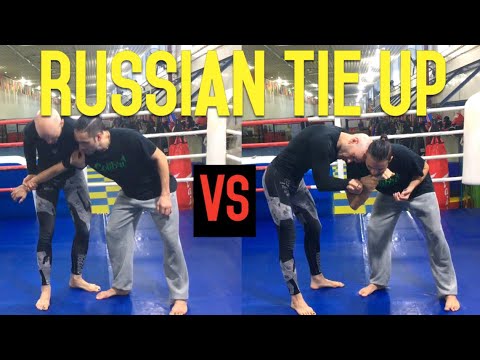
Have you ever been frustrated in your attempts to get that textbook perfect Russian tie up with the straight arm control…
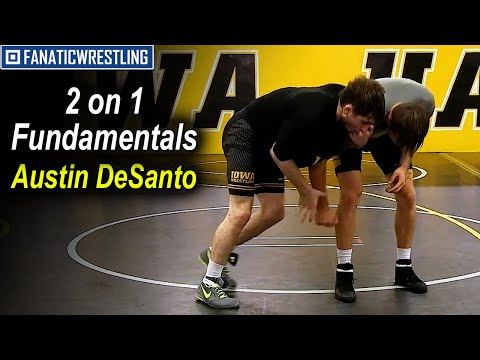
2 on 1 Fundamentals by Austin DeSanto https://fanaticwrestling.com/ Austin DeSanto teaches 2 on 1 control fundamentals …
The two-on-one, also called a Russian arm tie or single-arm control, is a standing grip-fighting technique in which the defender uses both arms to control and immobilize one of the opponent's arms. CSW Association emphasizes grip-breaking mechanics, body positioning, and tight control against the shoulder and armpit to prevent arm withdrawal, while detailing transitions to takedowns (foot sweeps, ankle picks), back control, and leg attacks. FANATIC Wrestling focuses on pressure through the opponent's center rather than outward manipulation, climbing pressure up the arm, and methodical control before transitioning to single-leg takedowns, stressing not to release the grip prematurely. Ramsey Dewey introduces a variation using the torsion knot—a wrist grip with the other hand woven beneath and around the arm—combined with head positioning and shoulder shrugging to counter opponents who pull their arm inward, enabling control even when the arm is bent. All three instructors agree on maintaining tight elbow positioning, staying connected to the opponent's shoulder, and using the two-on-one primarily as a setup for leg attacks (particularly single-leg takedowns) or back control rather than as a submission finish itself. The key differentiator is Dewey's emphasis on the torsion knot variation for handling arm-retraction defenses, whereas CSW and FANATIC prefer the straightarm control with different positional and transitional priorities.
Synthesized from 3 instructors
No instructional courses yet for this technique.
Sign in to suggest a course.
Risk of injury to the person this technique is applied to
Wrist lock variant targeting carpal and radioulnar joints through forced deviation or torsion
Skill level needed to execute this technique reliably
Whether this technique is allowed under major competition rule sets
Kodokan Judo — morote prefix (as in morote-gari); Aikido morote-dori
Japanese terminology sourced from Kodokan Judo — morote prefix (as in morote-gari); Aikido morote-dori
Official Kodokan ground technique classification system
Aikido technique naming conventions
Standard Japanese martial arts terminology (kanji/hiragana)
Established Japanese martial arts naming convention — native Japanese term (和語/漢語)
Japanese terminology sourced from Kodokan Judo — morote prefix (as in morote-gari); Aikido morote-dori
fine motor control, grip sensitivity, quick hand transitions
dexterous hands with strong fingers
forearm flexors and extensors, intrinsic hand muscles
Every move, in any martial art, shares a few universal traits. Mix and match below to pinpoint the right tool — or compare equivalents across styles.
The two-on-one wrist lock from clinch uses both hands to control a single wrist during a standing clinch exchange, with one hand gripping the hand and the other controlling the forearm or wrist to apply flexion force. [1,2] The two-on-one grip provides double the leverage of a single-hand wrist bend, making it effective against the opponent's ability to resist the flexion through muscular tension. [1] The clinch provides the entanglement and proximity needed to isolate the wrist with both hands while preventing disengagement. [1,2]
The two-on-one wrist lock from prone control is applied against a face-down opponent by isolating one wrist with both hands and bending it into flexion using the doubled grip leverage. [1,2] The prone position pins the opponent's body weight against the ground, preventing them from using hip movement or rolling to relieve the wrist pressure. [1] The attacker typically applies the lock when the opponent reaches out with a hand to post or attempts to turn over, creating the opening for the two-on-one wrist isolation. [1,2]
The two-on-one wrist lock from seated guard uses both hands to control and manipulate a single wrist while maintaining guard position. [1] The attacker grips the opponent's hand with both hands and applies leverage against the wrist joint through flexion or deviation, using the guard to prevent the opponent from posturing away. [1,2]
The two-on-one wrist lock from standing uses both hands to control and bend the opponent's wrist into flexion while both fighters are on their feet. [1,2] One hand grips the back of the opponent's hand while the other controls the forearm, and the attacker applies flexion by pushing the hand toward the inner forearm with coordinated two-handed force. [1] The standing position allows the attacker to add body weight and rotational torque to the wrist bend by stepping and turning. [1,2]
Stay low on the opponent's hip and apply head and shoulder pressure to cut off their head, which prevents them from shooting an underhook escape over your head. The CSW Association emphasizes keeping your hand ready as a preventative measure to stop immediate escape attempts.
Foot placement is a major factor in controlling the technique—where your foot is positioned significantly affects how well you can stretch the opponent's arm and maintain the lock.
Keeping your elbows tight prevents the opponent from escaping easily; if your elbows are loose, they can break free even if you have the right hand position and head placement. Ramsey Dewey stresses that tight elbows make the control substantially harder to escape from.
Keep your head to the side rather than squared up directly in front of your opponent, which allows you to control their movement and keep them on their side rather than letting them center themselves on you. Ramsey Dewey explains this positioning is critical for maintaining leverage and preventing escape.
The two-on-one wrist lock from seated guard is a flexion submission where the attacker uses both hands to control and bend a single wrist from a seated or guard position. Both of the attacker's hands wrap around the opponent's hand and wrist, with one hand cupping the fingers and the other pressing against the back of the hand, driving the wrist into forced flexion.
Two-on-one wrist locks from guard became more visible in BJJ competition as practitioners like Claudio Calasans and Roli Delgado demonstrated wrist lock finishes as legitimate competition weapons from the guard position. The technique draws from the broader tradition of wrist manipulation in jujutsu and aikido, adapted to the guard-based ground fighting paradigm of Brazilian Jiu-Jitsu.
IBJJF: legal — Legal at all belt levels; IJF: banned — Only elbow joint locks (kansetsu-waza) permitted in judo — all other joint lo…; ADCC: legal — Legal — all submissions legal in ADCC; Unified MMA: legal — Legal submission technique; FIAS Sport Sambo: legal — Legal; FIAS Combat Sambo: legal — Legal
Danger rating 5/10. Wrist lock variant targeting carpal and radioulnar joints through forced deviation or torsion
The standard setup chain: Establish Position → Create the Threat → Secure the Hold → Finish.
Standard counters include: Early Recognition — identify the submission attempt early and begin defence immediately / Posture and Base — maintain strong posture and base to prevent submission setups / Grip Fight — deny the attacker their preferred gripping configuration.
Common variants: Standard wrist lock (kote gaeshi) (two-handed rotational lock on the wrist); Gooseneck wrist lock (flexion lock bending the wrist down toward the forearm); Standing wrist lock (applied during grip fighting or a standing exchange); Ground wrist lock (catching the opponent's posted hand from mount, side cont…).
Two-on-one grips are used extensively in wrestling and no-gi BJJ competition at all levels.
Top errors to watch for: Using equal force with both hands — typically one hand controls direction while the other provides force; they serve … / Gripping only the hand without the forearm — the forearm hand provides stability; without it, the opponent moves the … / Not using body weight to supplement the grip — drape weight through the two-on-one; hands alone may be insufficient a… / Releasing the grip prematurely — maintain the two-on-one control even if the initial lock direction fails; switch to ….
The Two-On-One is also known as Ni-tai-Ichi, Two-on-One Wrist Lock, Double Wrist Control Lock.