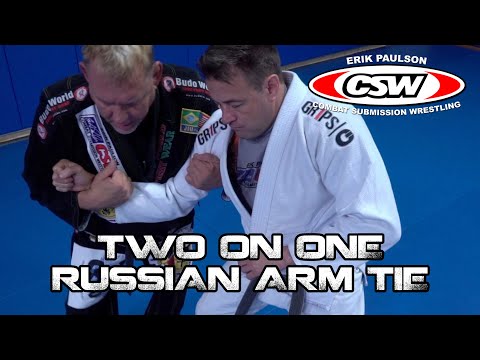
Two On One - Russian Arm Tie
0
From Prone Control·CSW Association·Added by Admin
00:00 Start 00:24 Grip Breaking 00:46 Capture The Arm 01:18 Foot Placement 01:25 Front Headlock - Snap Down To Side Cont…
Translation: from prone control
The two-on-one wrist lock from prone control is applied against a face-down opponent by isolating one wrist with both hands and bending it into flexion using the doubled grip leverage. [1],[2] The prone position pins the opponent's body weight against the ground, preventing them from using hip movement or rolling to relieve the wrist pressure. [1] The attacker typically applies the lock when the opponent reaches out with a hand to post or attempts to turn over, creating the opening for the two-on-one wrist isolation. [1],[2]
Two-on-one wrist manipulation from prone control is a staple of law enforcement restraint training, where controlling a suspect's wrist with both hands is standard protocol for handcuffing procedures. [1],[2] In sport grappling, the technique was adapted as top players sought submissions from flattened positions where conventional attacks like chokes were difficult to apply. [1] The method reflects the practical crossover between tactical control and submission grappling. [1],[2]
Prone control submissions attack a face-down opponent with chokes, cranks, and arm locks, exploiting a position where the bottom player has limited defensive options. [1]
Prone control attacks were developed in catch wrestling (the 'chain wrestling' system) and adopted into modern BJJ. [1]
Prone position chokes and cranks are used in both MMA (ground-and-pound to submission sequences) and advanced BJJ competition. [1]
No images yet for this technique.
Sign in to suggest an image.
00:00 Start 00:24 Grip Breaking 00:46 Capture The Arm 01:18 Foot Placement 01:25 Front Headlock - Snap Down To Side Cont…
No instructional courses yet for this technique.
Sign in to suggest a course.
Risk of injury to the person this technique is applied to
Wrist lock variant targeting carpal and radioulnar joints through forced deviation or torsion
Skill level needed to execute this technique reliably
Whether this technique is allowed under major competition rule sets
Japanese wrestling/BJJ standard terminology
Japanese wrestling/BJJ standard terminology
Standard Japanese martial arts terminology (kanji/hiragana)
Established Japanese martial arts naming convention — native Japanese term (和語/漢語)
Japanese terminology sourced from Japanese wrestling/BJJ standard terminology
fine motor control, grip sensitivity, quick hand transitions
dexterous hands with strong fingers
forearm flexors and extensors, intrinsic hand muscles
Stay low on the hip and use shoulder pressure to cut off the head. If your opponent tries to underhook and shoot over your head, immediately place your hand as a preventative measure and chest cut to keep control of the position.
Controlling the armpit is critical—keeping the arm pinned prevents it from popping free. By maintaining this control, you can transition to folding the arm or moving into a better position.
The placement of your foot is a major factor in the control—adjusting where your foot is positioned changes the effectiveness of the lock and overall control of your opponent's arm.
The two-on-one wrist lock from prone control is applied against a face-down opponent by isolating one wrist with both hands and bending it into flexion using the doubled grip leverage. The prone position pins the opponent's body weight against the ground, preventing them from using hip movement or rolling to relieve the wrist pressure.
Two-on-one wrist manipulation from prone control is a staple of law enforcement restraint training, where controlling a suspect's wrist with both hands is standard protocol for handcuffing procedures. In sport grappling, the technique was adapted as top players sought submissions from flattened positions where conventional attacks like chokes were difficult to apply.
IBJJF: legal — Legal at all belt levels; IJF: banned — Only elbow joint locks (kansetsu-waza) permitted in judo — all other joint lo…; ADCC: legal — Legal — all submissions legal in ADCC; Unified MMA: legal — Legal submission technique; FIAS Sport Sambo: legal — Legal; FIAS Combat Sambo: legal — Legal
Danger rating 5/10. Wrist lock variant targeting carpal and radioulnar joints through forced deviation or torsion
The standard setup chain: Establish Position → Create the Threat → Secure the Hold → Finish.
Standard counters include: Early Recognition — identify the submission attempt early and begin defence immediately / Posture and Base — maintain strong posture and base to prevent submission setups / Grip Fight — deny the attacker their preferred gripping configuration.
Common variants: Standard wrist lock (kote gaeshi) (two-handed rotational lock on the wrist); Gooseneck wrist lock (flexion lock bending the wrist down toward the forearm); Standing wrist lock (applied during grip fighting or a standing exchange); Ground wrist lock (catching the opponent's posted hand from mount, side cont…).
Prone position chokes and cranks are used in both MMA (ground-and-pound to submission sequences) and advanced BJJ competition.
Top errors to watch for: Not maintaining control while attacking — the prone opponent will scramble to escape; maintain chest-to-back contact … / Attempting submissions before establishing control — secure the riding position first, then identify which limbs are … / Not using body weight — from prone control, body weight is your primary tool; lifting off to apply a technique allows… / Ignoring the back-take — from prone control, the back take is often the highest-percentage option; don't skip it for ….
The From Prone Control is also known as Fuse Seigyo kara, Ground Two-on-One Wrist Lock, Prone Double Wrist Lock.