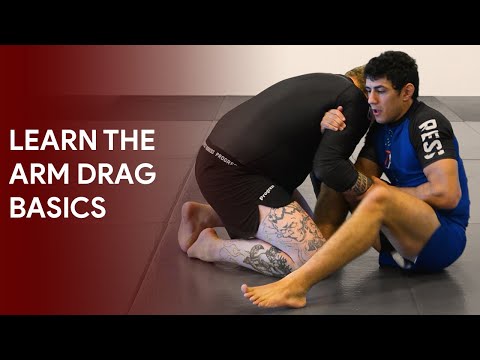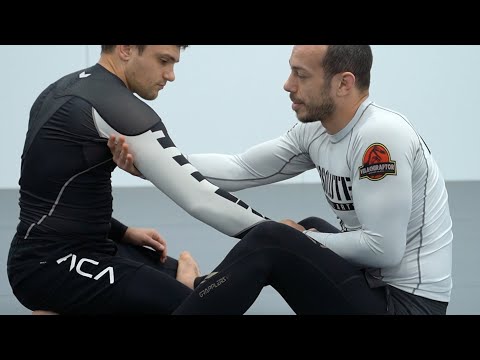
Arm Drag from Seated Guard (Lachlan Giles)
0
Arm Drag From Seated:Guard·Absolute MMA St Kilda - Melbourne
You can check out the full seated guard instructional on SUBMETA, for now we are in Beta mode, register your interest th…
Translation: arm drag from seated/guard
The arm drag from seated guard applies a wrist flexion lock while the bottom player uses an arm drag to off-balance the top player from the guard position. [1],[2] The guard player grips the opponent's wrist with one hand and the triceps or elbow with the other, pulling the arm across the body while bending the wrist into flexion. [1] The seated guard provides the hip angle and leg control needed to prevent the opponent from simply stepping back to relieve the wrist pressure, trapping them in range for the submission. [1],[2]
The arm drag from guard is a fundamental BJJ technique developed for off-balancing opponents and taking the back. [1],[2] Adding wrist lock finishes to the arm drag from guard represents the modern trend in competitive grappling toward chaining joint locks into positional transitions. [1] This combination reflects the influence of small-joint manipulation traditions from aikido and traditional jujutsu on contemporary sport grappling. [1],[2]
The seated arm drag from guard pulls the passer off-balance and exposes their back, making it one of the highest-percentage back-take entries in BJJ. [1]
The seated guard arm drag was popularised by Marcelo Garcia in the 2000s and became a staple of modern no-gi BJJ. [1]
Marcelo Garcia's seated arm drag back-take was his signature technique at ADCC and IBJJF World Championships. [1]
No images yet for this technique.
Sign in to suggest an image.
You can check out the full seated guard instructional on SUBMETA, for now we are in Beta mode, register your interest th…
🔗 Links: Follow me on Instagram for more jiu-jitsu content: https://www.instagram.com/tarik_bjj/ Discover top-qualit…
BJJ Techniques: ARM DRAG TO BACK TAKE BY GORDON RYAN // In this BJJ Techniques video, Gordon Ryan demonstrates the Arm …
The arm drag from seated guard is a fundamental technique for transitioning to the opponent's back, initiated when the opponent reaches toward the legs rather than the upper body. All three instructors—Absolute MMA St Kilda (Lachlan Giles), BJJ Fanatics (Gordon Ryan), and Tarik BJJ—emphasize that successful execution requires simultaneous leg and arm movement rather than isolated pulling. The foundational grip involves controlling the opponent's wrist with the same-side hand while securing the armpit or shoulder with the opposite hand; Giles and Ryan stress gripping high on the armpit to prevent slippage, while Tarik BJJ demonstrates the same-side wrist control with under-arm grip. Leg mechanics are critical: Giles emphasizes kicking the inside of the opponent's knee to turn them away while simultaneously scooting the hips to the side, whereas Tarik BJJ uses a leg kick to create momentum for self-movement. All instructors agree that the pulling action must integrate body weight and positioning, with Giles and Ryan highlighting the importance of keeping the chest tight against the opponent's tricep to prevent arm recovery. Ryan adds that chest orientation must face downward toward the floor rather than upward, and that weight distribution over the opponent's arm is essential. Common errors include falling backward during execution, using butterfly hooks instead of external foot placement, and delaying the transition to back control. The technique sets up further attacks including seat belt control and back takes.
Synthesized from 3 instructors
No instructional courses yet for this technique.
Sign in to suggest a course.
Risk of injury to the person this technique is applied to
Wrist lock variant targeting carpal and radioulnar joints through forced deviation or torsion
Skill level needed to execute this technique reliably
Whether this technique is allowed under major competition rule sets
Japanese wrestling/BJJ standard terminology; widely used in Japanese competition
Japanese wrestling/BJJ standard terminology; widely used in Japanese competition
Mixed Japanese-Western terminology — combines traditional Japanese terms with katakana loanwords
Japanese terminology sourced from Japanese wrestling/BJJ standard terminology; widely used in Japanese competition
fine motor control, grip sensitivity, quick hand transitions
dexterous hands with strong fingers
forearm flexors and extensors, intrinsic hand muscles
Most people think it's all about pulling the opponent past you, but Lachlan Giles emphasizes that especially against bigger opponents, you need to move yourself to the side simultaneously rather than just pulling. Additionally, many practitioners incorrectly grab at the elbow instead of gripping the wrist with one hand and the shoulder with the other.
According to Lachlan Giles, you must immediately put your chest tight over the opponent's tricep and keep the arm trapped with your arm still—if your chest loses contact with the arm, they can pull it back and escape underneath. Gordon Ryan adds that you should tuck your elbow in and hang off your partner's body to create a wedge behind the tricep.
No. Lachlan Giles stresses that you should turn your chest face-away and go onto your side as you scoot around, never falling backwards with your chest facing upward, as this allows the opponent to posture up and escape the arm.
Kick with your leg to turn your opponent away by striking the inside of their knee, while simultaneously bringing your hips to your foot—this coordinated leg and hip movement is essential and commonly done incorrectly by beginners.
The arm drag from seated guard applies a wrist flexion lock while the bottom player uses an arm drag to off-balance the top player from the guard position. The guard player grips the opponent's wrist with one hand and the triceps or elbow with the other, pulling the arm across the body while bending the wrist into flexion.
The arm drag from guard is a fundamental BJJ technique developed for off-balancing opponents and taking the back. Adding wrist lock finishes to the arm drag from guard represents the modern trend in competitive grappling toward chaining joint locks into positional transitions.
IBJJF: legal — Legal at all belt levels; IJF: banned — Only elbow joint locks (kansetsu-waza) permitted in judo — all other joint lo…; ADCC: legal — Legal — all submissions legal in ADCC; Unified MMA: legal — Legal submission technique; FIAS Sport Sambo: legal — Legal; FIAS Combat Sambo: legal — Legal
Danger rating 5/10. Wrist lock variant targeting carpal and radioulnar joints through forced deviation or torsion
The standard setup chain: Control the Arm → Position the Hips → Pinch Knees → Extend for the Finish.
Standard counters include: Clasp Hands — grip own wrist to prevent arm extension / Stack — drive forward to compress the attacker and relieve elbow pressure / Hitchhiker Escape — rotate the thumb toward the mat and roll to extract the arm.
Common variants: Standard wrist lock (kote gaeshi) (two-handed rotational lock on the wrist); Gooseneck wrist lock (flexion lock bending the wrist down toward the forearm); Standing wrist lock (applied during grip fighting or a standing exchange); Ground wrist lock (catching the opponent's posted hand from mount, side cont…).
Marcelo Garcia's seated arm drag back-take was his signature technique at ADCC and IBJJF World Championships.
Top errors to watch for: Pulling without moving your body — your hips must escape laterally as you drag; staying in place keeps you in front / Not using the butterfly hook — the hook on the near leg prevents the opponent from re-squaring their hips after the drag / Dragging and lying flat — stay seated or get up to your knees; lying back after the drag gives up the angle you created / Not controlling the tricep — the wrist grip alone is insufficient; the tricep grip completes the two-on-one and preve….
The Arm Drag From Seated:Guard is also known as Zai kara no Āmu Doraggu, Seated Arm Drag, Guard Arm Drag.